


The two-week ceasefire in Iran appears to be holding — barely.
Attacks from Iran against its Gulf neighbors and Israel have largely stopped; the U.S. is holding its fire as well.
But both sides believe that other parts of the agreement are being violated. Iran and Pakistan, which mediated the ceasefire, say that Israel is violating the deal by continuing to attack Lebanon; the U.S. and Israel say that Lebanon was not part of the agreement. (Complicating matters, the deal was reportedly never written down. Who could have predicted disputes over what it entailed?) Israel and Lebanon are set to hold separate ceasefire negotiations next week, though Israeli attacks continue in the meantime, killing more than 300 people and wounding 1,150 others on Wednesday, according to Lebanese officials.
The U.S., meanwhile, says that Iran is failing to hold up its end of the bargain by continuing to keep the Strait of Hormuz largely closed. Only four vessels crossed through the strait on Wednesday, followed by nine on Thursday, still much fewer than the 100+ that were crossing daily before the war. Iran has reportedly said behind closed doors that it will only allow around 12 ships a day to cross the strait during the ceasefire, and it will be charging tolls. “Iran is doing a very poor job, dishonorable some would say, of allowing Oil to go through the Strait of Hormuz. That is not the agreement we have!” President Trump wrote on Truth Social last night. In another message, he said Iran “better stop” charging tolls.
These disputes will be hanging in the air at the U.S.-Iranian peace negotiations set to take place in Pakistan on Saturday. Vice President JD Vance will lead the U.S. delegation, making these the highest-level talks between the U.S. and Iran since 1979. The talks are liable to fall apart at any moment and give way to further attacks. (Indeed, the last two rounds of U.S.-Iranian negotiations in the last year were followed by American attacks against Iran.)
All of this makes the first question in today’s Q&A newsletter especially pertinent. It’s possible that the Pakistan talks will lead to a peace deal. But if the two-week ceasefire ends without any broader agreement (or collapses prematurely), it is not at all difficult to imagine a scenario where the Iran war resumes and then continues on past the 60-day mark, which is often invoked as a legal deadline of sorts hanging over the conflict.
Today’s newsletter will start by taking a close look at the 1973 War Powers Resolution, and answering the question of whether it requires the war to wind down after 60 days if Congress has not authorized the conflict. But that’s not at all. I’ll also answer questions on:
How the 25th Amendment works, and whether it could ever lead to Trump’s removal
The odds of Samuel Alito retiring before the midterms
The current state of the Maine Senate race
And how often Congress is on recess and who gets to make that decision.
It’s a packed edition. Let’s dive in…
The 60-day clock
Q: What happens on Day 60 of Operation Epic Fury if the U.S. attacks on Iran continue despite a lack of congressional authorization?
The War Powers Resolution, which became law in 1973 over President Richard Nixon’s veto, says that whenever the U.S. military is “introduced into hostilities” without congressional authorization, the president must report it to Congress within 48 hours. President Trump did that for the Iran war on March 2; his letter is below.
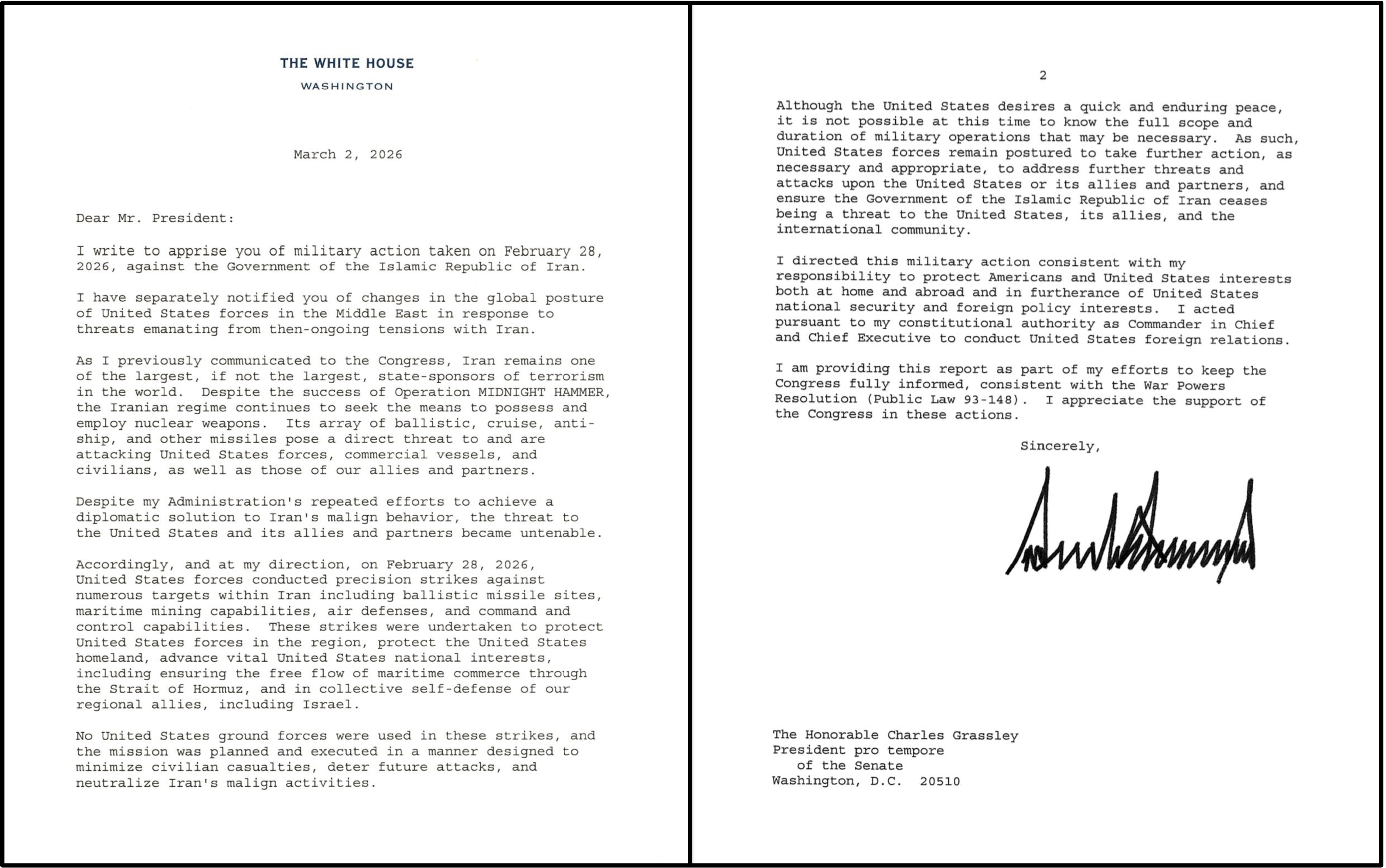
After that, the resolution says, the president has 60 days to terminate the hostilities, unless Congress has granted authorization or “is physically unable to meet as a result of an armed attack upon the United States.” For the Iran war, the 60-day mark after Trump’s initial letter will be May 1.1
But the resolution also gives the president a 30-day extension window, so the real deadline we’re looking at is May 31. What happens then?