


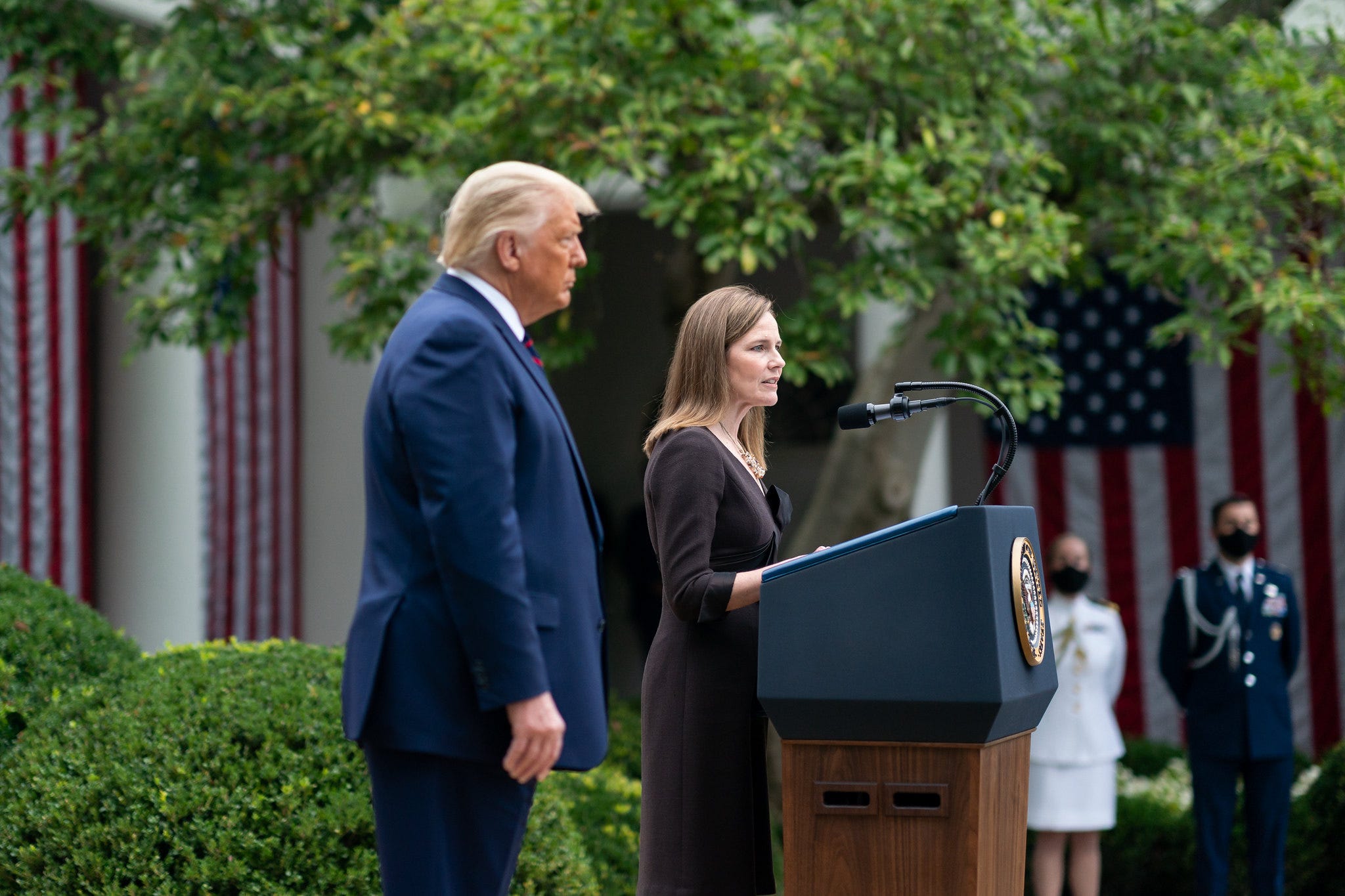
Donald Trump views his personnel choices as one of the biggest mistakes of his first term; this go-around, he has been much more adept at making picks suited to his extreme governing ambitions.
First-term roadblocks like Defense Secretary Jim Mattis, White House Chief of Staff John Kelly, Attorneys General Jeff Sessions and Bill Barr, and Director of National Intelligence Dan Coats, have become second-term rubber stamps like Pete Hegseth, Susie Wiles, Pam Bondi and Todd Blanche, and Tulsi Gabbard and Bill Pulte. As a result, a president who was prevented from governing as much more than a traditional conservative in his first term has come much closer to his vision of an imperial presidency this time.
However, there is a select group of first-term picks who Trump can’t replace: the ones who wear black robes. Even in this term, Trump’s most extreme policy forays have repeatedly been thwarted at the Supreme Court, not just by the three liberal justices and Chief Justice John Roberts, but also by a fifth (and often sixth) vote supplied by a rotating mix of Trump’s own appointees, Justices Neil Gorsuch, Amy Coney Barrett, and Brett Kavanaugh.
Consider, for a moment, how different Trump’s second term would be if he had managed to appoint Supreme Court justices in his first term more in the mold of Justices Clarence Thomas and Samuel Alito, both of whom have sided with him in a suite of major cases. In this alternate reality, Trump would currently be:
Imposing sweeping and unlimited tariffs on every country in the world.
Deploying National Guard troops to major cities across the country.
Using the Alien Enemies Act to quickly deport migrants without due process.
Reshaping the Federal Reserve to secure his desired interest rate cuts.
Singlehandedly redefining the meaning of American citizenship.
His presidency would look much more like the one he imagined: unleashed, unrestrained, and asserting unilateral control over much of American life. Instead, Roberts and the liberal trio joined with Gorsuch and Barrett to block Trump’s tariff dreams in Learning Resources v. Trump; with Kavanaugh and Barrett to prevent National Guard deployments in Trump v. Illinois; (seemingly) with Gorsuch, Kavanaugh, and Barrett to mandate more than 24-hour notice for migrants being deported under the Alien Enemies Act in A.A.R.P. v. Trump; with Kavanaugh to block his firing of a Federal Reserve governor in Trump v. Cook; and with Kavanaugh and Barrett to overturn his executive order attempting to end birthright citizenship for the children of illegal immigrants in Trump v. Barbara.
The birthright citizenship ruling was handed down just yesterday — I was inside the courtroom, more on that below — on the last day of the court’s term, which makes this a perfect time to revisit my dataset on Trump’s win-loss record at the court.
Below, I’ve charted each of the 44 actions the court has taken in Trump-related cases since his re-election. Note that the court has sometimes taken more than one action in the same case, which is why some cases are listed multiple times. Also note that I’ve included two cases involving Trump in his personal capacity, his (pre-inaugural) January 2025 attempt to forestall his sentencing in a New York criminal case and his appeal of a verdict requiring him to pay $5 million to the writer E. Jean Carroll, which the court refused to hear this week.
For each justice, cases where they sided with or against Trump are noted in green or red; a case where Trump won, and a justice did not indicate that they dissented, is noted in light green, while a case where Trump lost, and a justice did not say that they dissented, is noted in light red. I’ve also coded some cases as “mixed,” meaning there were key parts of the court ruling that were both a win and loss for Trump.
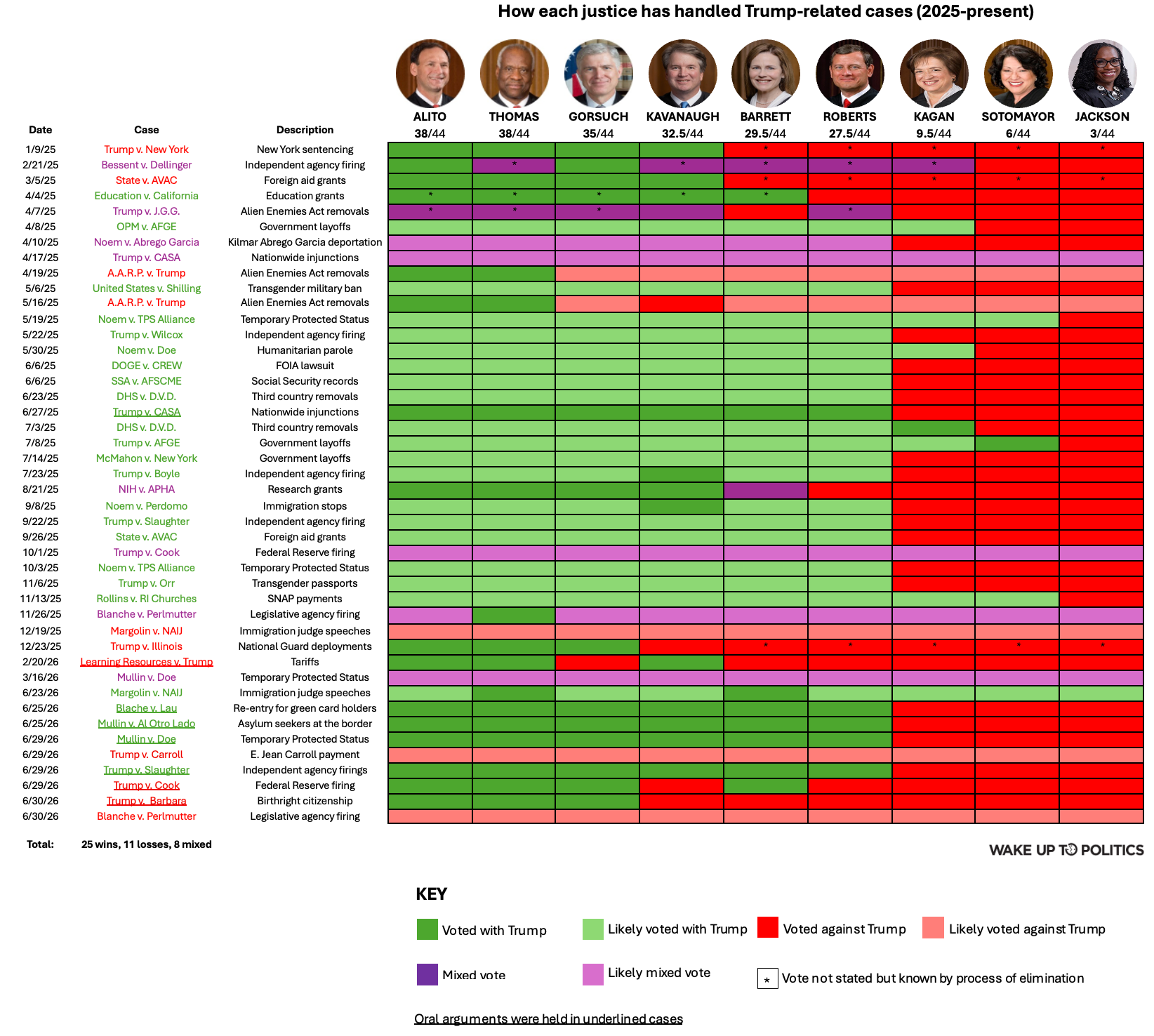
If we look at how often each justice has sided with Trump, a court that is generally referred to as 6-3 — and sometimes as 3-3 — really starts to look like a 2-1-3-1-2 court.
Justices Samuel Alito and Clarence Thomas basically always side with Trump on the right, while Justices Sonia Sotomayor and Ketanji Brown Jackson basically never side with Trump on the left. Moving one layer in, Justice Neil Gorsuch occasionally breaks with Trump, while Justice Elena Kagan occasionally sides with him. The crucial bloc of swing votes comes from Chief Justice John Roberts, and Trump-appointed Justices Brett Kavanaugh and Amy Coney Barrett.
This obviously plants the median of the court well to the right, and when Trump has tried to execute standard-issue conservative policies, the middle bloc (and, thus, the court as a whole) has swung his way. The justices, for example, have blessed many of Trump’s border security efforts, his attempts to terminate Temporary Protected Status for various groups of migrants, and his policies toward transgender people.
Most notably, earlier this week, in Trump v. Slaughter, the court overturned a 1935 precedent known as Humphrey’s Executor and empowered the president to fire the heads of independent agencies like the Federal Trade Commission and the Federal Communications Commission, an ability Trump has sought — and which aligns perfectly with a long-running conservative project to place the headless federal bureaucracy more clearly under the authority of the elected president.
In my dataset, Trump has won much more often than he’s lost (25 wins, 11 losses), but seven of the wins can really be consolidated together as one, since they are all related to the president’s ability to fire members of the executive branch, a foundational belief for many of the court’s conservatives, who were coming up in the legal world as the unitary executive theory began to percolate.
While Trump’s losses are fewer, they contain many of Trump’s biggest swings — and nearly all of the times he has tried to go beyond the conservative legal project and apply his own, more extreme governing vision.
A perfect example is Slaughter’s twin case, Trump v. Cook, which was also handed down on Monday. In Slaughter, Trump was trying to fire a member of the Federal Trade Commission. Legal conservatives have been trying to gut independent agencies for years, and the court happily handed him a win. But in Cook, Trump was trying to fire a Federal Reserve governor. It is true that some right-wing libertarians have long despised the Fed, but generally most business-minded conservatives appreciate the stabilizing impact of the central bank. The court told Trump that he was fine to fire the FTC’s Slaughter, as head of the executive branch, but (at least for now) that he could not fire the Fed’s Cook.
Why one but not the other? I’ve read both opinions, and it’s certainly not obvious. Chief Justice John Roberts’ majority opinion in Cook didn’t even mention Slaughter or attempt to reconcile the Fed ruling with the FTC ruling, which he also wrote. Justice Brett Kavanaugh did, in a concurrence, writing that the Federal Reserve “occupies a unique role in the U.S. Government and maintains critical responsibility for the stability and success of the U.S. and world economies” and “follows in a distinct historical tradition of central bank independence,” though this felt like more of an assessment of the longtime status quo (and the risks in upsetting it) than constitutional analysis.1
Then again, what could be more conservative than refusing to upset the status quo? Trump, who loves to rock the boat, might buck against that trait, but his conservative Supreme Court appointees often cling to it.
The same dynamic can be seen in the court’s immigration jurisprudence. Trump’s attempts to terminate temporary status for some migrants, use race as a factor in immigration stops, and turn away asylum seekers at the border have been sanctioned by the justices.
But his most extreme moves, where he has deviated from conservative orthodoxy to try to do things no president (Democrat or Republican) had done before, like invoke the Alien Enemies Act in peacetime as a way to deport migrants to a foreign mega-prison without any semblance of due process, have been met with a firm “no.”
Then, yesterday, came the court’s ruling in the birthright citizenship case that was perhaps closest to Trump’s heart, the only one for which he attended the oral arguments. This was one of Trump’s most daunting (attempted) uses of presidential power yet, an attempt effectively to rewrite the Supreme Court’s long-standing interpretation of a constitutional amendment simply by executive order.
I sat in the courtroom on Tuesday as the justices released their opinion on birthright citizenship, as well as their opinion in an unrelated case on states banning transgender athletes from playing in women’s and girls’ sports, another case where the conservative outcome won out. In both cases, as I listened to Chief Justice John Roberts and Justice Brett Kavanaugh, respectively, read summaries of their majority opinions aloud, I was struck by how much the sensibilities of the conservative justices diverged from Trump’s (even in the latter case, where his preferred side won).
Roberts waxed poetic about the importance of birthright citizenship in his bench statement: “Those who fought the Civil War to treat all Americans as equal…knew that equal citizenship was the key to lasting peace,” he said, a line that does not appear in his written opinion.
Similarly, Kavanaugh’s statement from the bench (and his written opinion) included a distinctly un-Trumpian flourish about transgender athletes. While ruling that Title IX and the 14th Amendment allow schools to separate athletics according to biological sex, Kavanaugh closed by adding a note of respect to transgender young people.
“Most of the biological female and transgender student-athletes who are involved in transgender sports disputes around the country are teenagers or in their early twenties,” Kavanaugh wrote in his opinion. “Those student-athletes want to play sports. Their desire to compete warrants respect. No student-athlete on either side of the issue, whether a biological female or transgender, deserves to be ostracized or vilified.”
Reading the court’s opinions, one gets the sense that if Trump ever tried to mimic the style of his court appointees, rather than expect them to replicate his, he might find more success before the court. In Cook, the court did not foreclose the possibility that Trump might ever be able to fire a Fed governor; rather, they ruled that he had not followed sufficient process in doing so. In Barbara, Trump’s case might have been strengthened if he had limited his executive order to ending birthright citizenship for the children of so-called “birth tourists,” parents who are in the U.S. on temporary visas.
Even the justices who did not believe Trump’s order should be automatically struck down seemed concerned about restricting the children of illegal immigrants who have been in the U.S. for an extended time.
“Is a child born here to parents who have long chosen to make this Nation their permanent home not a citizen under the Fourteenth Amendment solely because his parents’ presence violates statutory law?” Justice Neil Gorsuch asked in his dissent. “If those parents are not domiciled here, then where are they domiciled? And if the answer is nowhere, how can we reconcile that conclusion with this Court’s longstanding recognition that every person is domiciled somewhere?”2
Mostly due to a quirk of who he was listening to — typical conservatives like Leonard Leo, who Trump now calls a “sleazebag” — Trump ended up nominating three Supreme Court justices who would have been more at home in the Bush-era GOP, while the two Presidents Bush nominated the two most Trump-like justices on the bench.
If only he had managed to find justices in the mold of Thomas and Alito (and to secure their confirmations), Trump would likely be governing as a largely unrestrained president today: deporting whoever he wanted, tariffing whoever he wanted, restricting citizenship, presiding over a roving domestic army of National Guard troops, and reshaping the Fed. Instead, at each of these crucial turns, Trump has been thwarted by one or more of his own chosen SCOTUS justices.
When Trump has hewed to conservative legal principles, the Supreme Court has not stood in his way. But the minute he has stepped outside of movement orthodoxy, his nominees have slapped him down, yielding a president who has succeeded in unlocking the ability to govern according to the wildest dreams of Ronald Reagan, but nothing more.
Will Trump get the opportunity for a do-over, the chance to name a Supreme Court nominee who could rule in a truly MAGA mold, not just with principles frozen in amber from the 1980s?
For about five minutes yesterday, it seemed like he might. Shortly after I left the court on Tuesday, I glanced at my phone to see a notification that NPR’s veteran legal correspondent Nina Totenberg — the dean of the Supreme Court press corps — had reported that Justice Samuel Alito was planning to retire.
I raced back into the court’s press room, where everyone was furiously trying to confirm Totenberg’s apparent scoop. Quickly, however, NPR retracted the report. The Supreme Court’s spokeswoman, who rarely speaks on the record, appeared in-person in the buzzing press room to give an impromptu statement. “NPR’s reporting regarding Justice Alito is inaccurate,” she told us. No retirement announcement, at least for today.3
Of course, for Trump to truly change the balance of the court, he would have to replace one of the seven justices who have ruled against him in a major case — not Thomas or Alito, the only two who could potentially retire. But another SCOTUS pick would give Trump the chance to put at least one MAGA-fied justice on the court for several decades.
On the lower court level, it seems that Trump is already learning from his first-term mistakes: he has now nominated three of his own personal lawyers to the appellate bench. If he gets another Supreme Court pick, expect Trump to cast his gaze more in that direction. His first-term appointees haven’t exactly lived up to his expectations.
It’s unclear, as Justice Amy Coney Barrett noted in her dissent, whether there are other government bodies that are also an exception to the court’s holding in Slaughter. One pending question is over legislative agencies: Trump has attempted to fire Shira Perlmutter, who serves as Register of Copyrights, a position within the Library of Congress.
A lower court has ruled against Trump; when he asked the Supreme Court to pause that ruling, the justices decided to leave it in place, explaining that they would defer ruling until they had decided Slaughter and Cook. Then, yesterday, without any explanation, the court officially shot down Trump’s request. The justices did write that their denial was “not a ruling on the merits of the legal issues presented in the litigation,” but the effect will be to allow Perlmutter to continue serving while the case continues to work its way through the courts.
Notably, in other appointments cases, the court’s brief orders on the status quo have presaged its eventual, more detailed rulings: the court allowed Trump to fire Slaughter temporarily, and then upheld her firing; the court prevented Trump from firing Cook temporarily, and then extended that ruling in this week’s decision.
Even Justice Clarence Thomas acknowledged the possibility that children of illegal immigrants could be considered citizens if it were established that their parents had established a permanent home in the U.S., though he said he “would reserve for another day the question whether the children of illegal aliens can be domiciled here.”
Totenberg was sitting right in front of me during the court’s session on Tuesday. She gave no indication that she was about to report an earth-shattering story about Alito, but then again, you would expect a veteran reporter to have a good poker face.
Then, NPR explained that Totenberg’s report was due to a “misunderstanding,” which made it seem like she did not start the day planning to hit “publish.” Suddenly, I was left wondering, had Totenberg really heard something in the 10 minutes between when I had seen her and when her report published that made her incorrectly think Alito had retired?
It turns out, she had. After the opinion announcements on Tuesday, Chief Justice John Roberts acknowledged several court personnel who were retiring at the end of the term. I’ll admit: I also leaned forward in my seat when Roberts first said he had “retirement announcements,” but within a few seconds, it was clear these were about court employees, not justices. (Alito, for what it’s worth, wasn’t even on the bench yesterday, nor was Neil Gorsuch.)
By this point, Totenberg had already left the courtroom; apparently, the misunderstanding came about because, after a few minutes, she asked someone why no one else had left yet, to which they replied, “retirement announcements.” Based on that alone, she says, she called her editor and told him to publish her pre-written story (prepared just in case) about Alito retiring. Because she is such an institution at NPR, he did so without checking whether Alito had, in fact, retired.
So, basically: Totenberg heard someone refer to “retirement announcements,” immediately assumed that meant a Supreme Court justice was retiring, and told her news organization (which believed her) to publish that important story based on those two words alone.
Spot-on analysis. That’s why Gabe’s Substack is a must-read.
Another great read! So glad I've been subscribing to you since forever!! Now time to celebrate 250 years of the USA!