


Here’s one narrative that we can officially dispense with as Election Day approaches: that President Trump, now that he’ll never again be on the ballot, is not lifting a finger to help Republican candidates in the upcoming midterms.
As recently as September, there were articles galore about Trump barely traveling to campaign for the GOP and potentially hoarding his super PAC war chest without spreading the wealth down ballot. (I wrote some of these articles, I will admit.)
Trump, however, has fully immersed himself in politicking in the campaign’s final stretch: his MAGA Inc. committee has dumped $277 million into a last-minute blitz of key races, while between this upcoming week and the last one, Trump will have held 13 rallies in 14 days, hitting Kansas, North Carolina, South Carolina, Iowa, Florida, Georgia, Michigan, Mississippi, Texas, Ohio, Florida again, and Iowa again.1 Despite some in the party doubting that he would, Trump is clearly putting time, energy, and money into the goal of keeping Republican majorities in the House and Senate.
Still, of course, that’s different than it helping.
So far, the torrent of GOP spending doesn’t seem to be moving polls in the party’s favor. And Trump is hardly offering a coherent message in his stump speeches, from praising Ohio Sen. John Husted’s “ass” to calling Michigan Democratic Senate candidate Abdul El-Sayed, without evidence, a “jihadist Muslim Brotherhood member.” (As I write in the Washington Post this morning, if Trump truly wanted to help Republican candidates, he wouldn’t have taken steps almost guaranteed to topple the coalition that placed him in the White House in 2024 — starting a new war, imposing tariffs, carrying out such a flashy deportation campaign — but that ship has long since sailed.) Trump urging voters to pretend he’s on the ballot may not be the message Republicans want him to spread.
The other way Trump is trying to boost Republicans is through legal means. We’ve already talked about one hypothetical route such intervention could take, looking at the overhyped “nightmare scenario” some pundits have floated of Republicans trying to block a Democratic House majority from being sworn in on January 3. If you haven’t watched my video on that, find it below:
But something that’s much less hypothetical is the Trump administration filing lawsuits to try to intervene in election administration … since that’s already underway. This morning, I want to dig into two such lawsuits the Justice Department has filed in recent days — one in California, the other in Alaska — to bring you up to speed on the issues in question and how likely the suits are to prevail.
California
The Trump administration has been on a long-running quest to ferret out noncitizens voting in American elections, which has so far borne little fruit.
The government has also been frequently thwarted in its attempts to gain insight into state voter rolls. The Justice Department has filed lawsuits seeking voter information from 30 states to probe for citizenship status; so far, district court judges have issued rulings in 27 of these cases. Trump has lost all 27, suffering rejections at the hands of both Democratic- and Republican-appointed judges.
The DOJ has particularly trained its sights on California, filing an additional lawsuit seeking to temporarily block the state from counting the votes of about 20,000 people who the Trump administration says are “likely noncitizens.” (For the purposes of this discussion, remember: California may not be particularly competitive on the statewide or national level, but this year it is home to several key House races that will help decide control of the lower chamber.)
It is not 100% clear how the Trump administration came up with this list of 20,000 voters. The DOJ has said that it obtained “information about [California’s] voter rolls,” without saying how it did so (though the state’s list of registered voters is available for purchase). It then used “third-party software to identify high, medium, or low confidence matches between voter information and information about that individual compiled by the software program,” before seeking to connect the high-confidence matches with noncitizens in the Department of Homeland Security’s internal database and attempting to perform additional layers of verification.
At a court hearing yesterday, the administration’s lawyers declined to identify the third-party software that was used as part of this process; the DOJ has also been vague about its methodology and the information that was used to make the matches.
In accordance with California’s liberal election laws, on October 1, the state sent a mail-in ballot to every registered voter. On October 13, the Justice Department sent its list of 20,000 voters to the top election officials in California and Los Angeles County, requesting that they fully investigate everyone on the list and separate out any ballots returned by those whose citizenship status they could not verify. (The administration stressed that it wasn’t asking for the ballots to be canceled, only that they not be tabulated until the state was sure they were citizens.) The administration gave the election officials 48 hours to carry this out; if it wasn’t done by then, the DOJ said it would take legal action to try and block the ballots from being counted.
California’s secretary of state said that she wasn’t actually sent the list, while her Los Angeles counterpart said she was not legally or practically able to fulfill the DOJ’s request, while also raising questions about the security of the list. (She said that the administration had stuck a sticky note on its letter with a handwritten password for an attached thumb drive that had the list on it.) LA County has since conducted a preliminary analysis of 200 names on the list, finding that 71% of the individuals had never voted, 40% had canceled or inactive registrations and did not have ballots sent to them, and 39% of those with reported birthplace information were born in the United States (indicating a high likelihood of U.S. citizenship2).
The Justice Department, as promised, sued.
The only problem? It’s not clear they can. The statute cited in its suit allows the DOJ to prosecute noncitizens who vote; it says nothing about telling states how to deal with (potential) noncitizens on their voting rolls or potentially bringing civil actions as a result.
The Trump administration has tried to leapfrog the district court level in this case, going straight to an appeals court, which held oral arguments yesterday. The panel of judges seemed very skeptical of this effort to speed through the legal process, as well as of the merits of the suit in general.
The Elections Clause of the Constitution gives state legislatures the power to organize elections, and Congress the ability to override them if it sees fit. No mention is made of the president, who only has a role if he is delegated one by Congress.
Here is what Judge Mark Bennett, a Trump appointee3, had to say to the Trump administration’s lawyers during yesterday’s oral arguments:
California prohibits noncitizens from voting just like the United States does. California requires a certification on mail-in applications that someone is a citizen. They’re not — by federal law, Title 52 — allowed to do much more than that, and they have a procedure for dealing with challenges to votes that have been laid out by the legislature.
The executive, the United States executive, is unhappy with what they’re doing and doesn’t like the manner in which they have determined how they’re going to conduct the election. But it seems to me that under the Elections Clause, they have the right to determine the manner of the elections, including sorting out noncitizens. And Congress has not directly changed what the legislature has adopted, which they had the right to do. And it seems to me you want us to issue an injunction that is entirely inconsistent with the law the California legislature has adopted pursuant to the Elections Clause.
The Constitution gives power over elections to the state legislatures and to Congress. The state legislature laid out a procedure for discouraging voting by noncitizens. Congress hasn’t overridden it. Why would the president be able to step in and force it to be changed?
In addition to that central question, there is also the matter of timing. The Trump administration could have done this months ago, but they waited to send out their letter until after mail-in ballots had already been sent out by the state of California. Under a doctrine known as the Purcell principle, federal courts are generally very reticent to alter state voting rules shortly before an election takes place. They may similarly be uninterested here in delving, so close to Election Day, into the messy waters of segregating out ballots that have already been cast for further investigation.
Trump frequently alleges that the U.S. suffers from an epidemic of noncitizens voting, but the evidence has never lived up to this claim — not even the evidence supplied by his own administration. In Nevada, for example, the Trump administration once claimed that almost 16,000 registered voters might be noncitizens. But by the time the administration sent over those names to state officials, the list had shrunk dramatically, to 185 individuals. And even from that list, Nevada found that every single person named was, in fact, a U.S. citizen.
Similarly, in California, the administration claimed in July that “as many as 190,832 noncitizens [were] registered to vote in California.” Clearly, by October, this number had slipped to 20,000 — and even that amount remains unverified. The administration’s proclivity for moving targets and claims divorced from evidence are unlikely to improve its legal prospects.
Alaska
Here is what Alaska’s ballot for U.S. Senate will look like this cycle:
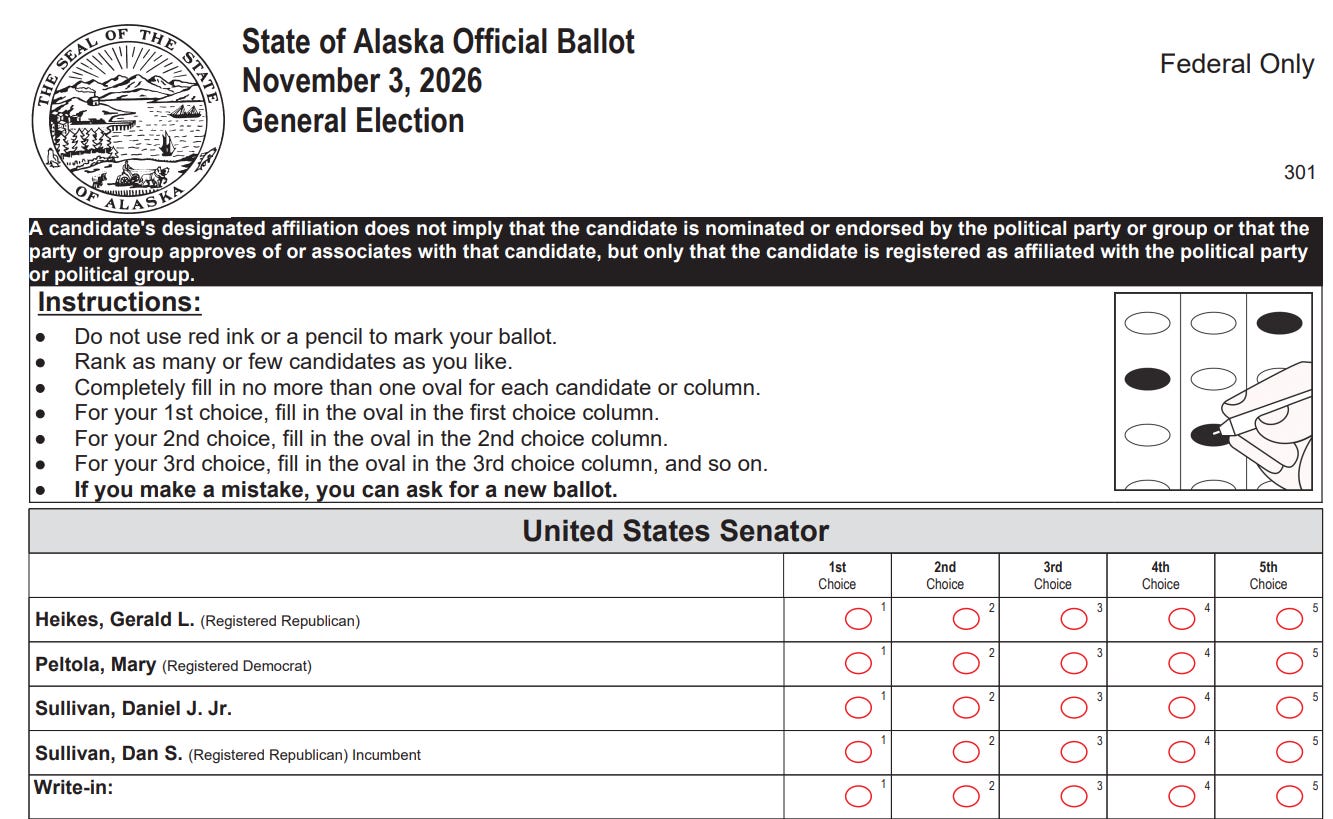
Notice anything odd? That’s right: there are two Dan(iel) Sullivans. (Or is that Dans Sullivan?)
There’s Dan S. Sullivan, the incumbent Republican senator since 2015. And there’s Daniel J. Sullivan, Jr., a retired schoolteacher who also filed to run as a Republican. (Alaska uses a ranked-choice voting system, where every candidate competes together in a first round and then the top four contenders, regardless of party, advance to the November ballot, where voters can then rank their choices. Both Sullivans advanced to the second stage.)
Let’s start out by acknowledging the truth: what the second Sullivan is doing is extremely shady!
He has acknowledged that he voted for the Democratic nominees in the last three presidential elections. He also voted for Mary Peltola, the Democratic Senate nominee this year, both times that she ran for the House. He is a Trump critic who has attended a “No Kings” protest.
And yet, Sullivan initially asked to be listed as a Republican on the Senate ballot. (He says he is a moderate member of the party, though he had never previously been a registered Republican.) He also asked to be listed on the ballot as “Dan Sullivan” (the name the senator goes by), despite being registered to vote as “Daniel.” Not just that, actually: he initially asked to be listed on the ballot as “Dan S. Sullivan” … even though his middle initial is “J,” not “S.” (I’ll give you one guess as to whose middle initial is “S,” though.)
The teacher Sullivan has largely not campaigned at all for the U.S. Senate seat he is purporting to seek (outside of extensive litigation in order to get on the ballot). As far as I can tell, he no longer has a working campaign website. A consultant who has worked for several Alaska Democrats and supported Peltola in the past has assisted with his “campaign.” Also, look at his campaign logo (left) and the incumbent senator’s logo (right). They look a bit alike, you must admit.
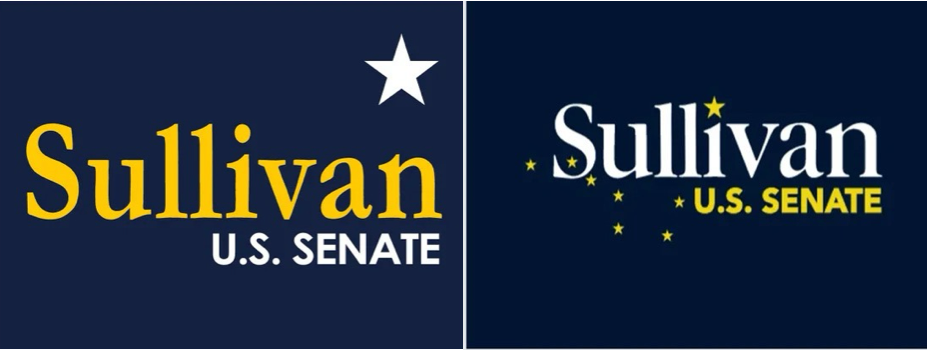
There is no evidence that the larger Democratic Party is tied to this, but even if it is just the “candidate” himself and a lone consultant who are involved, the facts above do suggest a transparently bad-faith effort to siphon votes away from Sen. Sullivan towards the teacher Sullivan. If a majority of Alaska voters want to send Mary Peltola to the Senate, that’s their right. But if she only gets there because a majority of Alaskans wanted to elect Dan Sullivan but inadvertently split their votes between two people with that same name, then it wouldn’t exactly be an example of the will of the electorate being followed. Speaking from a democratic, not legal, standpoint, voters should have the opportunity to work their will without their choices being muddied, and political operatives and activists should trust them (and give them the space) to be able to do that.
The top election official in Alaska agreed, determining that the teacher Sullivan’s declaration of candidacy “was not filed in good faith for the purpose of genuinely pursuing election as Alaska’s U.S. Senator.” She booted him from the ballot.
However, not everything that’s shady is inherently illegal. In this case, the U.S. Constitution lays out three qualifications to be a U.S. senator: being 30 years or older, a U.S. citizen for at nine years or longer, and an inhabitant of the state where you were elected. Perhaps there should be a fourth qualification, requiring that a candidate has run “in good faith,” but there is not.
For that reason, the Alaska Supreme Court preliminarily ruled that the teacher Sullivan could remain on the ballot, finding that the Alaska official had effectively added a fourth qualification to be a senator that did not exist. Sullivan meets all the qualifications set out by the Constitution, and filed by the deadline set out by Alaska, which means he had to be placed on the ballot, the state Supreme Court said, whether he was running in good faith or not. (Alaska law does say, however, that a candidate’s name cannot be listed on the ballot “in a manner that is confusing or misleading to voters or compromises the fairness or neutrality of the ballot,” which is how the teacher Sullivan’s Republican identity came to be stripped and Sen. Sullivan came to be identified, unlike other sitting officeholders running in Alaska, as the incumbent.)
The Trump administration was not happy with this result. So it filed a lawsuit on Thursday in federal court. Like in the California lawsuit seeking to stop specific ballots from being counted, the administration made a fairly extraordinary ask: preemptively trying to block the Alaska Senate race from being certified, but only in the event that its preferred candidate does not come out on top.
If Sen. Sullivan loses, and teacher Sullivan receives enough votes such that Sen. Sullivan would won have won if teacher Sullivan’s votes were considered votes for the incumbent, the Justice Department said, Alaska should not be able to certify its election results.
Instead, per the DOJ, the state should have to carry out an “investigation to determine whether votes cast for Daniel J. Sullivan were meant to be cast for Senator Sullivan” before certification. The Justice Department offers no details on how such an investigation should (or possibly could) be carried out. After all, ballots are anonymous and they don’t include an extra comments section: there is no way an election official could separate out a vote for Daniel J. Sullivan that was intended for Daniel J. Sullivan from a vote for Daniel J. Sullivan that was intended for Dan S. Sullivan. They will look the same.
(Here, it is relevant to note once again that Sen. Sullivan is listed as the incumbent on the ballot, which should hopefully mitigate confusion, and that Alaska uses a ranked-choice voting system, which means someone could theoretically rank the teacher Sullivan first, but as long as they also rank Sen. Sullivan second, their vote will already be transferred to Sen. Sullivan as part of the ranked-choice voting tabulation in the likely event that Sen. Sullivan has more support than teacher Sullivan. However, it should also be noted that a persistent problem with ranked-choice voting is voters only ranking one candidate and then turning in their ballot, so there still could be voters who intend to vote for Sen. Sullivan, but rank the teacher Sullivan first and then don’t rank anyone else, in which case their vote won’t be transferred to Sen. Sullivan in later rounds of tabulation. There still isn’t any way to distinguish such a voter from someone who genuinely wants the teacher Sullivan to be senator, but it is worth noting that such a scenario is certainly possible based on what we know about how voters interact with RCV.)
The administration’s Alaska lawsuit suffers from many of the same defects as the California lawsuit, including similar questions about timing. Just as with the California suit, the administration could have sued over this months ago, when the teacher Sullivan was first added to the ballot. Now, courts are going to be very hesitant about getting involved this close to the election due to the Purcell principle.
Also like the California suit, it isn’t even clear the Trump administration can sue under the law they’re trying to sue under. As Notre Dame law professor Derek Muller notes, the main legal authority the Justice Department cites is language in the preamble of the National Voter Registration Act (NVRA) vaguely saying that states are required to “protect the integrity of the electoral process.”
But the administration does not cite any specific substantive provision of the NRVA, likely because there is no part of the law that places any duties on states regarding ballot access or a pathway for the DOJ to sue in that area.
Muller called the legal argument “one of the worst ones I’ve ever seen.” Experts on both sides of the aisle expect the lawsuit to be shot down in short order; even Sen. Lisa Murkowski (R-AK) said that the DOJ “should never have filed this lawsuit.”4
The common thread between the Alaska and California suits is thus that they seem to have been shoddily put together at the last minute, were likely filed too late to make an impact, and reside in areas in which the federal government lacks much leeway to make states do things.
The federal government simply does not have much power over the administration of elections. At various points, both Democrats and Republicans have tried to change that — but they’ve both failed to pass their signature elections bills through Congress, which means most elections powers remain with the states (and, in the Trump era, perhaps some Democrats are not as unhappy with that decentralized status quo as they were just two years ago). There aren’t many laws the Trump administration can point to giving them the legal right to make the requests they’re now trying to make, because Congress has never delegated such powers.
That’s why these lawsuits are likely to join a growing pile of failed Trump election lawsuits, from his 0-for-62 record in 2020 to his 0-for-27 record seeking voter rolls. In between, he has also seen several federal judges block his executive orders on elections and failed to persuade the Supreme Court to allow him to intervene with mail-in voting. In all of these examples, another common thread has been Democratic and Republican appointees alike (including Trump appointees) shooting down Trump’s legal claims.
Our courts are often quite adept at separating the wheat from the chaff and rejecting meritless lawsuits; this is the system working. Presidents have basically no powers over elections, and almost no judges in the country seem inclined to hand him any. As the 2026 midterms approach, more legal efforts are likely to crop up, but there is little reason to expect those two simple facts to change.
Note the reddish tint of many of these states, however. The only ones on the list that Trump did not win in 2016, 2020, and 2024 are Michigan and Georgia, both of which he still won in 2024. In other states with key races that he did not win in three consecutive elections, like Maine, New Hampshire, and Minnesota, Trump has either not been welcome or knows it is better that he stay away.
As you’ll recall from our discussion of birthright citizenship, there are only a handful of people who are born in the U.S. without automatically becoming U.S. citizens, including the children of foreign diplomats or hostile occupying forces.
Although remember our rule about partisanship of judges: if a judge was appointed by the president of one party but hails from a state controlled by the other party, you shouldn’t make the same assumptions about their ideology that you might make otherwise, since the Senate’s blue slip tradition gives senators an effective veto over judicial nominees from their state.
That tradition is no longer in effect for appeals court judges, but when Judge Mark Bennett (who is from Hawaii) was nominated during Trump’s first term, it was. That means he was only confirmed because he had the support of Hawaii Democrats Mazie Hirono and Brian Schatz, two of the most liberal members of the Senate. Bennett was a Republican state attorney general before joining the bench, but knowing he had Hirono and Schatz’s endorsements, you should still adjust your automatic assumptions about his ideology accordingly.
The Alaska suit should not only be thrown out, it should also result in sanctions for the DOJ attorneys who brought it. The only way to stop the DOJ from pursuing these types of actions is to make it cost the individuals personally. Once attorneys at the DOJ realize that they may have to pay thousands of dollars in fines or be referred to the bars in states where they are admitted, they may stop going along with this insanity.
There is value to drawing attention to the shenanigans.