


If there’s anyone who should understand why Democrats are poised for success in next month’s midterms, it’s Donald Trump.
Trump’s 2016 presidential campaign was centered around the idea that Washington stunk of corruption, had abandoned the economic interests of the “forgotten men and women,” and needed to scale back its taste for foreign adventurism. His 2024 comeback reinforced all these themes, with a particular focus on driving consumer prices down and targeting an unpopular incumbent.
“No new wars.” “Drain the swamp.” “Make America affordable again”: This three-legged stool of Trump slogans now roughly forms the basis of Democratic campaigns this fall. Democrats are using Trump’s own playbook against him.
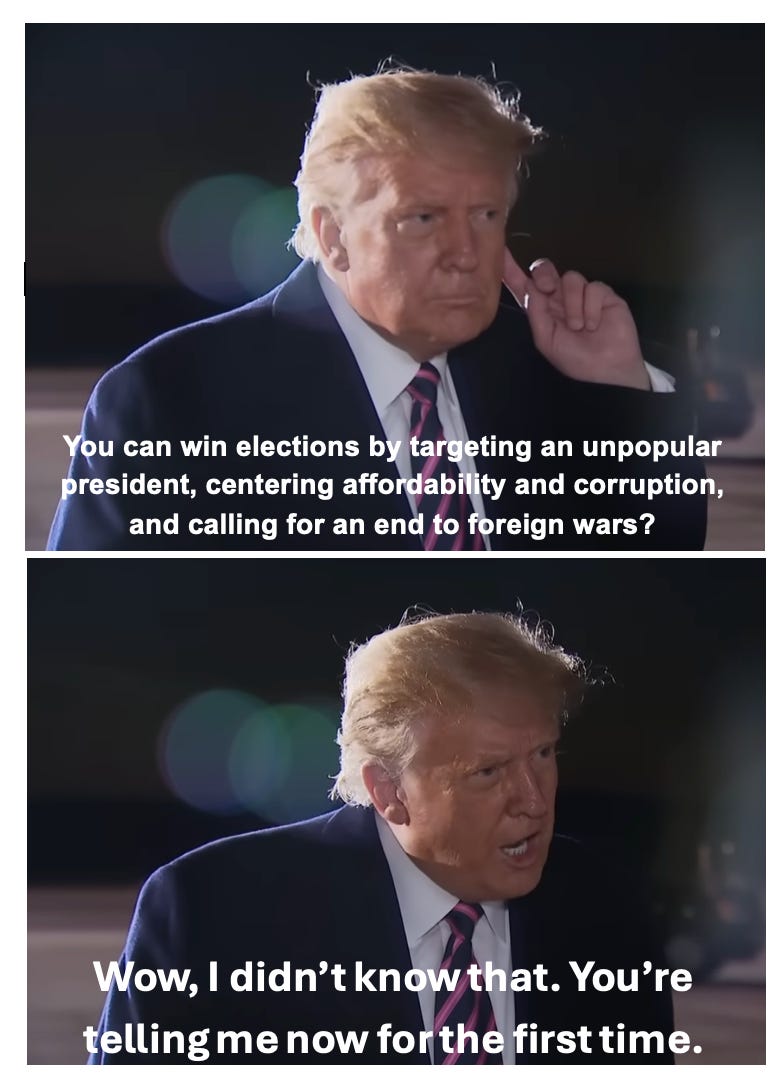
Democrats have also, at least on some issues, succeeded in wresting the slippery mantle of populism away from Trump and infusing it into their own campaigns. Perhaps the paradigmatic example of this — and of Trump more or less abandoning his populist instincts upon returning to the Oval Office — is the brewing clash over AI policy.
Almost every poll that has been conducted on this issue suggests that AI advancement is not overwhelmingly popular with the American public. (Strangely, tech executives saying that their product might cause widespread job losses and human extinction seems not to have sat well with people.) An NBC News poll last month found that 70% of Americans are more worried than excited about AI. 69% would oppose the construction of an AI data center in their area. And 81% said the government is not doing enough to regulate AI.
This would be a lay-up for any populist: a fight that could place you on the side of the overwhelming majority of the electorate, while positioning you to rage against tech billionaires. It would be very easy to imagine Trump having taken this side of the dispute, calling everyone in Silicon Valley “weirdos” and promising to protect American jobs from the liberal California elite.
Indeed, before AI really hurtled onto Washington’s radar for the first time courtesy of a 27-year-old’s resignation from Anthropic in September, the politics of the issue were largely unsettled. It wasn’t clear where either party would end up.
A New York Times poll conducted just before the resignation story blew up showed Democrats leading Republicans on every major policy issue — except for AI, on which Republicans had a two-point edge. This reflected less that the GOP boasted an advantage on the issue, and more the fact that the battle lines hadn’t really been drawn yet: more voters (18%) said they didn’t know which party to trust on AI than any other issue. For the most part, both parties can count on about 40% of the country to side with them on any issue, while the rest are up for grabs. Basically what this poll showed was that, at the beginning of September, both parties had their usual supporters on AI; everyone else was up for grabs.
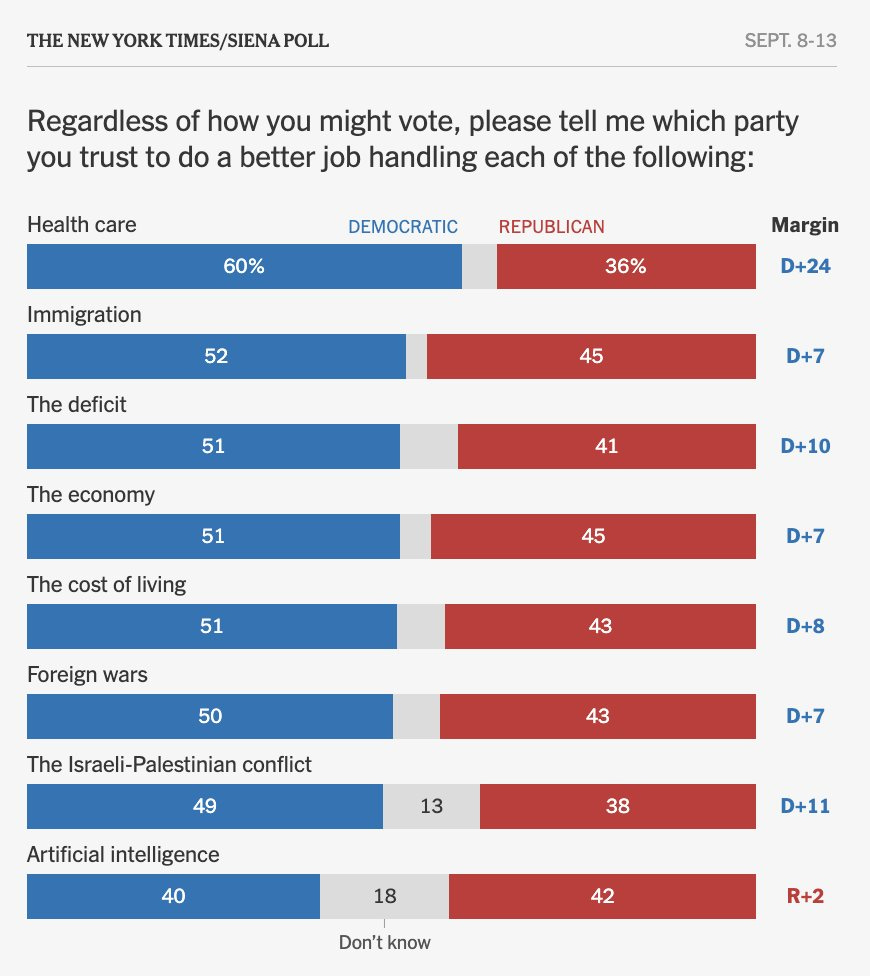
Strikingly, Trump chose this exact moment to weigh in on the issue — on the opposite side of the one most Americans had taken. Trump had rarely commented on AI before sending out a burst of Truth Social posts starting after September 14, right after the above poll had been completed.
“The only control or ‘guardrails’ that AI needs is a STRONG AND SMART (High IQ!) PRESIDENT, and the U.S.A. has that, in spades!” Trump insisted that day, dismissing the need for government regulation. “There is a SICK conspiracy going on against AI and Data Centers,” he added. In other posts, he referred to concerns about the technology as a “hoax.” Democrats, in turn, started taking on AI and data centers in their campaign messaging: Democrats have spent $14 million on ads mentioning Big Tech this year, The Atlantic reports, compared to $6.3 million in spending by Republicans.
This set up a perfect natural experiment. Polls showed that neither party had a clear advantage on AI, seemingly because neither party had staked out a clear position on it. Then, both sides started talking about it. Now we would be able to test its popularity by seeing if the politics of the issue shifted at all in the subsequent weeks.
Well, the results of our little experiment are in. This week, the New York Times came out with its latest national poll, and that Republican advantage on AI? It disappeared as soon as Trump started saying that worries about AI were akin to a “hoax” or a “conspiracy.” What was an R+2 issue last month has now turned to D+11, per the Times’ latest poll.
I bring this up partially because it’s interesting on its own terms: if you believe, as I do, that AI will be a central issue in our political discourse over the coming years, then it’s notable to see how opinions are shifting on the issue — which was so recently a blank slate (at least as a partisan question) in the electorate’s imagination, though that doesn’t seem to be the case anymore. This will be notable to track in the coming months and years.
But I also think it’s a fascinating indication of where Trump’s political instincts lie 10 years into his political career. Trump frequently talks about “80/20 issues,” mocking the Democrats for siding with the 20% on issues where a supermajority of the public is aligned against them. His main examples are usually immigration and transgender participation in female sports.
These are two issues where Trump is on the side of the supermajority: per Pew, 83% of Americans think at least some immigrants living in the U.S. illegally should be deported, while 73% of Americans are uncomfortable with transgender athletes playing on teams that don’t match their sex at birth. They are also two issues where Democrats haven’t copied Trump’s stances (though some battleground candidates have tried to moderate on them). That means they remain valuable weapons in the Republican arsenal, though seemingly not enough to stave off major losses this November.
Outside of those two issues, though, I’ve been struck recently by how many issues on which Trump seems to be taking the “20” side on “80/20” questions. AI is a perfect example. As stated, about 80% of the country supports increased government regulation of AI. Trump has pointedly sided with the 20%.
There are more examples, too — and the unpopularity of Trump’s stances on these questions might tell us something about the future of the GOP after he leaves the stage.