


Today’s newsletter was supposed to go out yesterday; my apologies on the delay. I’ll see you back in your inbox tomorrow. — Gabe
Republican pollster Patrick Ruffini recently made a point on a podcast that has stuck with me. “In order to have a majority coalition in this country, the coalition needs to not entirely make sense,” he said.
By way of example, he pointed to the coalition that lifted Barack Obama to the presidency in 2008 and 2012. Obama famously performed well among so-called “ascendant” voters: Black voters, Hispanic voters, millennials, college-educated whites. But that was not enough to win the White House. Obama only got across the finish line with the support of white working-class voters in key states. It was a marriage of demographic opposites: white and non-white, those rising the socioeconomic ladder and those falling down it. In a country as large and diverse as ours, that is what you need to win. A coalition broad enough that it doesn’t entirely make sense.
Donald Trump also won in 2024 with such a coalition. Trump appealed to neocons and isolationists. Billionaires in search of tax cuts and working-class economic populists. Immigration hawks and a sizable chunk of Hispanic voters. Republicans have spent the last 18 months laboring (largely in vain) to keep these groups together; the 2026 midterms will hinge, in part, on whether they can do so.
Another paradox within Trump’s coalition has gotten less attention, but could also be pivotal this November. The demographic group among which Trump improved the most in 2024 is also the one that has come under the fiercest attack from his own party: Muslim Americans.
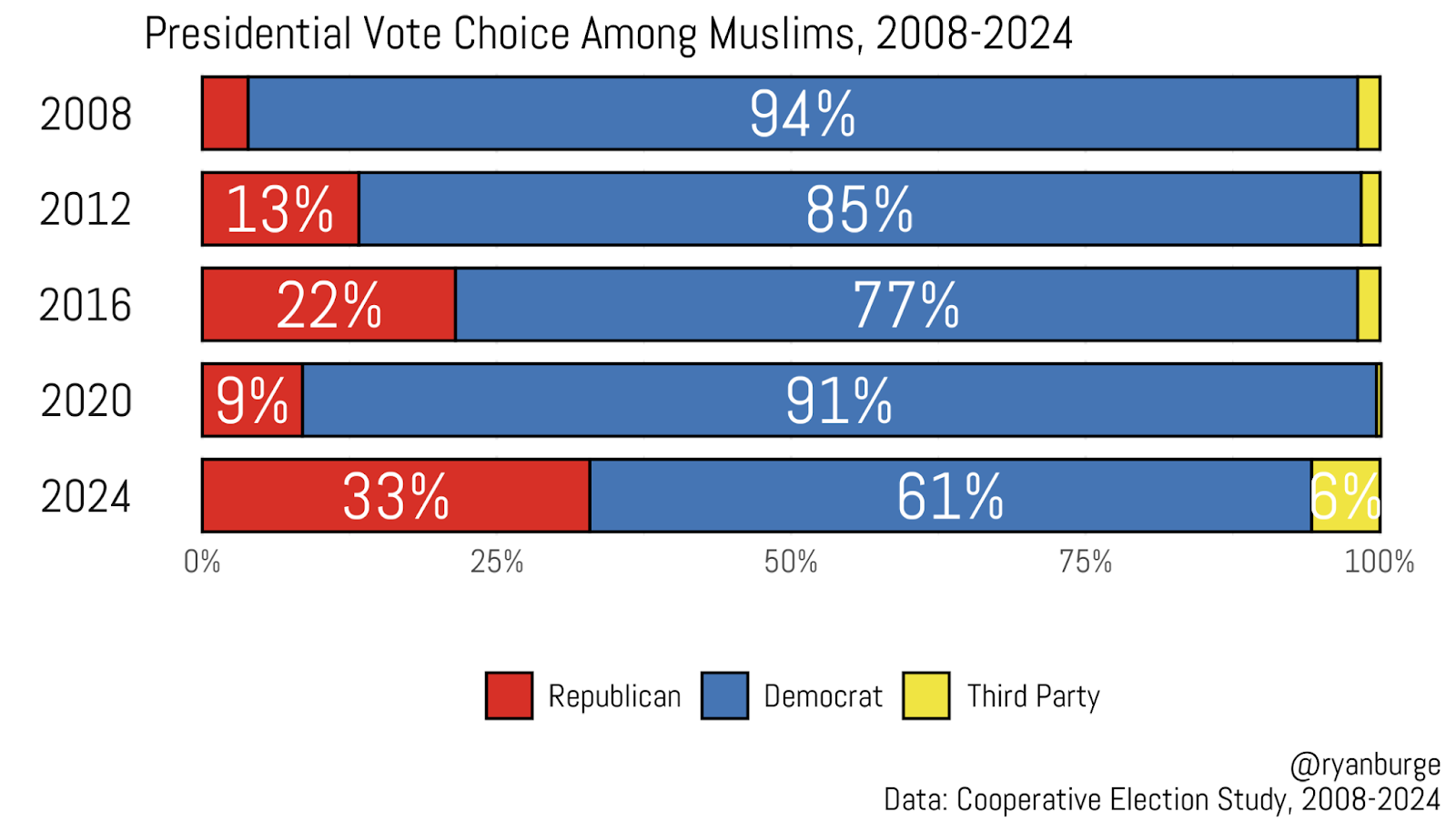
According to data from the Cooperative Election Study — a major post-election survey with a sample size of more than 50,000 — Trump went from winning 9% of the Muslim vote in 2020 to 33% in 2024, a 24-point improvement that well outstrips his gains among young voters (five points), Black voters (seven points), Hispanic voters (eight points), and Jewish voters (eight points) that have attracted more attention.
The sizable Muslim population in Michigan likely helped tip the critical swing state in Trump’s favor.
Not that many Republicans seem to have noticed.
“If they force us to choose, the choice between dogs and Muslims is not a difficult one,” Rep. Randy Fine (R-FL) wrote on X in February. “Muslims don’t belong in American society,” Rep. Andy Ogles (R-TN) echoed in March.
These Islamophobic comments have stopped catching headlines, but GOP lawmakers continue to make them. “Evidence is exposing the FACT that North Texas is ground zero for the growing influence of Sharia in America,” Rep. Keith Self (R-TX) posted just yesterday, citing plans for a nearby Muslim residential community, a new Muslim college, and a local waterpark being rented out for an event to celebrate Eid.
“These people have no desire to assimilate, their intent is to dominate! … It worked in Europe, Michigan, Minnesota, and New York, now it is playing out in North Texas,” Self wrote. “The time to take a stand against their sinister plan is now!”
When asked, Republican leaders including House Speaker Mike Johnson (R-LA) have declined to condemn these remarks.
Some Muslim Republicans and analysts think the GOP might be making a political error, needlessly unraveling Trump’s 2024 gains with a demographic group that might have come in handy in 2026 and 2028.
“I shook my head at how ridiculous those statements were… I read them, and I just shook my head, and I just was like, you know, what do you say to somebody like that?” New Jersey state assemblyman Al Barlas, one of only two Muslim Republican state legislators in the country, told me in an interview, referring to the recent anti-Muslim comments by GOP lawmakers.
Barlas said that he believes the comments could hurt Republicans in the 2026 midterms. “I wish they would think about what impact this has on the greater good,” he said. “In their district, it probably doesn’t matter, right? … But those comments then could be used in Georgia, where the Senate seat is a tossup and the governorship is considered a tossup, or in Michigan, where there’s an open seat for governor and for U.S. Senate. I think they have to sometimes be careful and take a step back and think, how does this impact everybody else?”
Georgia, which Trump won by 115,000 votes, has about 125,000 Muslim residents. Michigan, which Trump won by 80,000 votes, has about 240,000 Muslim residents. “Those 200,000 voters, they could change the outcome of that election,” Barlas said. “So if Congressmen Ogles and Fine truly want to help President Trump deliver on his vision for America going forward, then they’ve got to think about how their comments have the potential to hurt that from happening.”
“Because they can say whatever they want, they can tweet whatever they want to tweet, but it’s not going to help the president if the House is 433-2,” he added.
Saher Selod, the director of research at the Institute for Social Policy and Understanding (ISPU), a non-partisan organization focused on polling American Muslims, agreed that the comments could hurt Republicans in Michigan and Georgia. She also added another battleground state to the list. “The campaigning in Texas…is some of the most overt anti-Muslim rhetoric I’ve seen,” Selod said. “And I remember 9/11.”
Texas Republicans placed a measure on the party’s March primary ballot asking whether the state should ban Sharia Law, the Islamic legal system. (94% of Texas Republicans voted “yes.”) The topic has also heavily featured in GOP advertising in the state in recent months. Texas is home to 313,000 Muslim residents and a contested Senate race this fall; Selod, a native Texan, said there are Muslim Republicans in the state who “would vote for Trump again” if he were running for another term but “might not vote Republican for these other elections” downballot in protest of the party’s anti-Muslim turn.
This wouldn’t be the first time that right-wing rhetoric has turned Muslim voters against Republicans. Muslim Americans were once a reliable GOP constituency; as recently as 2000, more than 70% were Republican voters, according to estimates by the Council on American Islamic Relations (CAIR).
“Most people would say the Muslim community would line up more with the Republicans in terms of sort of their social and family values as well as their…fiscal perspective,” Barlas, the New Jersey assemblyman, told me. “And then I think the war in Iraq changed a lot of that for a lot of Muslims.”
The Bush administration’s war in Iraq, as well as the post-9/11 surge in Islamophobia, helped fuel an almost complete turnaround in Muslim voting trends. By 2008, 94% of Muslim Americans cast ballots for Barack Obama, according to the Cooperative Election Study.
Muslim Americans make up only about 1% of the country, which makes them a difficult group to accurately poll. But several groups align with the finding that 2024 marked the largest movement of Muslims towards Republicans since the post-9/11 shift. An exit poll by CAIR found that Kamala Harris sunk in third place among Muslim voters in 2024, behind Green Party nominee Jill Stein and then Trump; a study by the ISPU found the Trump won 31% of the Muslim vote, up from 14% in 2020, numbers that roughly align with the Cooperative Election Study findings.
Barlas said that one element of the shift was the group’s existing social conservatism, similar to conservative Black and Hispanic voters who sided with Trump in 2024 after decades of voting for Democrats despite ideological differences with the party. But he and other experts agreed that the Biden administration’s war in Gaza was also a huge factor in the shift.
“It was a reluctant vote,” said John Esposito, a professor of Islamic studies at Georgetown University who has been involved in polling Muslim Americans for decades. “It was a vote that just couldn’t bring themselves to accept what Biden was doing in Palestine.”
A year and a half later, Esposito said, Trump has hardly governed as these voters expected, ruminating about a U.S. “take over” of the Gaza Strip and partnering with Israel on a new war in Iran. When added to the recent string of comments by Republican lawmakers, these newfound Muslim Trump voters are “not people that will be voting Republican again” in 2026, Esposito said. “That vote will be lost.”
An ISPU poll last year found that approval of Trump’s job performance among Muslim Americans had slipped to 21%.
In some ways, this is an interesting story about a specific demographic group that was once overwhelmingly Republican, then overwhelmingly Democratic, and then suddenly competitive in 2024 for the first time in decades, due to dissatisfaction with the Biden administration’s policies, both foreign and domestic.
But it is also a case study in coalition management. There are always inherent tensions that come when you must stitch together a broad, diverse coalition to win the White House. Some presidents, like Ronald Reagan, Bill Clinton, and Barack Obama, have been adept at smoothing over these tensions and keeping those coalitions intact. Biden, on the other hand, struggled at the same task.
While campaigning in 2024, Trump made a lot of promises to a lot of constituencies, seemingly throwing anything at the wall to see what would stick. Now, his bill is coming due.
Trump went to Dearborn, Michigan — the only Arab-majority city in the U.S. — and promised “peace in the Middle East.” And he went to Florida and said that the “most important day in the history of Israel” would be the day he was re-elected. The Jewish and Muslim votes both swung in his direction, simultaneously.
Since then, Trump has continued heaping praise on Israel and the country’s prime minister, Benjamin Netanyahu. But he has carried out very little Muslim outreach, and stood by as his allies in Congress have made comments openly targeting the very group that swung towards him the most in 2024. His decision not to tend to a demographic that is potentially winnable for the GOP could cost his party votes in key races in Michigan, Georgia, and Texas, all home to significant Muslim populations.
This is the same dynamic playing out across the board, as Trump tries to keep neocons like Lindsey Graham and isolationists like Tucker Carlson under one party tent, and also pro-life activists and pro-choice swing voters, and also CEOs who want tax cuts and Medicaid recipients who want to keep their benefits.
Coalitions that don’t make sense require careful maintenance in order to keep them together for more than one election cycle in a row. Otherwise, presidents can run the risk of contorting themselves in too many ways at once, stretching their coalitions so thin that eventually, they burst.
Thoughtful analysis, Gabe.
It amuses me when conservative Christian voters get worked up about sharia law, then turn around and advocate policies that look a lot like…sharia law. (I’ve lived in countries that largely follow sharia law since 2010, so I am familiar. :))
There is a whole other side to Trump picking up Muslim, Black, Jewish and Hispanic voters in 2016 and 2024 - plain, old-fashioned misogyny. They weren't voting for Trump or for the GOP so much as voting against a "woman-President."