


The metastasizing Minnesota fraud scandal, which led to Democratic Gov. Tim Walz dropping his bid for re-election Monday, contains two mysteries in one.
The first and most obvious mystery is how such a breathtaking amount of money was able to be so brazenly stolen. So far, according to the Justice Department, 98 people have been charged with defrauding the social services system in Minnesota out of at least $500 million. Acting U.S. Attorney Joe Thompson, a career prosecutor who has investigated the scandal during both the Biden and Trump administrations, said in July that the total amount of fraud could surpass $1 billion — and then updated that estimate to $9 billion in December as new revelations continue to emerge.
Thompson and other prosecutors have been probing the case since 2022, when they unveiled the first set of charges in what they called the “largest Covid-19 fraud scheme in the nation.” Those allegations primarily concerned a Minnesota non-profit called Feeding Our Future, which took advantage of lax Covid-era requirements to steal $250 million from the Federal Child Nutrition Program (which is administered on the state level, using federal dollars) by falsely claiming to have distributed 125 million meals to children.
The DOJ said that one defendant used the website “listofrandomnames.com” to create a fake list of children who had received meals; another used an Excel formula to insert random ages between seven and 17 next to each name. One conspirator claimed to have been feeding more than 5,000 children a day; in fact, the DOJ said, she used the millions of dollars she received from the government to make personal purchases including a 37-acre property and an airplane.
Subsequent parts of the scandal have extended to housing, autism, and day care programs run by the Minnesota government and funded through Medicaid. In one case charged last month, which prosecutors called “fraud tourism,” a pair of Pennsylvanians with no connection to Minnesota traveled to the state and created a fake service for people in public housing because they heard that Minnesota’s Housing Stabilization Services Program “was a good opportunity to make money.”
Per the DOJ, out of the 98 Minnesota fraud defendants so far, 85 belong to the state’s large Somali community. It appears that the state government failed to stop them for so long at least partially because Walz’s appointees, who oversaw the programs being defrauded, were afraid of being accused of racism.
The Minnesota Department of Education found irregularities in Feeding Our Future as early as 2020; the non-profit told the agency that a cancellation of its funding would lead to a lawsuit alleging racism that would be “sprawled across the news.” The funding continued to flow. The state’s nonpartisan auditor later said in a report that “the threat of legal consequences and negative media attention” impacted that decision.
“There is a perception that forcefully tackling this issue might cause political backlash among the Somali community, which is a core voting bloc” for Democrats, Kayseh Magan, a former Minnesota state fraud investigator who is himself Somali American, told the New York Times. One of the many bizarre sideplots in the saga is an attempted bribe that a group of defendants arranged, dropping off a note and a bag containing $120,000 at the home of a juror. This, too, contained a racial dimension: “Why, why, why is it always people of color and immigrants prosecuted for the fault of other people?” the note said. The juror, who immediately reported the bribe, appeared to have been targeted as the sole non-white person on the jury.
Walz, who has served as governor since 2019 and was tapped as the Democratic vice presidential nominee in 2024, has repeatedly vacillated about when he learned about the fraud. He initially said he was briefed in April or May 2020. Then, a spokesperson clarified and said it was the summer of 2020. The spokesperson then clarified again and said it was November 2020. Walz has said that his administration “had a culture of being a little too trusting” and that he ultimately bears accountability because the fraud took place on his watch.
The governor had announced in September that he planned to seek a third term this year, but ended his campaign on Monday. (Democratic Sen. Amy Klobuchar is reportedly mulling a run to succeed him.) Walz’s departure statement focused almost entirely on the fraud scandal, marking a dramatic fall for someone who less than a year ago was being floated as possible presidential timber.
And that bring us to our second mystery: Why is this becoming a scandal now, years after the first indictments began flowing?
The general assumption, at least on the right, is that it’s because the media neglected to cover the story. “You literally can’t find a single mainstream article about the Minnesota fraud,” one conservative commentator wrote on X, in a post that has been viewed 9 million times.
But this is actually an even more interesting mystery precisely because the media has been covering the story. The first mention of the scandal in the New York Times came in February 2022, almost four years ago, when an online post said that David Fahrenthold — the star investigative reporter who broke the “Access Hollywood” story in 2016 — would be in Minnesota that week. The Times put out a solicitation for any tips on “possible fraud involving government programs meant to feed hungry children.”
The next month, Fahrenthold’s piece (“F.B.I. Sees ‘Massive Fraud’ in Groups’ Food Programs for Needy Children”) was published, breaking the story of the FBI investigation. Many news outlets, in Minnesota and nationally, also covered the first indictments in September 2022. The story was featured that month on the flagship podcasts of both the Times (episode title: “The Great Pandemic Theft”) and the Washington Post (“The plot to steal $250 million from hungry children”).
I’ll pause here to note that even though it would be wrong to say this story wasn’t covered in the media, it is odd how little coverage it received during the 2024 campaign, when Walz was nearly placed a heartbeat away from the presidency.
At the time Walz was selected as Kamala Harris’ running mate, the aforementioned state auditor report dinging his administration had already been released, as had many of the revelations that are now forcing his retirement. (I would be curious to know the extent to which it came up in the Harris campaign’s vetting of him.) A handful of news outlets, including ABC News, Fox News, and Minnesota Public Radio, reported on the fraud scandal in the days after Walz’s selection, but it was hardly a dominant theme of the campaign.
Of course, this is a function of many things: the story wasn’t about Walz directly, though it does speak to his management style and the appointees he surrounds himself with; vice presidential candidates are never the dominant theme of a campaign; media scrutiny is, to some degree, dependent on what the campaigns themselves choose to focus on.
Republicans did briefly highlight the scandal by having a House committee issue a subpoena to Walz in September 2024, which was widely covered by the media, but the story never stuck. (One sub-mystery: what happened to that congressional investigation? Did Walz simply ignore the request for documents? Did he comply, but the documents didn’t show anything too damning and Republicans simply dropped it? Republicans never indicated a response from Walz, or any further follow-up. I reached out to the lawmaker’s office who led the probe yesterday, but have yet to hear back.)
Frankly, to the extent Walz received negative attention during the campaign, it seems like Republicans moved on to other Walz-related scandals, and found that those broke through more, so the GOP kept talking about those and the media followed suit. (Later in September, another House committee issued a subpoena on Walz’s “connections to the Chinese Communist Party.”)
Google data suggests that searches related to the Minnesota fraud saw a small uptick in 2022, when the story broke, and then again in the summer of 2024, before really spiking in the past few weeks. The story about Walz and China got some play in 2024 but never really broke through. A separate story about Walz’s military record seems to have been the breakout Walz scandal of 2024. (Just speaking for myself, I remember hearing about the China and military stories at the time, but not the fraud story.)
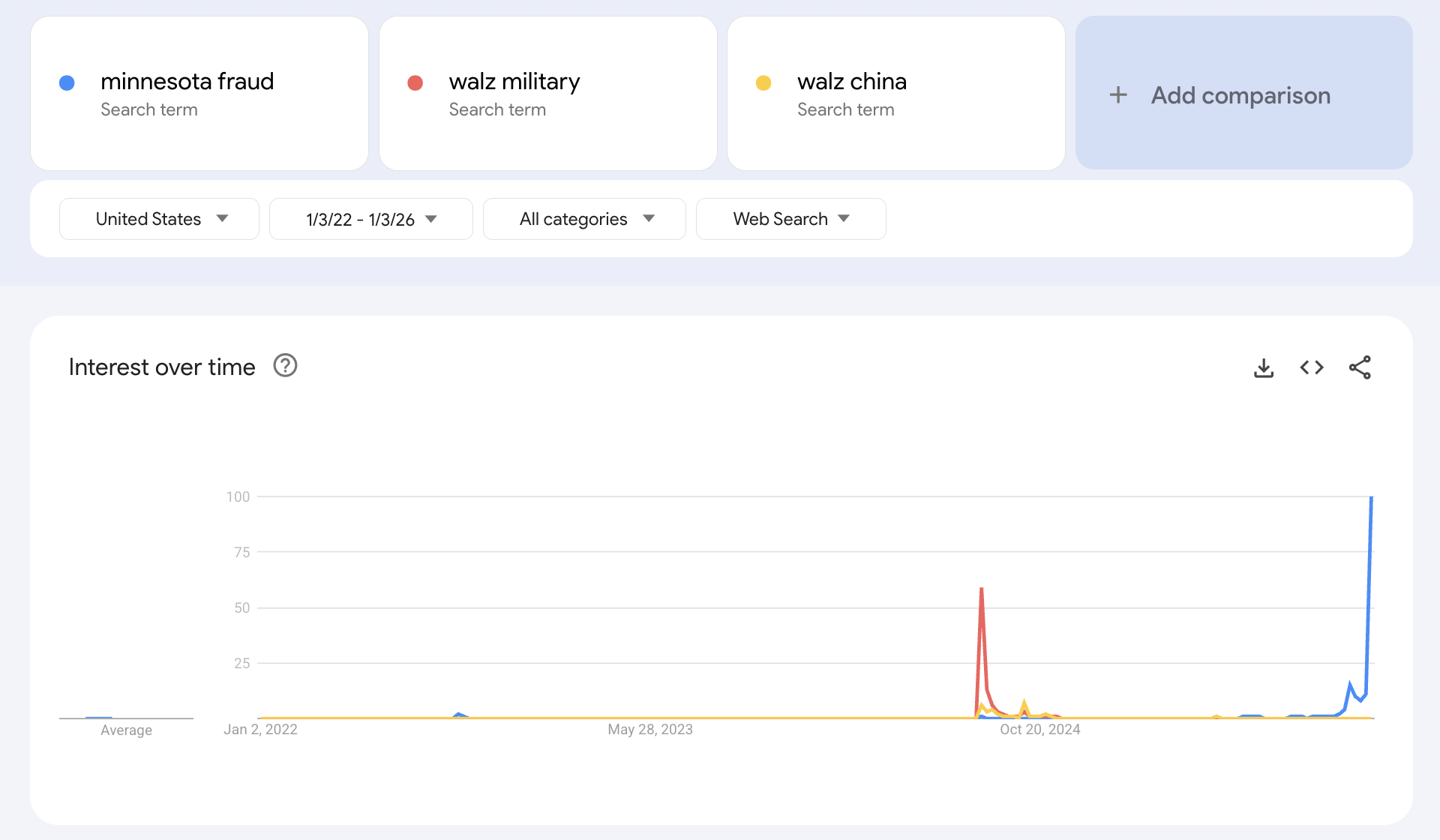
My guess is that part of the story here is that the fraud scandal did emerge in Republican opposition research on Walz, the GOP tried to make it stick, found other stories that were more tantalizing, focused on those in its messaging (to the extent there is a 2024 “spike” for the fraud story, it came at the same time as the spike for the military story, and it isn’t hard to see which spike is larger), and more Republican mentions of other stories led to more media attention on them.
All of this to say, the media didn’t miss the fraud story, per se, since it had been covering it since 2022, but did plainly whiff on covering it when it mattered, which is probably partially due to where Walz’s opponents were focusing their energy but nevertheless should be considered a major journalistic failing in hindsight. (If the story was important enough to end Walz’s career as governor, it was important enough to receive more coverage when he was running for vice president, no matter if his opponents focused on it or not.) Partisan bias, ignoring-the-VP bias, and ignoring-important-stories-on-management-in-favor-of-flashy-personal-scandals bias also likely played a role.
That helps us solve one element of our second mystery: Where was this scandal a year and a half ago? But it leaves another element hanging: How did the story end up roaring back into the news cycle?
As best I can tell, the story was revived on November 19 by a report in City Journal, a publication by the conservative Manhattan Institute think tank, which alleged that some of the stolen taxpayer funds were sent back to Somalia and ended up in the hands of terrorist group Al-Shabaab. (This claim has not been independently verified by any other news outlets and has not been alleged in any of the federal court cases.)
Two days later, President Trump announced that he was revoking temporary legal protections for Somali migrants in Minnesota, writing that the state “under Governor Waltz [sic], is a hub of fraudulent money laundering activity.” Then, on November 29, the New York Times published a new report (“How Fraud Swamped Minnesota’s Social Services System on Tim Walz’s Watch”), which is when the scandal first came my radar.
This led to a drumbeat of further stories, investigations, and Trump administration actions — but, still, it seemed like Walz would survive the scandal.
The tipping point appears to have come courtesy of Nick Shirley, a 23-year-old conservative influencer who has been making YouTube videos since he was in high school. As NPR put it, he started making “shock-value” prank videos, like “flying to New York City at age 16 without telling his parents” or “riding a bike over a ramp lit on fire.” His content eventually became more political, including filming outside the Capitol on January 6th, on the U.S.-Mexico border in 2023, and at the Salvadoran mega-prison CECOT in 2024.
On December 26, Shirley posted a video where he visited a series of child care centers in Minnesota that receive federal funding. Several of them didn’t appear to be operative; others were staffed by Somali-Americans who told him he could not enter, and did not appear to be serving any children. The sign outside of one center read “QUALITY LEARING CENTER,” misspelling the word “learning.”
The video went mega-viral, receiving more than 3 million views on YouTube and spreading like wildfire across other platforms. On TikTok, clips of the video have received a combined 40 million views. On X, the video has been viewed more than 138 million times.
Shirley’s video was shared on X by Vice President JD Vance, FBI Director Kash Patel, and the platform’s owner, Elon Musk. The Trump administration quickly responded by freezing child care funds and sending 2,000 immigration agents to the state. Shirley has gained more than 400,000 new subscribers on YouTube, making his the fastest-growing political channel on the platform, according to the journalist Kyle Tharp.
It’s not that the mainstream media hadn’t covered the story: it had, for years. It’s that the mainstream media lost its agenda-setting power. Hundreds of millions of people only paid attention when the story was covered by a viral video creator.
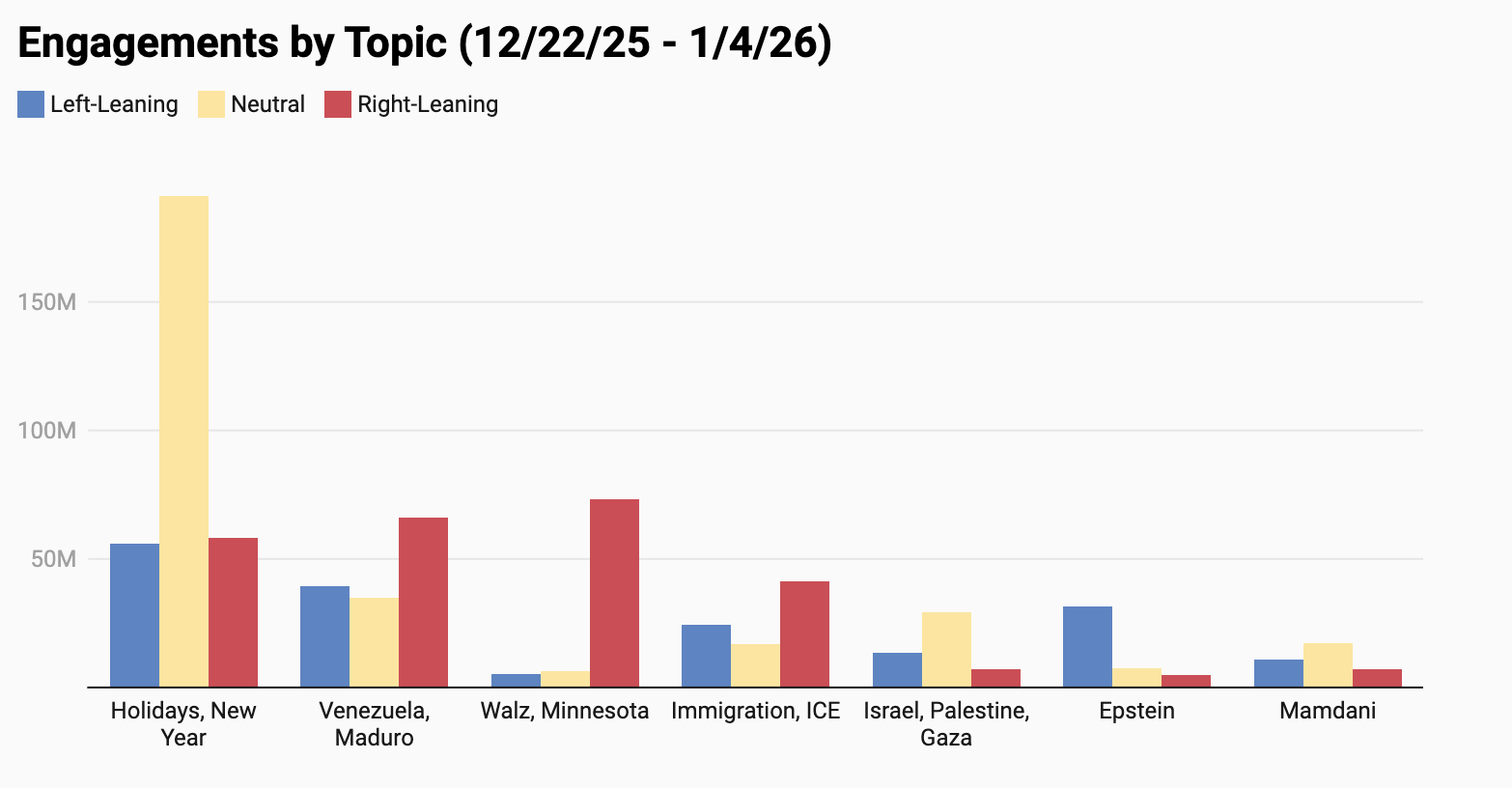
Due to Shirley, and the powerful people who promoted the work of a freelancing influencer — something that wouldn’t have been possible not long ago — the story rocketed across social media. According to Magnitude Media, it was the story that was most covered by right-leaning social media pages over the last two weeks, even as left-leaning and neutral pages barely touched it.
That was enough for several observers — including Walz himself — to credit Shirley with forcing the fraud story to the forefront. CNN wrote that Shirley was “not the first” to cover the story, but “perhaps the most resonant,” describing him as “the right figure — with the right following and with the style that resonates with the audience hitting at the right time — that can make all the viral difference.”
In his retirement statement, Walz referred to “conspiracy theorist right-wing YouTubers breaking into daycare centers and demanding access to our children.” It wasn’t difficult to deduce who he was referring to.
Shirley’s video has all the hallmarks of the viral era. It would not have been possible without reporting by the mainstream media, but it added a new angle that was produced in a visually compelling way. It was originated by a micro-influencer, and then picked up by mega-influencers who allowed it to spread. Shirley is already trying to monetize his newfound fame. (“Quality Learing Center” hoodies are going for 50 bucks.) Importantly, it’s also not clear how much of the video is accurate, another common feature of online fare: state investigators say that they visited all nine of the child care centers in Shirley’s video and found them to be operating as expected, even though that is not the case in the clips that Shirley shows.
But the video spread anyway, combining with other reports and investigations to make the situation untenable for Walz.
The fact that Shirley, without any connection to a mainstream newsgathering platform, produced the most widely spread video about the scandal shows how the balance of power between mainstream and independent journalists is wobbling.
About four-in-10 voters under 30 say they regularly get their news from influencers, as opposed to from traditional news sources, according to Pew Research Center; respondents listed “a feeling of authenticity” as one of the prime reasons they seek out news from influencers. Indeed, Shirley’s video isn’t produced like something you’d see on the nightly news: it’s personal and compelling, reflecting his “shock-value” roots, although it also doesn’t seem to have been fact-checked like it would be if it was on the nightly news. (Or maintain the same independence: Minnesota Republican lawmakers say they assisted Shirley.)
The New York Times hasn’t posted a YouTube video that has received as many views as Shirley’s (3.3 million) since 2023, despite boasting 4.95 million subscribers on the platform to Shirley’s 1.45 million (many of whom are new). CNN has had only four YouTube videos receive that many views in the last six months, despite having 19 million subscribers. And that’s not even mentioning his X view count (138 million), the type of number any mainstream news outlet — with vastly larger budgets — can only dream of.
It has already become commonplace in the entertainment space for influencers to end celebrities’ careers, with TikToks and YouTube videos that spread across the internet. Tim Walz, who appeared likely to survive a growing fraud scandal while it was only under mainstream media scrutiny, is now the first politician to fall victim to the same phenomenon. Other politicians have been felled by viral videos (see George Allen or Howard Dean) but those were videos of them speaking. This is a whole new thing: the influencers who have taken over our social media feed taking their tactics to politics, and turning a scandal that was survivable in black-and-white headlines, and making it viral — and fatal.
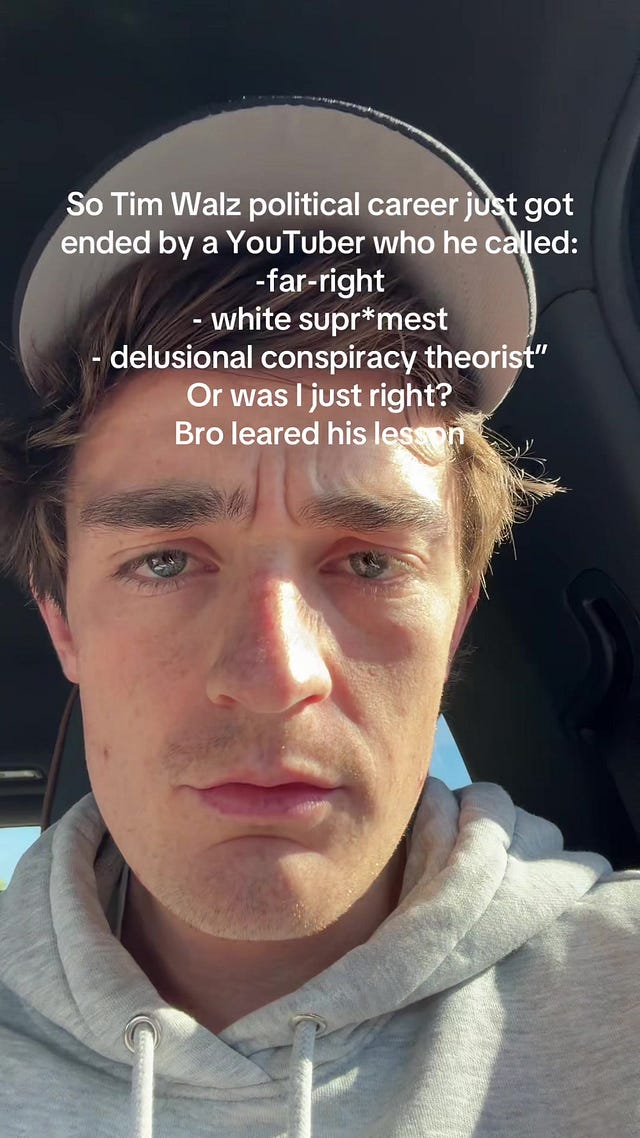
“So Tim Walz political career just got ended by a YouTuber who he called far-right, white supr*mest, delusional conspiracy theorist,” Shirley posted in a TikTok video yesterday. “Or was I just right? Bro leared his lesson.”
 Tiktok failed to load.
Enable 3rd party cookies or use another browser
There are so many different things that went wrong in Minnesota, but I am inclined to follow lots of stories to the same ending.
Our systems hold liberals and Democrats to more stringent standards than they hold conservatives and Republicans.
They hold the left to stronger anti-corruption standards. And higher benchmarks of public support. And more consistency in appealing to the center rather than the fringes.
The media does this. Pollsters do this. And election officers do it too.
And now, we see, so do the online influencers who drive media attention to the politically disengaged.
Nothing will ever get better for the left until the left begins demanding our political systems to hold the right to more consistent standards of official competence, public support, and service to the entire range of citizens of all political positions.
A few comments:
-The proven "fraud" is still less than what Philip Esformes ($1.3 billion) or Rick Scott ($1.9 billion) stole. And Trump pardoned Esformes in December 2020.
-The "$9 billion" is pulled out of Press Con Joe Thompson's ass.
-By forcing Walz to drop out, they opened the door to Amy Klobuchar to run. Oops.
If Klobuchar runs, she not only wins big, she pulls the rest of the party ballot up with her. The Democrats would lock up both Houses of the state legislature for at least the next two years.
A-Klo has incentives to do it. She's been in the Senate for years but is stalled out careerwise. A move to the Governor's Office gets her the executive experience she needs to pursue a run for the presidency in 2028.