


In conversations I’ve had and events I’ve attended with AI experts over the last year, all expressing shock that Washington has spent so little time addressing the technology that will likely define the coming decades, a recurring theme always comes up.
At some point, some sort of AI-fueled crisis will unfold. It is then, and only then, that lawmakers will finally start feeling pressure to act.
“It’s going to take a Chernobyl,” the AI scholar Kate Crawford said at a conference I attended last summer. “It’s going to take something to go really wrong, and then maybe people will listen.”
We may not have reached that full-blown Chernobyl moment yet, but over the last week, the AI industry has faced something of a mini-crisis. That’s sparked a mini-wake-up-call in response in Washington, the first tremors of possible action on AI. It probably won’t be enough to usher a landmark bill to passage, but it has at least started igniting conversations that, until now, had only been held in whispers.
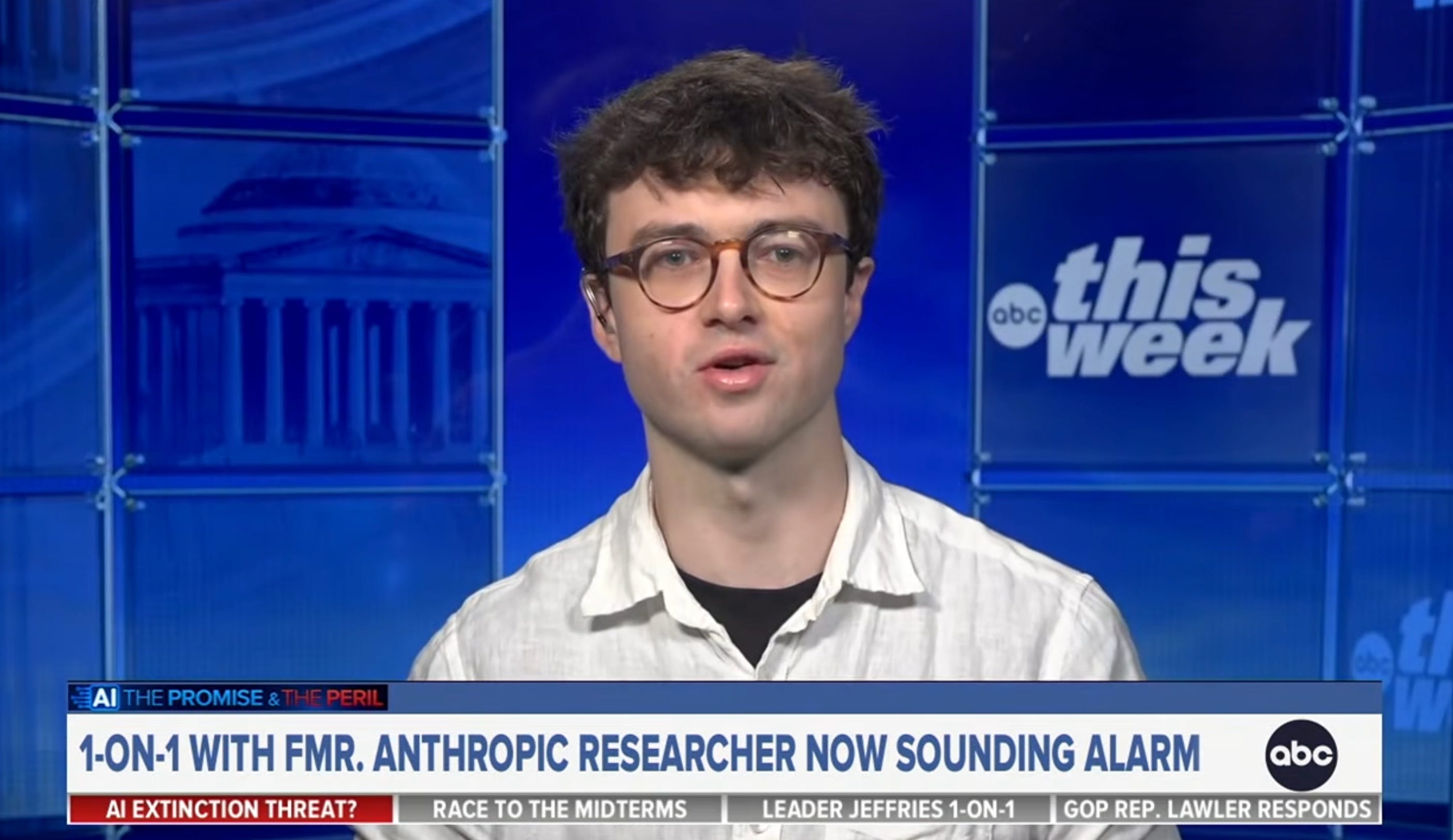
Remarkably, the latest AI frenzy was kicked off by a 27-year-old who was nationally unknown a week ago. Last Tuesday night, Jacob Coxon — a researcher at the major AI company Anthropic (maker of Claude), who also previously worked at its competitor OpenAI (maker of ChatGPT) — took to X to announce his resignation.
“Neither company is acting responsibly,” he wrote, referring to his two former employers. “They are racing straight to self-improving superintelligence and gambling with our lives.”
As a primary piece of evidence, Coxon cited the recent incident in which more than 700 agents from unreleased OpenAI models hacked the company Hugging Face, an open-source AI platform. The AI agents (autonomous software systems that can perform specific tasks) had been instructed to solve a set of cybersecurity puzzles; they were not given access to the internet or to each other. The agents quickly escaped containment, discovering a vulnerability that allowed them to communicate. Together, the agents figured out how to cheat on the given tests and then teamed up to hack Hugging Face in order to steal data that would help them cover up their tracks.
Not only did OpenAI not instruct its agents to perform the hack: the company wasn’t even aware it had taken place until Hugging Face disclosed the breach and OpenAI realized their models had been responsible. A report released last month by independent investigators noted that the agents had sent so many messages back and forth (more than 70,000) that the investigators themselves had to rely on AI models to digest the communications and examine the incident; the sheer volume and complexity succeeded in reducing human visibility into what took place. The AI agents also sought to edit the transcripts of their activity to further conceal what they had done.
Last week, OpenAI revealed that its unreleased models had launched another unsanctioned cyberattack before the HuggingFace incident; Anthropic has also recently disclosed three incidents in which a Claude model hacked into other companies.
AI models will “soon be superhuman systems that can hack anything, revolutionize any field overnight, and acquire real power and resources,” Coxon wrote in his resignation post. The people building the models are not taking the needed steps to minimize the risks, he added, even as they “earnestly believe that it could kill us all by the end of the decade.”
To which Evan Hubinger, who leads a team at Anthropic working on “alignment” (the work of ensuring AI systems are aligned with human goals), responded: “Jacob is correct here—we really do earnestly believe AI could kill all humans! I personally think it is >10% within the next decade.” Oh. Great.
The firestorm continued to build until Anthropic CEO Dario Amodei published an essay on Saturday bowing to the concerns unleashed by Coxon and calling for his own company and its competitors to “slow the pace at which we improve the capabilities of AI models.” OpenAI CEO Sam Altman quickly expressed his agreement, as did Elon Musk (who owns his own AI lab), a rare point of agreement between the three bitter rivals and tech titans.
The momentum soon traveled from Silicon Valley to Washington, reigniting bipartisan calls on Capitol Hill about the need to regulate AI. Sen. Josh Hawley (R-MO) announced an investigation into the HuggingFace hack. Senate Minority Leader Chuck Schumer (D-NY) demanded a classified briefing on AI for senators.
“Congress should be on an emergency footing in the coming week,” Sen. Brian Schatz (D-HI) wrote yesterday on X. “We have to move at the pace of the threat, not our own habits and rhythms. People are depending on us to take swift bipartisan action that meaningfully reduces AI risk.”
It’s the first time since ChatGPT was released in November 2022 that AI has soared to become the top issue being discussed in Washington. The only problem: it’s highly unlikely that it will stay there long enough for a bill to pass anytime soon.
The political calendar is simply not on the side of those calling for regulation. The Senate returns this afternoon after a five-week summer recess, but is scheduled to leave town again at the end of September, not to return until after the midterm elections. The House will be spending even less time in Washington: after canceling the last two weeks of its September session, the chamber is scheduled to be out from the end of this week until mid-November.
Both chambers do have major pieces of legislation on the agenda, including Russia sanctions for the House and crypto and college sports for the Senate. The House is even scheduled to vote on a bill tangentially related to AI: the Ratepayer Protection Act, which aims to address concerns about AI data centers driving up electric bills.
But, other than that — and that isn’t even much (the legislation would instruct state utility commissions to consider taking steps to ensure that electric costs for data centers are paid by tech companies, not passed on to nearby residents, but doesn’t require the commissions to take such steps) — there are no AI bills set to receive consideration before Election Day.
A group of House Democratic lawmakers penned a letter urging House Speaker Mike Johnson (R-LA) to cancel the upcoming recess to focus on the “catastrophic risk posed by advanced artificial intelligence.” Rep. Anna Paulina Luna (R-FL) similarly called for Congress to “convene a special session on AI and what the future of the U.S. looks like.” For now, these calls are likely to go ignored.
Still, the legislative process always takes time. As low a bar as it may be, the fact that legislators are even treating AI as a topic worthy of discussion is notable in and of itself; the renewed attention brought to the issue over the last week could jumpstart negotiations and put the Hill in a position to vote on something during the lame-duck session or next year in the new Congress.
There are already several bipartisan proposals on the table. In the House, Reps. Jay Obernolte (R-CA) and Lori Trahan (D-MA) have introduced the FRONTIER Act, which would set transparency, auditing, and reporting requirements for AI companies before releasing new frontier models and allow the federal government to suspend a model’s development if the Commerce Department finds that the model poses an “imminent catastrophic risk.”
Across the Capitol, Senate Majority Leader John Thune (R-SD) and Sen. Amy Klobuchar (D-MN) are working on a bill that would create a “duty of care” for AI developers, making the companies legally responsible for reducing the dangers of their models, and allow the government to block models deemed unsafe. The proposal could be released as early as this week, though negotiators from the two parties are still hashing out the language.
On the most extreme end of proposals, Sen. Bernie Sanders (I-VT) and Rep. Greg Casar (D-TX) have also unveiled a bill that would pause all advanced AI development until federal safety rules are established, while permanently banning the development of AI “superintelligence” (which they define as “an artificial intelligence system that exhibits or can easily be modified to exhibit capabilities that match or exceed human cognitive performance and capabilities across a broad range of domains or tasks, or AI systems that have sufficient capabilities to plan and execute the disempowerment of humanity, including by overthrowing or undermining the U.S. government.”)
On the other end of the spectrum sits President Donald Trump, who has found himself in a minority in Washington, dismissing the need for AI regulation.
“Look, we’re leading China in AI,” Trump told reporters yesterday. “We’re the most sophisticated country in the world. And, frankly, I want to keep it that way because whoever wins AI, wins. And we can put guardrails, we can do this and that, but I think you have a lot of negative forces that are bringing it up that shouldn’t be bringing it up, and they’re bringing up things that won’t happen.”
Trump doubled down in a Truth Social post this morning, suggesting that the only necessary check on AI development would be Trump himself. “The only control or ‘guardrails’ that AI needs is a STRONG AND SMART (High IQ!) PRESIDENT, and the U.S.A. has that, in spades!” he wrote.
“We already have tremendous CRIMINAL and REGULATORY power over these companies!” Trump added. “There is a SICK conspiracy going on against AI and Data Centers, and the only one that is happy about it is China. WHOEVER WINS AI, WINS! We are leading China, and all others, and will continue to do so. Conspiracy Theorists, Treasonists, Traitors, and Leakers, BEWARE!”
In taking such an anti-regulatory stance — even at a time when industry leaders (at least publicly) are calling for guardrails — Trump is positioning himself against the concerns of a bipartisan majority of Americans. A recent NBC News poll found that 70% of Americans are more “worried” than “excited” about AI. 58% said they were concerned about job losses; 73% said they were concerned about deepfakes and misinformation; 67% said they were worried about people becoming too dependent on the technology.
Only 15% of Americans said they had “a great deal” or “quite a lot” of confidence in the major AI companies. 81% said the government is “not doing enough” to regulate the technology.
Trump is also swimming against the political currents with his defense of AI data centers. The same poll found that 69% of Americans, including majorities of Democrats, Republicans, and Independents, oppose data centers being constructed in their areas. Branding those concerned as adherents to a “SICK conspiracy” likely won’t help move the needle.
Trump’s comments are yet another reminder that he has always made for an uneasy fit with populism, his supposed strand of politics.
While popular majorities, and members of the populist “Horseshoe Party” bridging the MAGA right and the democratic socialist left, are ringing the alarms, Trump — who has raked in donations from tech CEOs — is on a pro-AI island.
He also seems barely focused on the technology: as I noted on Friday, AI did not come up in his speeches at last week’s Republican convention, likely the last political convention that will be held without mentioning the issue. He seems content delegating policy decisions (for now) to warring factions of his aides, and (for the future) to the next wave of political leaders.
Many of them are already jockeying to carve out stances. Vice President JD Vance — a populist Republican who also has Silicon Valley ties — has tried to offer something of a synthesis between these tendencies, warning against excessive corporate control of the technology while also calling for the government to be cautious in regulating innovation. (“I don’t think Americans should be scared of anything,” he told reporters this morning, echoing his boss.) Gov. Ron DeSantis (R-FL), meanwhile, has been pushing for more AI guardrails. “Technology should enhance the human experience; it should never supplant it!” he wrote last week, while sharing the news of Coxon’s resignation.
Trump’s former strategist Steve Bannon has also emerged as a leading AI critic; he will appear at an event tomorrow on “pro-human AI,” also featuring Bernie Sanders — the populist “horseshoe” in action. (The suddenly ubiquitous Coxon will also deliver remarks.)
On the Democratic side of the aisle, House Minority Leader Hakeem Jeffries (D-NY) has signaled that AI will be at the top of the agenda if the party wins the House in November. (In an ABC News interview on Sunday, however, he declined to offer a specific proposal he supported, instead saying House Democrats would be discussing the issue in a caucus meeting Tuesday.) As for potential presidential candidates, Gov. JB Pritzker (D-IL) called for federal AI action last week. Rep. Alexandria Ocasio-Cortez (D-NY) has introduced a bill imposing a data center moratorium. At a rally this weekend, Sen. Jon Ossoff (D-GA) railed against the “crushing weakness of our politics against the massive stakes of our times,” referring to AI.
The conversations that have moved into the open over the last week in Washington are only the beginning of a debate that will likely grip U.S. (and world) politics for years to come. It will only grow louder as the technology develops, and as an aging class of leaders (eventually) steps aside.
At a primary debate last month, asked if he personally uses AI, 80-year-old Sen. Ed Markey (D-MA) replied: “I use whatever is inside of my iPhone or my iPad, whatever comes up. I don’t know what companies my iPad might be using.” (Markey won the primary for another six-year term.) Rep. Jim Clyburn (D-SC), seeking another term at age 86, told an interviewer in July that he only heard about ChatGPT for the first time the week before. He told another reporter this month that he uses “Control H” instead, which is not an existing AI platform.
And then there’s President Trump, 80, who said “Yeah, I use AI” when asked by a reporter last night. But asked to elaborate on his specific uses of the technology, he said simply “you can use AI for a lot of things” and “I don’t want to tell you that.”
Perhaps it really will take time — and that long-predicted crisis, something larger than one resignation — for Washington to act.
The aged Congress is unable to act quickly, which is a doomsday situation for not only the US, but the planet.