


At the end of the day on Friday, barring a last-minute compromise, a key government surveillance authority is set to expire.
If the deadline comes and goes without a deal, it will largely be because President Donald Trump threw a grenade into the negotiations, announcing plans to install Bill Pulte as acting Director of National Intelligence (DNI) to succeed Tulsi Gabbard.
Pulte, who does not have any relevant national security experience, currently serves as head of the Federal Housing Finance Agency, a role he has used to investigate several Trump foes (including New York Attorney General Letitia James, Sen. Adam Schiff, and Federal Reserve governor Lisa Cook) for mortgage fraud.
Democrats have said they will not vote to renew the controversial surveillance power, known as Section 702 of the Foreign Intelligence Surveillance Act, if Pulte is placed atop the intelligence community, where he could potentially weaponize the tool for domestic political purposes. Republicans have reportedly pushed Trump to back down on Pulte, or at least to quickly announce a more experienced nominee to serve as DNI on a permanent basis, in order to appease Democrats and avoid a lapse in Section 702.
House Speaker Mike Johnson (R-LA) was even deployed to the White House on Tuesday to press this case to the president. But Trump rebuffed Johnson’s entreaties; in fact, he doubled down, pointedly announcing on Truth Social that Pulte will still be taking over as acting DNI, and will be doing so even earlier than had been previously planned. With less than 72 hours to go until the deadline, Section 702 talks are now at a standstill.
As is often the case in the Trump era, this is an important policy conversation that has now been completely disrupted by the president — even though Trump and his machinations are actually the least interesting part of the debate. Even before the president remade the negotiations into a fight about Pulte, Section 702 was controversial in its own right, an issue that scrambled party lines and produced a fascinating set of competing coalitions.
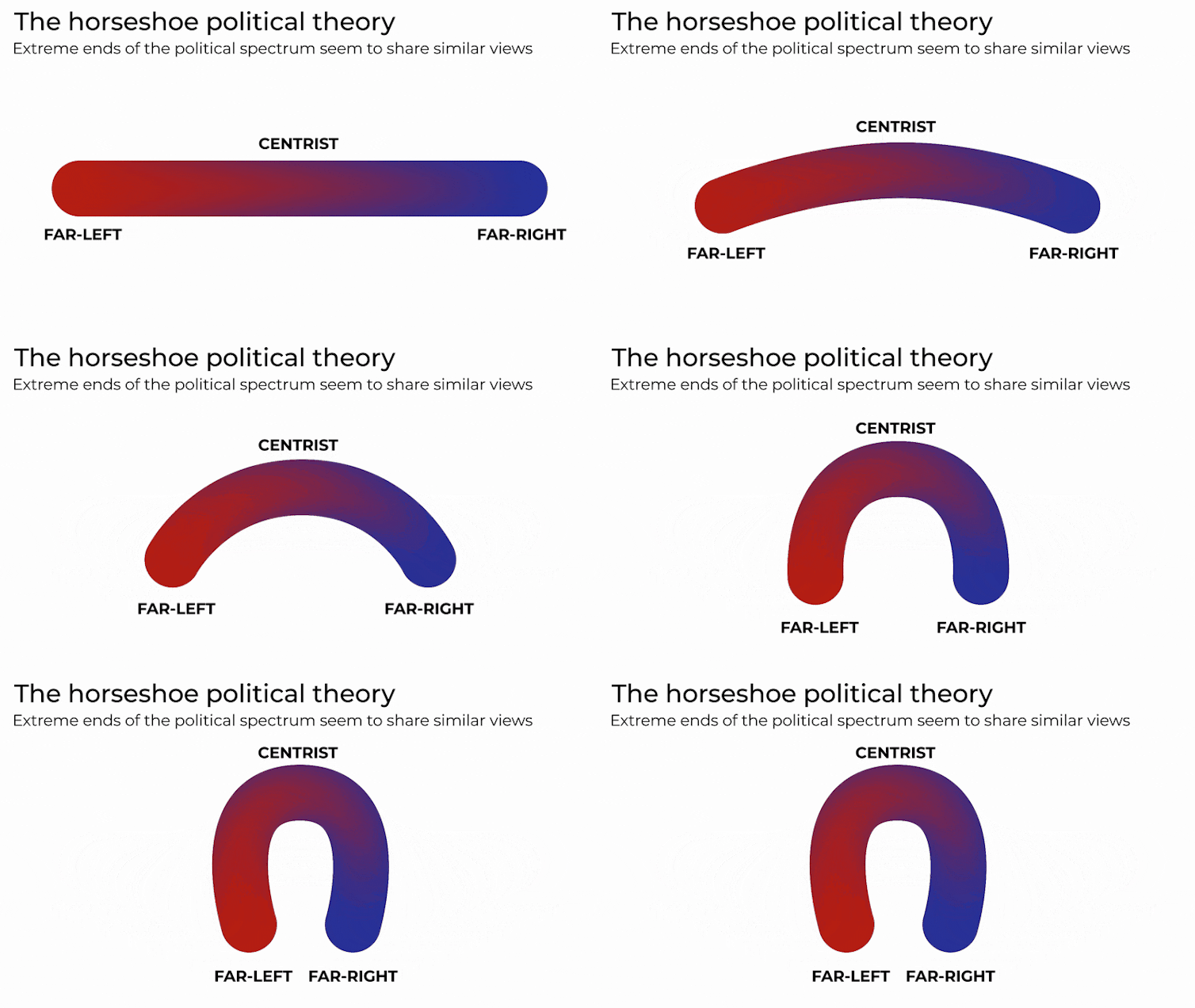
If American politics is truly, as is sometimes theorized, a horseshoe — not a straight-line spectrum, with the far-left and the far-right on opposite ends, but curved, so the two extremes meet — then this might be the issue that provides the ultimate proof.
The Foreign Intelligence Surveillance Act, or FISA, was enacted in 1978, as a way to rein in government surveillance after the abuses of the Nixon era. However, it has been amended over time into offering intelligence agencies even greater powers than the ones the original law was trying to curb.
Section 702 was added as part of a bipartisan FISA amendment passed in 2008, in order to formalize a program that the George W. Bush administration had already been carrying out in the wake of 9/11. The provision gives intelligence agencies the authority to surveil non-Americans located abroad, if they have reason to believe that the surveillance will produce important foreign intelligence information.
Under the law, the government can compel “electronic communication service providers” — think AT&T, Verizon, Google, Microsoft, etc. — to assist them in collecting the phone, email, text, or other communications of the foreign target. The Foreign Intelligence Surveillance Court (FISC) has to annually approve the broader categories of foreign intelligence that can be collected under Section 702, and the processes used to collect them, but no judge has to sign off on each specific target.
The law makes very clear that it cannot be used to “intentionally target any person known at the time of acquisition to be located in the United States,” or to “intentionally target a United States person reasonably believed to be located outside the United States” — which means it cannot be used to target a U.S. citizen anywhere, whether they are in the country or abroad.
But there is a “but.” Non-Americans located abroad often text, or email, or call American citizens. If an intelligence target is communicating with an American, the Section 702 surveillance will also sweep in the American’s side of the conversation, which is known as “incidental collection.” These communications are then stored in the same vast database that houses everything collected under Section 702; if agencies like the FBI or CIA are carrying out an unrelated investigation later, they can search the database for an American’s name, and retrieve any incidentally collected communications that were picked up through the Section 702 process.
This is known as a “backdoor search.” There is an approval process before doing this but, once again, no judge is involved — which means there is no warrant given out before the government accesses an American’s communication, as there normally would be. Critics of Section 702 argue that this is a violation of the Fourth Amendment, which protects against “unreasonable searches and seizures.” Proponents of the law say it is a vital national security tool.
Both sides bring emotionally charged anecdotes to the discussion. Critics point to the revelations that the FBI searched the Section 702 database to see if there were communications linked to more than 100 different Black Lives Matter protesters, as well as to several January 6 rioters, seemingly attempting to use information collected under Section 702 for domestic law enforcement investigations, even though FISA is only meant to be a foreign intelligence tool.
Proponents argue that the ends justify the means, pointing to the major intelligence victories that the government says it has used Section 702 to score. According to the CIA, it was Section 702 surveillance that allowed the U.S. to uncover a planned terrorist attack at a Taylor Swift concert in Austria, saving countless lives.
These arguments don’t track along the normal partisan lines. “Our government is spying on us,” Rep. Rashida Tlaib (D-MI) declared on the House floor in April, as part of a Section 702 debate. Sen. Mike Lee (R-UT) used almost identical language on X last week, writing: “No more government spying on law-abiding Americans. We need to reform FISA 702.”
On the other side of the debate, Rep. Brian Fitzpatrick (R-PA) argued: “I cannot, for the life of me, understand what is left to object to on this tool because I can promise you that if we were having this debate a week after 9/11, there wouldn’t be a single soul on this floor voting against this bill.”
Rep. Jim Himes (D-CT) has invoked a similar threat. “Three months from now, if FISA 702 is dark and there’s a bomb in Grand Central, there will be very little doubt in my mind … that that occurred because we shut down our most important counterintelligence,” he told Politico.
The horseshoe is starting to come into view. Questions of foreign policy and national security are increasingly starting to split both political parties internally — to the point that it can be hard, frankly, to identify what either party’s foreign policy actually is. A President Vance or Rubio on the one hand, or a President Ocasio-Cortez or Newsom on the other, likely wouldn’t handle questions of taxation, or abortion policy, or health care, or LGBT rights much differently than another of their co-partisans.
How would they handle the conflict in Iran? Or Ukraine? Or a potential Chinese invasion of Taiwan? I honestly think there would be four different answers, pointing to a much larger degree of division within the parties on foreign policy questions compared to the disagreements on domestic policy, which are more differences of degree than kind. Heck, Vance and Rubio are currently serving in the same administration, and no one thinks their Iran policy would be the same; meanwhile, the idea of an Ocasio-Cortez approach to Taiwan is so uncertain that she doesn’t even seem to know what it would be herself.
The Section 702 debate is an interesting proxy for these divides, which pit hawks against doves, but even more than that, seems to lie on the crucial axis of modern American politics, around which many of these foreign policy debates (among others) seem to revolve: establishment vs. anti-establishment, trust in experts and authority vs. skepticism, technocrat vs. populist, stuffy vs. crunchy. These are less questions of policy orientation, as economic and social questions are, than questions that get at a broader worldview: how one views the government/the elite/those in charge, and whether they view themselves as among that group or positioned against it.
Section 702 is the ultimate of these horseshoe issues because unlike other internal party splits, where the fights are fairly lopsided — yes, there are some on the far-right who are opposed to the war in Iran, but there aren’t many — this one actually is heavily contested within both parties, forming an exact mirror image of each other.
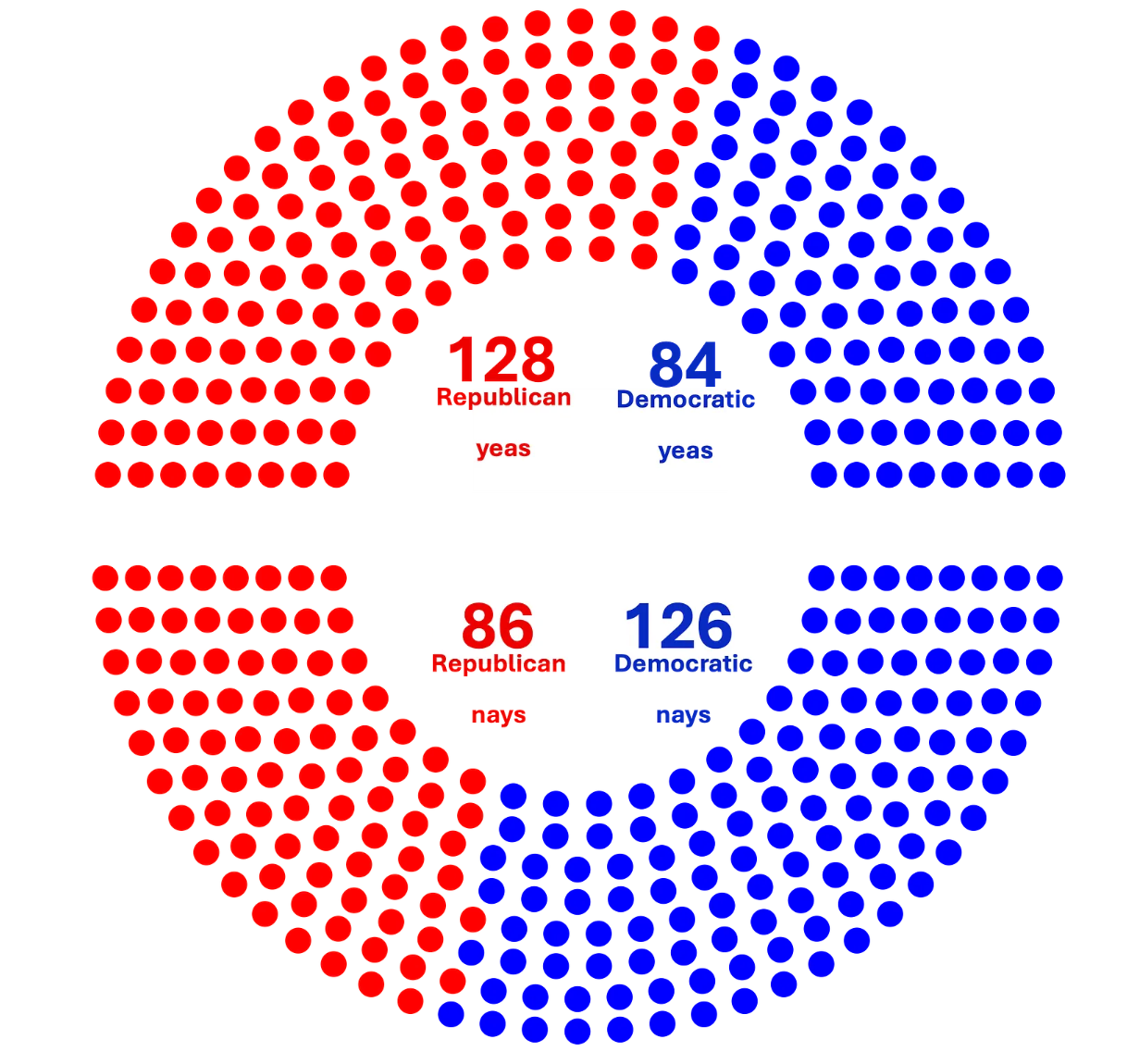
I can prove it. The last time Section 702 was up for reauthorization, in April 2024, the House voted on an amendment by right-wing Rep. Andy Biggs (R-AZ) to require government officials to obtain a judicial warrant before accessing Americans’ communications swept up as part of Section 702 surveillance.
128 Republicans voted for the requirement, while 86 Republicans voted against it. 84 Democrats voted for the requirement, while 126 Democrats voted against it. That means the proposal failed in a perfect 212-212 tie, the rare issue that divides Congress evenly — but not along party lines. Civil libertarians on both sides of the aisle argued that it would help cure potential Fourth Amendment issues with the status quo, while national security hawks in each coalition said that it would slow down law enforcement, potentially impeding critical investigations into thwarting urgent attacks.
Now that Section 702 is up for renewal again, with its most recent authorization set to lapse on Friday, we can also see another familiar facet of these establishment/anti-establishment issues coming into play: where you stand depends on where you sit. As it turns out, for many American politicians, whether or not they are reflexively anti-government seems to depend a lot on whether their party controls the government.
President Trump himself was once a leading critic of Section 702, an outgrowth of his skepticism of the intelligence apparatus that carried out investigations of him in the past. “KILL FISA,” Trump urged Republicans from his Biden-era wilderness in 2024. Now that he leads the intelligence apparatus, however, Trump has urged the GOP to renew Section 702 without any changes, which he has framed as a humble act of sacrifice on his part.
“While parts of FISA were illegally and unfortunately used against me in the Democrats’ disgraceful Witch Hunt and Attack in the RUSSIA, RUSSIA, RUSSIA Hoax, and perhaps would be used against me in the future, I am willing to risk the giving up of my Rights and Privileges as a Citizen for our Great Military and Country!” Trump wrote in April.
Many GOP lawmakers have followed suit: for example, House Judiciary Committee chairman Jim Jordan (R-OH) wrote last year that Congress should pass a warrant requirement as part of the next FISA renewal, but has now reversed himself to push for the clean reauthorization that Trump has called for.
However, other members of the House GOP right flank have held firm, uniting with Democrats — who, even before the Pulte appointment, now have many more opponents of Section 702 reauthorization in their ranks than during the Biden era — to defeat two April attempts by Speaker Johnson to extend the surveillance tool, before both parties agreed on the short-term extension that is set to lapse this week. Seven Senate Republicans then sided with Democrats to block a procedural vote in the Senate on advancing FISA renewal as well.
As part of the 2024 Section 702 reauthorization, Democrats and Republicans ended up agreeing on 56 bipartisan reforms, which the FBI has said led to a dramatic drop in the number of Americans who its agents searched for in the Section 702 database. The two parties were once again discussing various reforms, before Trump threw a wrench into the process with the Pulte appointment.
Unless a short-term patch is approved by Friday night, the Section 702 authority is poised to expire — with the asterisk that the FISA court has already approved use of Section 702 through March 2027, which means the authority will technically persist until then, instead of going completely dark this weekend. (However, it will have much less secure legal footing, which means tech companies could refuse to comply when the government demands they hand over communications.)
Any resolution of the dispute will likely depend on Trump naming a more conventional DNI, though that will only punt the broader questions about Section 702 for a few more years, not answer them. As both party platforms on national security continue to morph, with anti-establishment voices appearing to gain a bigger foothold on both sides, it is possible that the absence of any Trump personnel spats will make the next Section 702 fight even more contentious, not less.
The truth is, the Trump-specific fights (and Trump’s unique power to keep his party in lockstep) are covering over the most interesting divides on FISA, uniting each party and pushing them both back to their corners. It’s the next reauthorization debate that might split the two coalitions apart, dredging up one of the few issues that so comprehensively divides both parties.
Excellent What a lot of people don't realize is Jim Comey was involved in an earlier iteration of this
Bush had enhanced the Patriot act to allow for more intrusions into US citizens communications. He wanted to renew it, only his AG, John Ashcroft was in the hospital in serious condition. He sent Gonzalez to get Ashcroft's signature, Mueller found out about it and called Comey. Comey went to the hospital to stop it but Ashcroft was strong enough to say no
Then Bush called Comey into his office. Comey, as acting AG could sign off on it. Comey told Bush no and said he would resign first. It was even worse. Mueller and other senior justice department officials said no as well. Bush decided he didn't want another Saturday night massacre on his hand and let the matter drop.
The divide on this exact issue has less to do with ideology or party, and more to do with each individual politician’s personal relationship with the national security establishment. That is what really lends particular interest to the positions being taken by Trump and his followers. They all tended to begin with a certain antagonism toward establishments of every description because the establishments appeared to stand more often than not in opposition to Trumpism. But then Trump first achieved control of the main right-wing party, and then of a unified right-wing federal government. At this point he characteristically began to identify with the establishment with himself, rather in the manner of Louis XIV.
Not all of the populist Republicans are following him that far. They must be holding back at least partly because they realize that Trumpism can’t last forever, and they don’t want an unrestrained national security establishment under their political adversaries’ control when Trumpism becomes manifestly untenable.