


Quick flag for my St. Louis readers: I’ll be back home on October 13 for a public event at WashU looking ahead at the fast approaching midterm elections. Click here for more details and to RSVP. Looking forward to seeing you there!
Let’s start this morning’s newsletter with a pair of questions I received last week:
Q: Is it legal for Trump to promise that if Republicans win in November, he will give everyone $5,000? How can this even be done?
Q: What makes it legal for the president to offer $5,000 of tax payers money to every citizen if his party “wins” in the November elections? I thought it was illegal to pay for votes.
This promise was the signature policy initiative of President Trump’s speech at the Republican midterm convention last month.
“If the Republicans win the House of Representatives and the United States Senate, both of them…because of our tremendous strength and success economically, I will issue a dividend to every adult citizen in the United States of America for $5,000,” Trump proclaimed.
“So if the Republicans win, you win with us and you get $5,000,” he said. “We’ll call it the Trump dividend,” he added. Trump repeated the promise in a Truth Social post on Saturday.
There is much about this pledge that is murky, at best.
For one thing, Trump said that the “one condition” for the money — besides Republican control of Congress — would be that it “must be spent in the United States of America.” It is unclear how the federal government would be tracking how Americans spend their money.
For another, Trump claimed that he wouldn’t need congressional approval to send the checks, in which case it is unclear why their disbursement would hinge on who controls Congress next year. (If Trump really can send $5,000 to every American adult unilaterally, why not do it now?)
It is also unclear where the money for this would come from: Vice President JD Vance suggested that the dividend would be paid for by tariff revenue, but since Trump took office, tariffs have put about $426 billion in the U.S. coffers (more than $100 billion of which has had to be refunded). There are about 240 million adult citizens in the U.S., which means it would cost around $1.2 trillion to send each of them $5,000. Moving forward would likely blow an enormous hole in America’s already ballooning deficits.
And then there is the legal question.
Can Trump promise $5,000 to every adult?
The questioners are right that it is illegal to promise people money in exchange for their votes. Here’s 18 U.S. Code § 600:
Whoever, directly or indirectly, promises any employment, position, compensation, contract, appointment, or other benefit, provided for or made possible in whole or in part by any Act of Congress, or any special consideration in obtaining any such benefit, to any person as consideration, favor, or reward for any political activity or for the support of or opposition to any candidate or any political party in connection with any general or special election to any political office, or in connection with any primary election or political convention or caucus held to select candidates for any political office, shall be fined under this title or imprisoned not more than one year, or both.
Some of you may remember Elon Musk getting caught up in a state version of this same prohibition, when he set up a raffle contest to give away $1 million checks to people who had voted in the 2025 Wisconsin Supreme Court election. (The state’s election commission found that he likely violated Wisconsin law, though a Democratic prosecutor declined to bring charges.)
The crucial U.S. Supreme Court precedent here is a 1982 case called Brown v. Hartlage, which involved a candidate for a county commissioner role in Kentucky who promised to lower his own salary if elected, thereby saving taxpayers money. His opponent sued under a Kentucky version of this same law, prohibiting candidates from offering material benefits in exchange for votes.
The Supreme Court ultimately ruled unanimously that the promise was legally permissible. The justices reasoned that the candidate had not offered “some private payment or donation” from “his own pocketbook” in exchange for voter support, but merely had signaled “his intention to exercise public power in a manner that he believed might be acceptable to some class of citizens.”
The court also noted that the promise was “made openly, subject to the comment and criticism of his political opponent and to the scrutiny of the voters.” The justices added:
If Brown’s expressed intention had an individualized appeal to some taxpayers who felt themselves the likely beneficiaries of his form of fiscal restraint, that fact is of little constitutional significance. The benefits of most public policy changes accrue not only to the undifferentiated “public,” but more directly to particular individuals or groups.
Like a promise to lower taxes, to increase efficiency in government, or indeed to increase taxes in order to provide some group with a desired public benefit or public service, Brown's promise to reduce his salary cannot be deemed beyond the reach of the First Amendment, or considered as inviting the kind of corrupt arrangement the appearance of which a State may have a compelling interest in avoiding.
A State may insist that candidates seeking the approval of the electorate work within the framework of our democratic institutions, and base their appeal on assertions of fitness for office and statements respecting the means by which they intend to further the public welfare. But a candidate’s promise to confer some ultimate benefit on the voter, qua taxpayer, citizen, or member of the general public, does not lie beyond the pale of First Amendment protection.
It seems to me that this logic would apply to Trump’s promise just as it would to Brown’s — or as it would to Joe Biden’s promise of stimulus checks during the 2020 campaign, among other past presidential pledges. The Supreme Court has clearly distinguished between private bribes and public pronouncements of policy plans, the benefits of which would be spread out across the electorate.
But I wanted to talk about this today because I actually think the most interesting part of this promise isn’t the legal question: it’s that basically nobody believed it.
Trump has gambled away America’s trust
You can understand the logic of Trump’s $5,000 promise.
We know that Trump won the presidency in 2024 in no small part because of fond memories of the economy during his first term, and that the Covid-era stimulus checks sent out in 2020 helped cement that impression. From a New York Times poll in 2024:
When asked the one thing they remembered from Mr. Trump’s time in office, a vast majority of positive comments referred to the state of the economy. Many specifically remembered the stimulus checks with his signature printed on them that were sent to tens of millions of Americans during the waning days of his presidency.
This theme came up again and again in interviews with the key demographic groups Trump gained ground among in 2024, including young voters, Black voters, and Hispanic voters. People remembered the stimulus checks.
Unfortunately for Trump, he seems to have dangled this memory in front of voters too many times to be believed now. Over the past two years, Trump has floated a $5,000 “DOGE dividend” for every American and $2,000 “tariff rebates,” among other promises of cash that never materialized. (He also said on Friday that he plans to use an existing fund to send $100 checks to seniors using Medicare.)
The result of all these promises has been a loss of trust. In a recent YouGov poll, 61% of likely voters said they did not believe that the president would deliver on his “Trump dividend” promise.
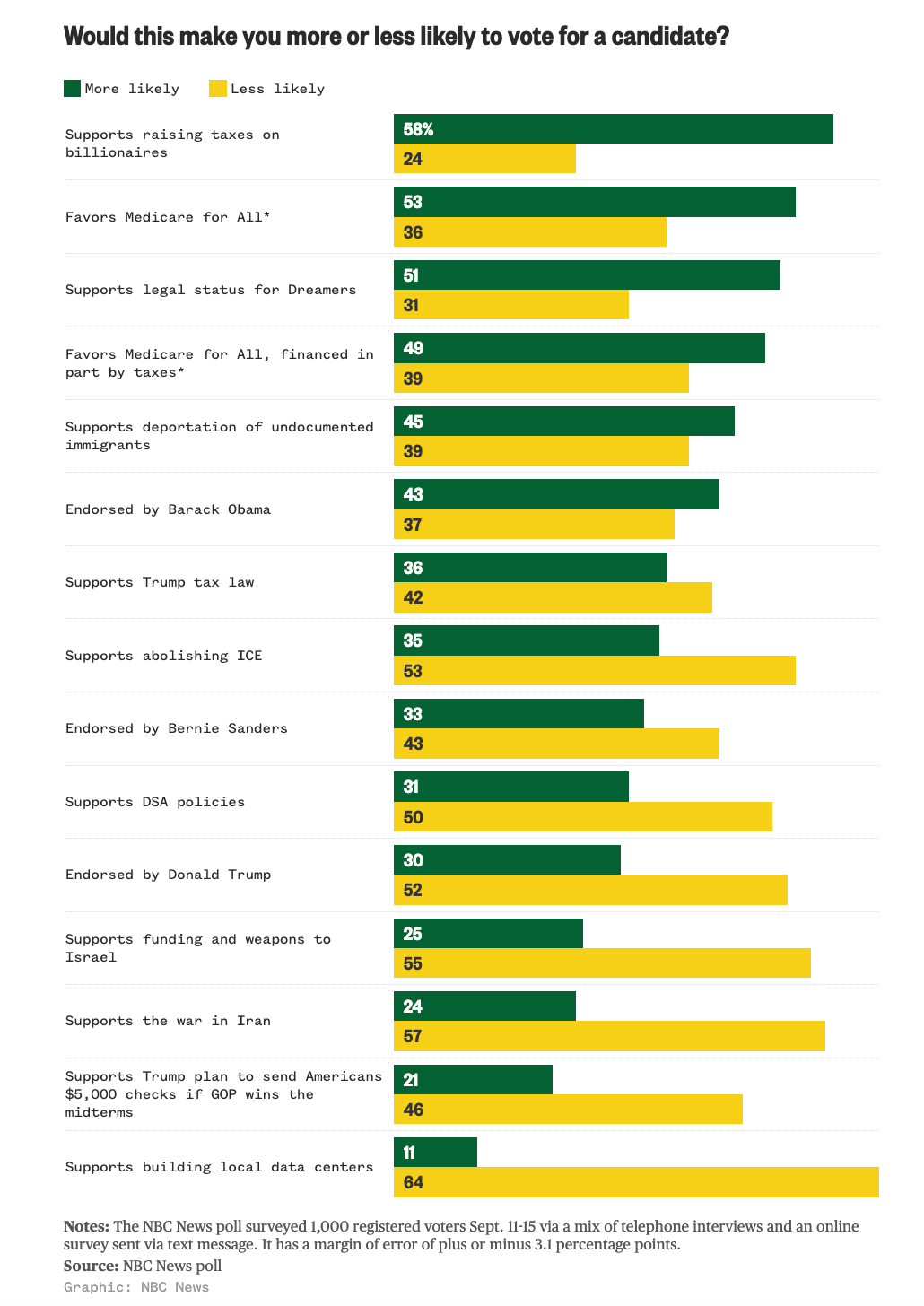
An NBC poll found that 46% of voters said a candidate supporting Trump’s plan for $5,000 checks would make them less likely to back that candidate — a somewhat remarkable finding considering that the plan in question is “giving you free money.” Only 21% said that a candidate supporting the plan would make them more likely to give that candidate their vote, less than any other policy proposal polled except for building local data centers.
The failure of the “Trump dividend” promise to win over the American electorate is representative of Trump’s inability to change the narrative and regain voters’ trust throughout this midterm cycle.
The promise was made during the GOP midterm convention, which was itself another of Trump’s ideas to gin up Republican enthusiasm and reverse the party’s fortunes.
There is a long history of political parties receiving a “convention bounce”: an uptick in support, however brief, after holding their presidential nominating convention.
Trump seems to have inspired the opposite: a rare reverse convention bounce. Below, I’ve charted two key measures of the political environment: Trump’s net approval rating (his approval rating minus his disapproval rating) and the Democrats’ advantage in generic ballot polls (how many more voters say they plan to vote for a Democrat, instead of a Republican, for Congress).
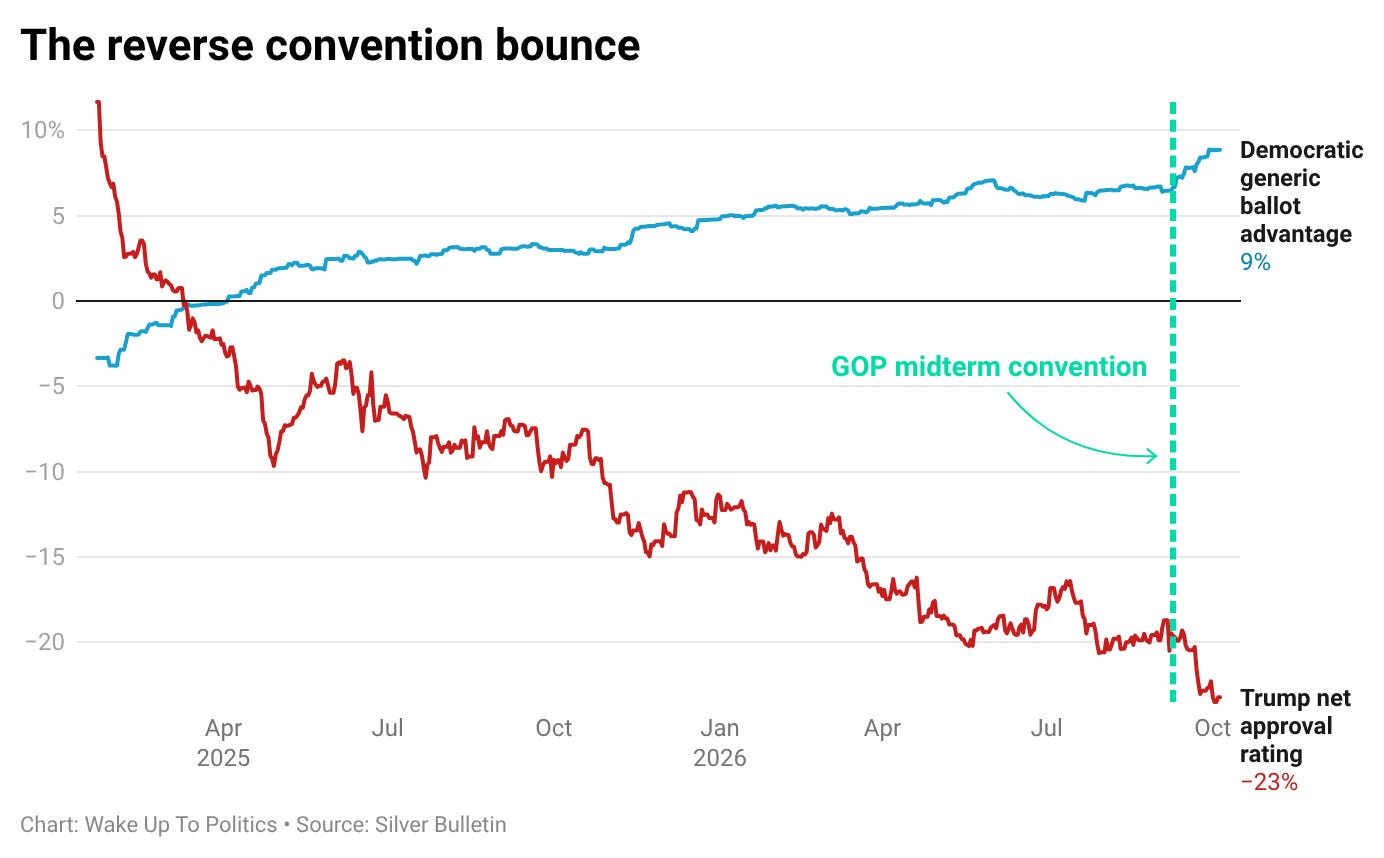
As you can see, both measures had been flat for several weeks before the midterm convention (which is represented by the green dotted line). Then, right after the convention was held, Democrats immediately started performing better on the generic ballot question and Trump’s approval rating immediately took a hit.
Democratic numbers have also soared in individual races in the subsequent weeks, including a New York Times/Siena poll this weekend that showed Democratic Senate candidates leading in Texas, Alaska, and Ohio — and tied in Kansas, a state that hasn’t sent a Democrat to the Senate since 1932.
“To be honest with you, the numbers — when we did that convention — it dropped our numbers,” Texas Republican Senate nominee Ken Paxton privately told a group of conservative donors last month, per a recording obtained by the Times. “Everybody’s numbers dropped.”
As Election Day looms, Trump is playing all his greatest hits, including promising Americans free money. Unlike in 2024, however, voters don’t seem to be buying what he’s selling.
Just a thought ~ if President Trump miraculously comes through on his dividend promise, why don’t Democrats pledge to patriotically spend the $5,000 dividend “in America”. ~ Keep $1,000 and open a savings account or contribute to their retirement fund or contribute to a favored Non-profit. And then send $4,000 to their local Democratic Senate Candidate. ~ A Trump Dividend well spent, eh?
Is it possible that the “negative convention bounce” might be caused, in part, by pollsters shifting from “Registered Voter” to “likely voter” screens after Labor Day?