


House Speaker Mike Johnson knows you think this has been an unproductive Congress, and he’s here to assure you: It has actually been a record-breaking Congress!
“The media won’t tell you this, but this has been one of the most productive Congresses in the history of the institution since 1789,” Johnson declared at the Republican midterm convention earlier this month. “In the House, we passed over 900 pieces of legislation, and that includes the SAVE America Act four times. It’s been the most productive Congress in eighty years, and we’re not done yet.”
Johnson is correct that the House has passed more than 900 pieces of legislation since the 119th Congress convened in January 2025. In fact, by the time Johnson excused the House for an extended recess last week, that number had gone up to exactly 1,000.
But he is not correct that it is the most productive Congress in eighty years (or even close), according to a Wake Up To Politics analysis of legislative data.
Below, I used Johnson’s own metric — pieces of legislation passed — to compare how productive the House has been this Congress versus Congresses past. To be fair to Johnson, I only included legislation passed through September 30 of the second year of a Congress, since lawmakers will often get a lot done in the lame-duck (post-election) session, and obviously this year’s Congress hasn’t had that yet. (The House is not expected to be back in Washington before the election, so there should be no difference between using today’s date, September 23, for this Congress and September 30 for previous Congresses. No more bills are set to pass the House this year before September 30.)
In the end, I did not need to go back eighty years. I only went back thirty, because the current House was so quickly outpaced by its predecessors. The House has passed more pieces of legislation this Congress than it did by this point in the previous three Congresses — but fewer pieces of legislation than it passed in almost every recent Congress before that. This is not the stuff of records.
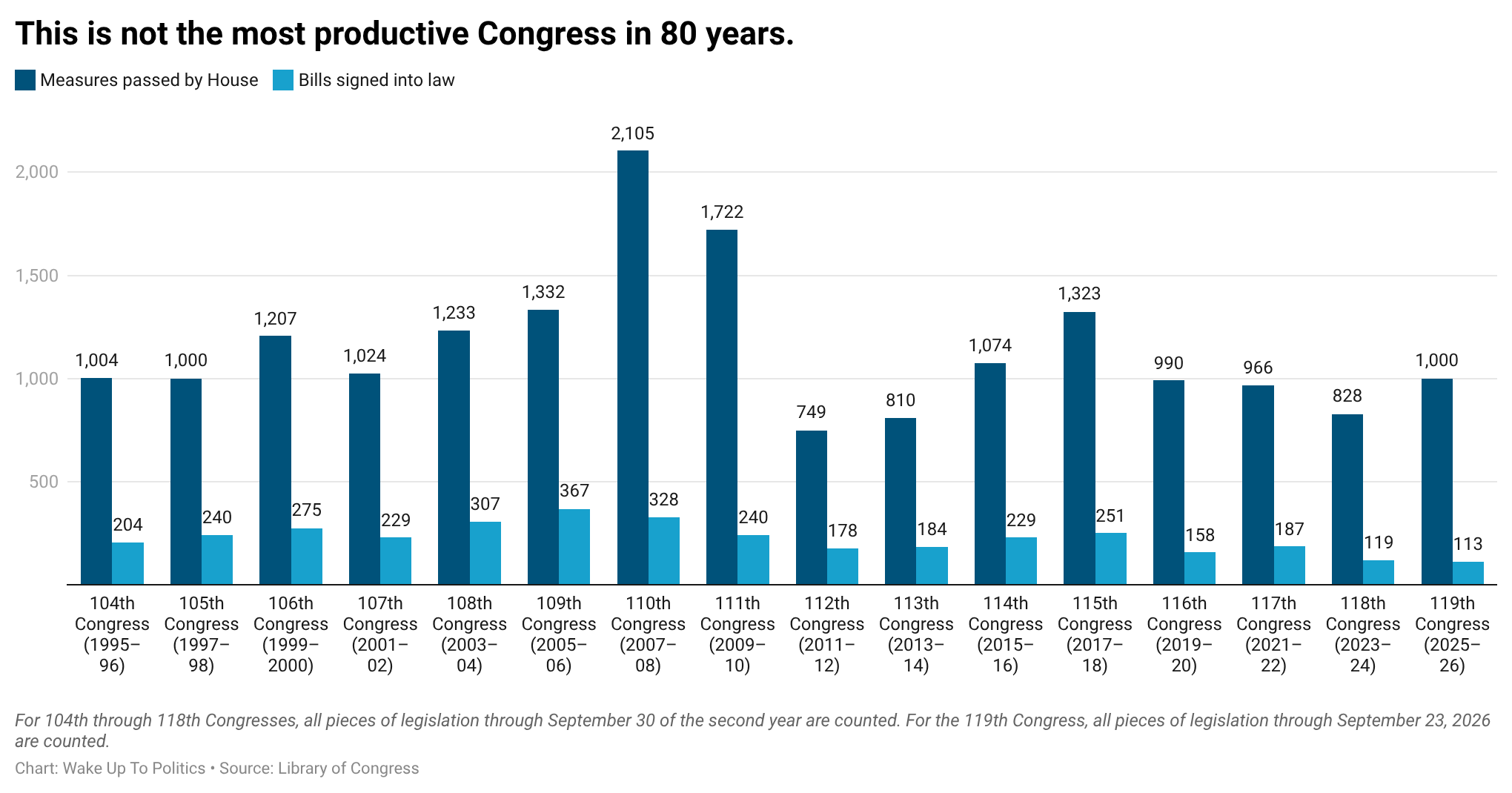
Although it was not the metric Johnson used, I also included the number of bills signed into law by this point in each Congress. By that metric, the 119th Congress fares even worse, passing fewer bills into law (just 113) than any preceding Congress, partially due to rising tensions between the House and Senate (despite the fact that the two chambers are controlled by the same party).
All that said, I don’t think the number of pieces of legislation a chamber passes is actually a good way to judge its productivity, because it treats every piece of legislation as equal — even though that’s clearly not the case.
That ends up skewing the count in both directions. It undercounts productivity because a single bill can often really be several bills stapled together; this metric only counts a 1,000-page, multi-bill omnibus package as a single measure. And it overcounts productivity, because it includes all sorts of bills and resolutions that are purely ceremonial and not really helpful in measuring what Congress is getting done.
Clearly, the One Big Beautiful Bill Act (which made major changes to health care, tax policy, defense spending, border security, and more) should not be given equal footing with a ceremonial resolution mourning the death of Lindsey Graham (which counts towards the 900+ pieces of legislation Johnson touted).
By my count, the House passed 83 pieces of legislation last week before leaving for its pre-election recess.
I think you can categorize these measures into three categories, in descendfing order of importance.
At the bottom, Tier 3, you have not just the ceremonial resolutions or internal administrative work (like a resolution formalizing a new congressman’s committee assignments), but also hyper-local pieces of legislation that can’t exactly be said to carry national importance.
The bill revising the water rights settlement between the Crow tribe and the state of Montana. The bill parting ways with various tracts of public lands in northern Nevada. The bill — I’m not kidding — naming a bandstand at a National Historic Site in the U.S. Virgin Islands. (All three of these bills, as well as all the bills listed in each category below, were passed by the House last week.)
These are pieces of legislation that would seem more fit for a city council than a national legislature, except they happen to impinge on federal land, which means they require Washington’s sign-off. These are the congressional equivalent of fixing potholes, except (in some cases) fewer people will be impacted.
Next, you move up to Tier 2. These are bills that might not be salient to hot-button issues, and might only impact a specific slice of Americans — but at least that slice is spread out, with at least some national relevancy as opposed to relevancy only to a small geographic community.
Here, you might include the Kay Hagan Tick Reauthorization Act, which re-ups various CDC programs aimed at addressing mosquito- and tick-borne diseases. (The bill, named for the late Sen. Kay Hagan, who died of the tick-borne Powassan virus, has also passed the Senate, which means it’s headed for the president’s desk.) Or the Safe Beaches, Safe Swimmers Act, which allows local governments to provide lifeguard services to the National Park Service if swimming areas under federal jurisdiction are dangerously short-staffed. Or the bill that would make it easier for prisoners leaving incarceration to work at port facilities, jobs that are crucial for the supply chain but for which there are currently large labor shortages.
Few of us would name these issues as our most pressing concerns, but all things considered, we would rather have tick-borne diseases reduced, national beaches be safe to swim in, and port facilities fully staffed. Congress is often quietly working to ensure that these aren’t things we have to be mindful of day-to-day. (Tick-borne disease cases have been climbing this year, however, so perhaps that one is a bit more societally salient, even if it isn’t politically.)
Finally, you have Tier 1, pieces of legislation that actually speak to national issues that Americans frequently name as among their top concerns. The 119th Congress has only passed a handful of truly major pieces of legislation — the One Big Beautiful Bill Act, say, or the 21st Century ROAD to Housing Act — but bills don’t need to rise to that level to reach Tier 1.
For example, last week, the House unanimously passed the Science of Reading Act, which would require that federal literacy grants preference programs that use phonics, a method focused on sounding letters out, which most researchers have found to be the most effective way to teach kids how to read (though there are some that dissent).
Education is a big issue. America is also in the throes of a brewing literacy crisis: just this month, a global exam found that the reading scores of American 15-year-olds had sunk to almost their lowest point in 25 years; another recent study found that reading scores were down last year in 83% of U.S. school districts compared to 2015. More than 40 states have already passed bills encouraging phonics; this bipartisan House-passed bill would mark a national step towards addressing reading education.
In its last week, the House also unanimously passed three bills to address America’s drug crisis. One bill, Tyler’s Law, would require the Department of Health and Human Services to issue guidance instructing hospitals to implement fentanyl testing as a routine procedure for patients who come into an emergency room experiencing an overdose. (The bill is named for Tyler Shamash, 19-year-old Californian who was tested for other drugs, but not fentanyl, when he arrived at an ER, despite his mother asking three times. He died the next day.)
The other two would increase criminal penalties related to manufacturing fentanyl and xylazine, a drug known as “tranq.” Synthetic opioids (primarily fentanyl) account for 60% of U.S. overdose deaths, killing nearly 50,000 Americans. An additional 6,000 Americans died from xylazine in 2023. These House bills would seek to address those tragedies.
Notably, the House also took bipartisan action last week on the Jeffrey Epstein investigation (voting to hold billionaire investor and Epstein associate Leon Black in contempt of Congress after he defied an Oversight Committee subpoena); politicization of disaster aid (voting to prohibit FEMA from discriminating on the basis of political affiliation); clean air (voting to reauthorize a program aimed at reducing diesel emissions); and taxpayer fraud (voting to codify the Trump administration’s National Fraud Enforcement Division). The first two of these measures passed unanimously; the clean-air bill was opposed by 79 Republicans, while the anti-fraud bill was opposed by 72 Democrats.
To cover Congress fairly is to acknowledge that more of these Tier 1 bills pass than is often portrayed in most news outlets, which covered last week’s House passage (in a bipartisan 262-159 vote) of the Russian sanctions package, but little else of the legislature’s parting output. These bills, if signed into law, would mark real, substantive changes in American public policy on issues that voters care about. Americans deserve to know when their representatives are legislating on these areas.
But full coverage of Capitol Hill also requires acknowledging how many issues are not making it to the House or Senate floor, from affordability to health care to immigration to the imminent collapse of Social Security.
The House also left town without voting on an AI bill; the closest they came was in approving the Ratepayer Protection Act, a bill that might be categorized as Tier 1.5: a measure addressing a hot-button issue, but not in a way that will clearly do anything. The measure, which was approved 417-3, would require state utility commissions to consider mandating that the energy costs for AI data centers are paid by the companies behind the data centers rather than being passed off to nearby residents. However, the measure doesn’t require anything beyond that; the state utility commissions are able to consider such a mandate, and then promptly decide against it.
The Senate’s docket has similarly been full of issues that few Americans name as their top public policy concerns, including a failed crypto bill and a bill addressing name, image, likeness (NIL) issues in college sports, which advanced in a 70-21 vote last week. Notably, Democratic and Republican senators are deep in negotiations on a permitting reform deal — an issue that doesn’t sound sexy, but which does speak to affordability, as it could speed up the approval of new energy projects, increasing supply and reducing consumer costs.
The Senate could embark on its pre-election recess as soon as this week, although there is talk of the chamber staying longer if a permitting deal materializes. There has also been some chatter about the House returning to Washington to also approve a permitting deal if one passes the Senate, though Punchbowl News has reported that’s unlikely.
That means the House will have finished out its session with a few notable, but under-reported accomplishments — but also an agenda littered with small-ticket items, from hyper-local fixes to bills eliminating the penny (the second time the House has voted on such a bill this Congress) and designating the T. rex as the national fossil dinosaur.
To be clear, none of this is new for Congress: in fact, it’s sort of a return to form. Congress used to spend a large portion of its time sifting through petitions from constituents and passing “private bills,” measures that would intervene in one specific person’s situation (their immigration status, veterans benefits, etc.) In the 19th century, hundreds of these private bills would pass a year; Congress has now largely dispensed with that tradition, but often it seems like it has expanded its aperture only slightly wider, spending an inordinate amount of time on issues that aren’t quite applicable to just one person, but still don’t affect much more than one tiny community.
This is all the more glaring now because so many Americans are so deeply frustrated with the state of the country. Just 21% of Americans are satisfied with the way things are going in the United States, per Gallup. 17% trust the government to “do what is right,” per Pew. Both statistics have collapsed in recent years.
There has never been a better time for Congress to act as a national forum for pressing policy issues, rather than a local city council managing land sales and renaming bandstands. Lawmakers are fixing potholes while Americans worry the country is driving off a cliff.
Everything with the GOP these days is "the biggest", "the best", "the most".
But, when they drop their trousers and you get a good look....
This quote, by Mark Twain, “says” it all…”Suppose you were an idiot, and supposed you were a member of Congress; but I repeat myself.”