


The undisputed king of the modern presidential biography is Robert Caro, who has so far published four out of his five-book series on Lyndon Johnson.
Caro has also written a great little book called “Working,” which gives readers a glimpse into his process and describes how he has been able to chronicle Johnson’s life in such meticulous detail.
In the book, Caro writes about his personal motto as a historian (“Turn every page”) and how it was tested upon walking into the Lyndon B. Johnson Presidential Library for the first time. This is the sight that greeted Caro, the same one that you’ll see if you visit the library, too:
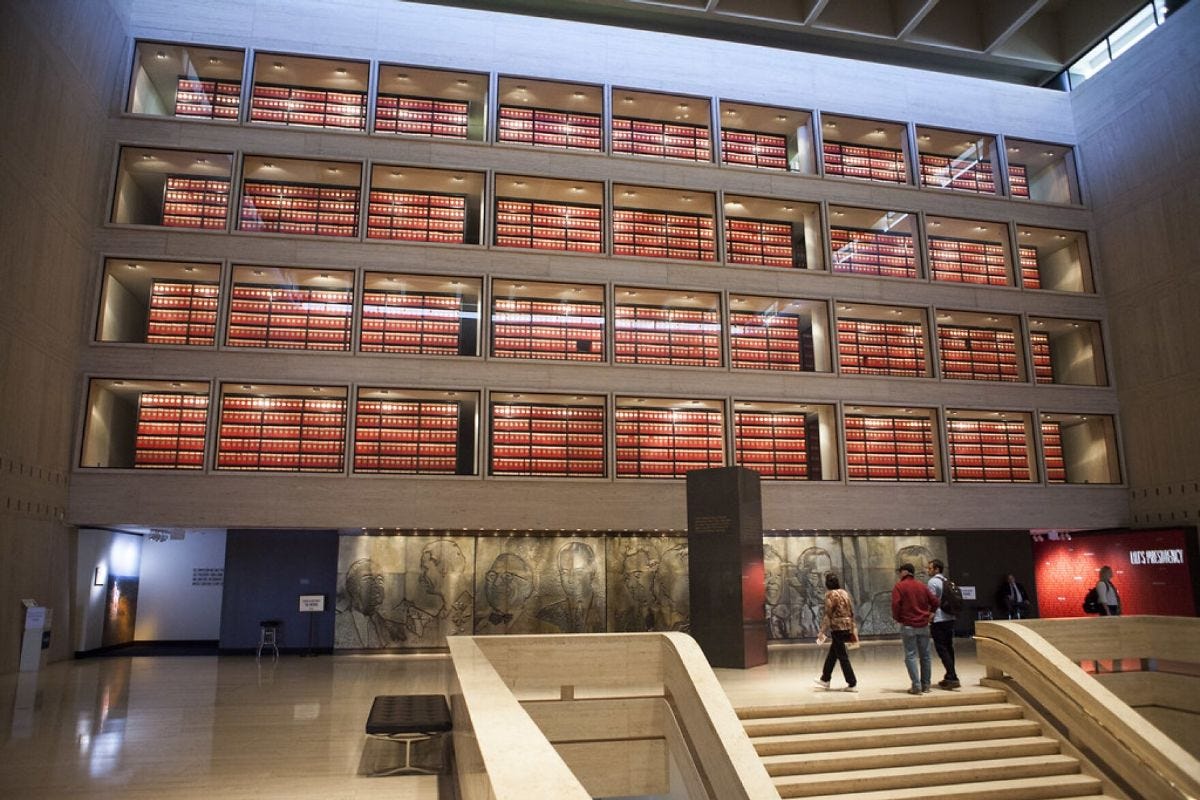
Each of those red things? Those are boxes. The library has more than 40,000 of them, each holding hundreds of pages of documents. In total, the LBJ Library houses about 43 million pages of records. That’s a lot of pages to turn.
Caro recounts one particular mystery those boxes helped him solve. When reading through LBJ’s papers from his eleven years in the U.S. House (all 349 boxes of them), Caro noticed a shift in how Johnson communicated with other lawmakers starting around the fall of 1940. Before that, Johnson spoke (and was spoken to) like the back-bench junior congressman he was. After 1940, without any change in his formal status, Johnson was treated like a power player, despite his lack of seniority. What changed?
Caro turned every page, until eventually he found a paper trail pointing to a series of $5,000 donations (big money in those days) that Johnson had secretly funneled from Texas businessmen and personally distributed to various congressmen of his choosing. “In that single month, October 1940,” Caro writes, “Lyndon Johnson had raised from Texas, and had distributed to congressional candidates, campaign funds on a scale that dwarfed anything ever given to Democratic congressional candidates from a single, central source.” Johnson had arrived as a force to be reckoned with in Washington.
It is a revealing finding that helps explain how Johnson was able to accumulate power in 20th century Washington. It helps us understand the man, how he operated and called in chits, in ways that started in his early days in Congress and eventually lifted him to the White House. It was also completely unknown until Caro unearthed it — and would have remained hidden if not for the documents kept at LBJ’s presidential library.
For most of American history, this type of discovery would not have been possible, because there was no process in place for what would happen to a president’s records after they left office. Documents from a president’s tenure were considered the personal property of that president. Some presidents took their papers home with them. Some burned them. Sometimes their descendants sold them. Other times, they lost them.
In 1939, Franklin D. Roosevelt became the first president to donate his records to the U.S. government and house them in a presidential library. In 1955, this process was formalized with the Presidential Libraries Act, though the decision to donate records was still left up to each individual president. The three presidents who came after Roosevelt followed his lead and gave up their records. Then, Richard Nixon did not. Congress passed a law in 1974, the Presidential Recordings and Materials Preservation Act, declaring that Nixon’s records specifically were federal property, and he could not keep or destroy them. He had to hand them over to the public. In 1978, the Presidential Records Act (PRA) made it so that all presidents’ records would be public property going forward.
That’s how it’s been ever since. There are now more than 600 million pages of documents in America’s 13 presidential libraries; stack them up and they would be as tall as seven Mount Everests. These documents form an invaluable public record, allowing future generations to understand how decisions were made at critical points in history. A handwritten draft of JFK’s inaugural address is part of that public record; so are the Nixon tapes; so are Ronald Reagan’s diary entries.
If he gets his way, documents from President Trump’s current term might not be.
The Office of Legal Counsel (OLC) at the Justice Department is known as “the president’s law firm.” It’s their job to advise the president on the legality of various actions, which generally means finding a legal rationale for why a president can do whatever he already wants to do. The OLC’s most recent advisory opinion, published earlier this month, is titled “Constitutionality of the Presidential Records Act.”
Over the course of 52 pages, the opinion argues that the 1978 law requiring presidents to hand over their records to the public exceeded Congress’ authority and intruded on the president’s autonomy. And then comes the big reveal on the final page: “For these reasons, the PRA is unconstitutional,” the OLC advises, “and the President need not further comply with its dictates.”
“The OLC opinion…is an earthquake with respect to open government, having huge implications for the ability for all of us to understand what our government has been up to,” Jason R. Baron, the former director of litigation at the National Archives and Records Administration (NARA), which oversees the presidential library system, told me in an interview.
Under the OLC’s interpretation, Baron noted, every president since the PRA took effect in 1981 would be able to take their papers out of government custody.
“The logical implication of the OLC memo is that it effectively ‘locks the doors’ on access to records at those presidential libraries — starting with Reagan — that have been covered under the Presidential Records Act, at least until such time as former presidents weigh in with their intention to keep on deposit those records subject to any restrictions they may wish to impose,” Baron said. “Indeed, the OLC opinion could allow them to remove and even destroy records that have been in the legal custody of the National Archives for the past three decades.”
Presidential records are not transmitted to NARA until the end of a presidency. While the OLC opinion would allow former presidents to take their records back, it imagines a world where Trump wouldn’t have to hand over his second-term records at all. “Under the OLC opinion there appear to be no legal barriers, at least for unclassified White House records, in terms of what President Trump could do with them after the end of his presidency,” Baron told me. “He will be free to do anything he wants with respect to selling, managing, or even destroying many millions of records that OLC says are now his personal records.”
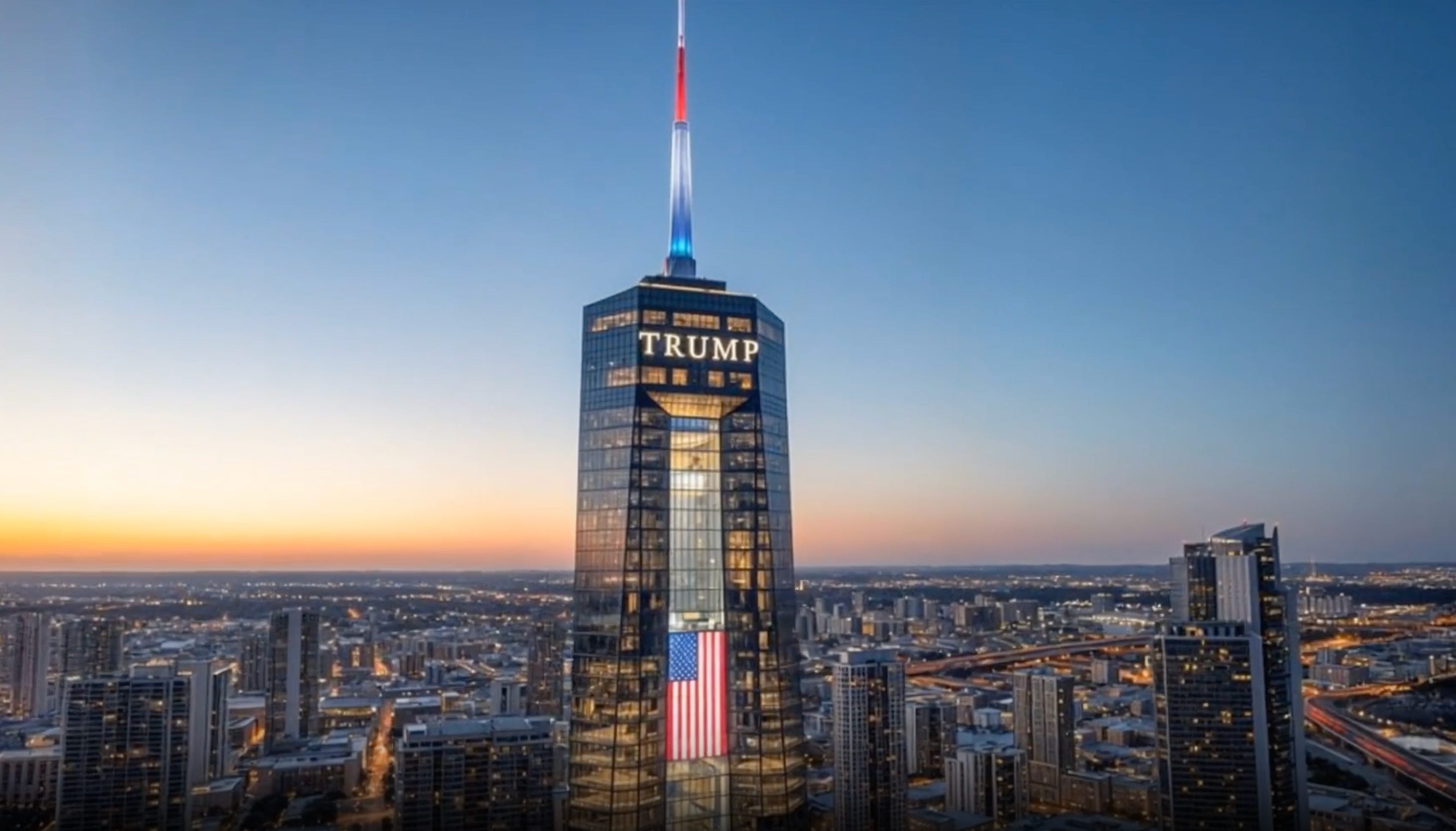
Trump has already begun planning (and accepting donations for) his presidential library, which he has said will be a skyscraper in Miami that will feature the Air Force One jetliner that he received from Qatar and potentially double as an active hotel. But with the OLC opinion, it is possible that it will be a library without any documents — or, perhaps, only specific documents, with Trump claiming the power to cherrypick which papers are made available to historians and which will be his to keep.
The OLC opinion will likely face several legal obstacles. The American Historical Association (AHA) and American Oversight have already filed a lawsuit attempting to preemptively stop Trump from flouting the PRA, as the OLC says he is free to do.
The AHA is an organization of historians, who say their work would be “directly injured” if access to Trump’s records are closed off. American Oversight is a non-profit watchdog group, which has several pending Freedom of Information Act (FOIA) requests for records from Trump’s first term. (Under the PRA, members of the public can start submitting FOIA requests for a president’s records five years after their administration ends, although the president can keep some records sealed for up to 12 years.) If the PRA is unconstitutional, the group notes, then that would have a direct impact on their pending litigation.
The OLC frames the PRA as an unconstitutional attempt by Congress to encroach on presidential power. While Congress can take ownership of the records of the various federal agencies it has created (which it did in the Federal Records Act of 1950), the OLC says, it cannot do the same for “a constitutional office—the Presidency—that Congress did not create and that Congress cannot abolish.”
“Congress cannot preserve presidential records merely for the sake of posterity,” the OLC adds, arguing that Congress does have oversight powers, but that they only extend to subpoenas of records with a specific legislative purpose.
University of Michigan-Dearborn political science professor Mitchel Sollenberger, who literally wrote the book on presidents pushing back against congressional oversight, told me in an interview that the OLC opinion makes a mistake when it frames the PRA as an abuse of Congress’ oversight powers.
“They’re taking the PRA as if Congress intends it to seek information from the president,” Sollenberger told me. “Like, that’s not what’s going on here. It’s not a subpoena. It’s not oversight. They’re not investigating. It is just a neutral, prospective law that seeks to organize [a president’s papers].”
The biggest vulnerability facing the OLC opinion is Nixon v. Administrator of General Services, a 1977 Supreme Court case which upheld the PRA’s predecessor law (which applied only to Nixon) as constitutional. In a 7-2 decision, the court reasoned that the Nixon-era law was not a separation-of-powers violation in part because it wasn’t as if Congress was taking the records for themselves; they still remain in the custody of an executive branch agency.
The OLC opinion gets around this by simply stating that Nixon v. Administrator was “wrong” in its separation-of-powers analysis. (“Historically, it has not been the role of the Office of Legal Counsel to pronounce Supreme Court precedent to be erroneous,” Baron noted. “The Department of Justice and its OLC are bound to follow the law and then interpret the law in ways that can be supported, not unilaterally overrule settled law.”) The issue will likely find its way back to the Supreme Court before long.
In the meantime, Trump’s plans remain an open question. “President Trump is committed to preserving records from his historic Administration and he will maintain a rigorous records retention program,” White House spokesperson Abigail Jackson told me in an email.
Jackson noted that the White House email system prohibits messages from being deleted, and said that Trump would keep that system in place. “The administration is already discussing with NARA how to move forward,” she said.
However, Jackson did not commit to doing what all of Trump’s recent predecessors have done: accepted the PRA as law and followed its requirements. While she said that Trump would preserve his records, she did not say that he would make all of them publicly available, potentially leaving room for him to pick and choose what to keep open for historians.
After all, the OLC said that its opinion was put together at the request of White House Counsel David Warrington. Why would the White House ask about the constitutionality of the PRA unless Trump was considering an attempt to skate past its requirements?
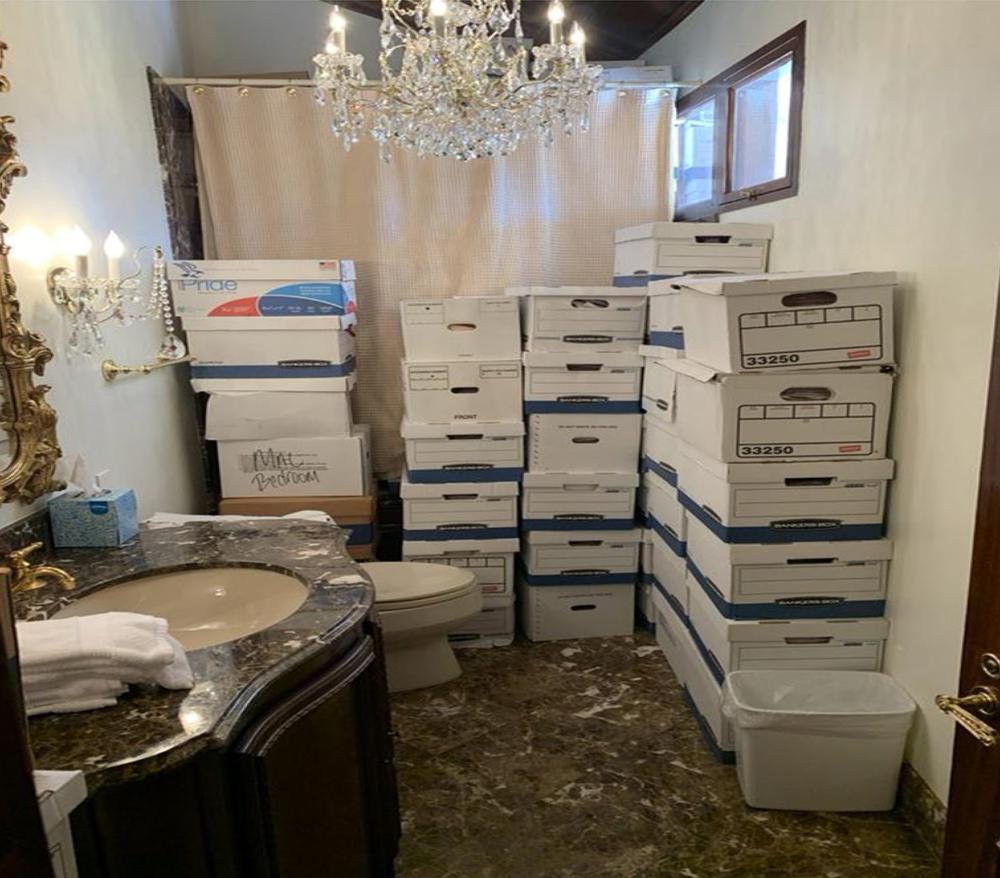
Of course, Trump already tried to do so after his first term, when he was indicted by Special Counsel Jack Smith for allegedly taking more than 13,000 government documents with him to Mar-a-Lago after leaving office (famously storing some of them in a bathroom).
Put in this light, the OLC opinion can be understood alongside Trump’s reported attempt to receive a $230 million settlement from the Justice Department, his pardons of January 6th rioters, and the dismissal of the case against Steve Bannon, among other the many other ways the president has used the DOJ to try to wipe away the criminal investigations that were carried out against him and his allies during his four years out of office.
But the OLC opinion — if upheld in court — would do more than just exact revenge for the FBI taking “my boxes,” as Trump called them, from Mar-a-Lago. (Those boxes, by the way, were returned to Trump shortly after he returned to office.) It would also deliver a significant blow to history’s understanding of the Trump presidency, shielding his White House deliberations from public view — and allowing him to hoard (or even destroy or sell) as many documents as he would like.
Baron, now a professor at the University of Maryland, noted that classified records created by the National Security Council are covered under the Presidential Records Act, due to litigation that he was involved with back in the 1990s.
“So, what happens with millions of classified records under the OLC’s opinion?” Baron asked. “OLC’s opinion appears to say they too are personal records of the current president and former presidents. This is tremendously concerning, given that there’s never been a situation where a former president owns millions of classified files.”
In total, Baron said, about 100 million White House emails are poised to be created by the end of Trump’s second administration, as well as reams of paper records, all of which would belong to Trump himself according to the OLC. It would “a tragedy for the American people,” Baron said; like Trump bringing those boxes back to Mar-a-Lago, but multiplied by several million. He better get a larger bathroom.
Thanks for reporting on this important story.
This story needs to see the light of day. It’s one more example of how this particular president does not see his role as serving the people. Soon (but not soon enough), we will see that he can’t cheat death, and we need to ensure that he can’t cheat history.