


Happy Friday! This morning, we’ll be diving into the memorandum of understanding that was signed this week between the U.S. and Iran: what it says and what it means, both on the world stage and here at home.
But first, as we often do on Friday, I wanted to give you an update on what happened in Congress this week. Only the Senate was in session this week, but they managed to do quite a lot!
The Senate voted 84-8 to advance the bipartisan 21st Century ROAD to Housing Act, the most significant housing bill to move through Congress in more than 30 years. (I wrote about the legislation here and here, and I’ll have more to say as it moves closer to becoming law.)
By voice vote, the Senate Judiciary Committee approved the bipartisan Sunshine in the Courtroom Act (which would grant all federal courts the discretion to allow cameras in their courtrooms) and the bipartisan Cameras in the Courtroom Act (which would require the Supreme Court to allow cameras in its courtroom, unless a majority of justices vote not to for a specific case).
The Judiciary panel also passed — again by voice vote — the bipartisan NO FAKES Act, which would allow people to sue if their likeness is used to create an AI deepfake without their authorization.
The Senate Commerce Committee approved the bipartisan Protect College Sports Act, which would create a national framework for name, image, likeness (NIL) rules in college sports. The bill passed the panel in a 19-9 vote, with 13 Republicans and six Democrats in favor and two Republicans and seven Democrats opposed.
The Senate Health Committee unanimously passed a series of bills, including the Charlotte Woodward Organ Transplant Discrimination Protection Act (which I covered in 2024), prohibiting hospitals from denying organ transplants to people with disabilities. The panel also began consideration of the Ensuring Timely Access to Generics Act, a bipartisan bill that aims to lower the cost of prescription drugs. The committee voted 15-8 (with four Republicans joining all Democrats) to add the bipartisan INSULIN Act (which would cap the cost of insulin at $35 a month) to the legislation.
OK, now let’s talk Iran.
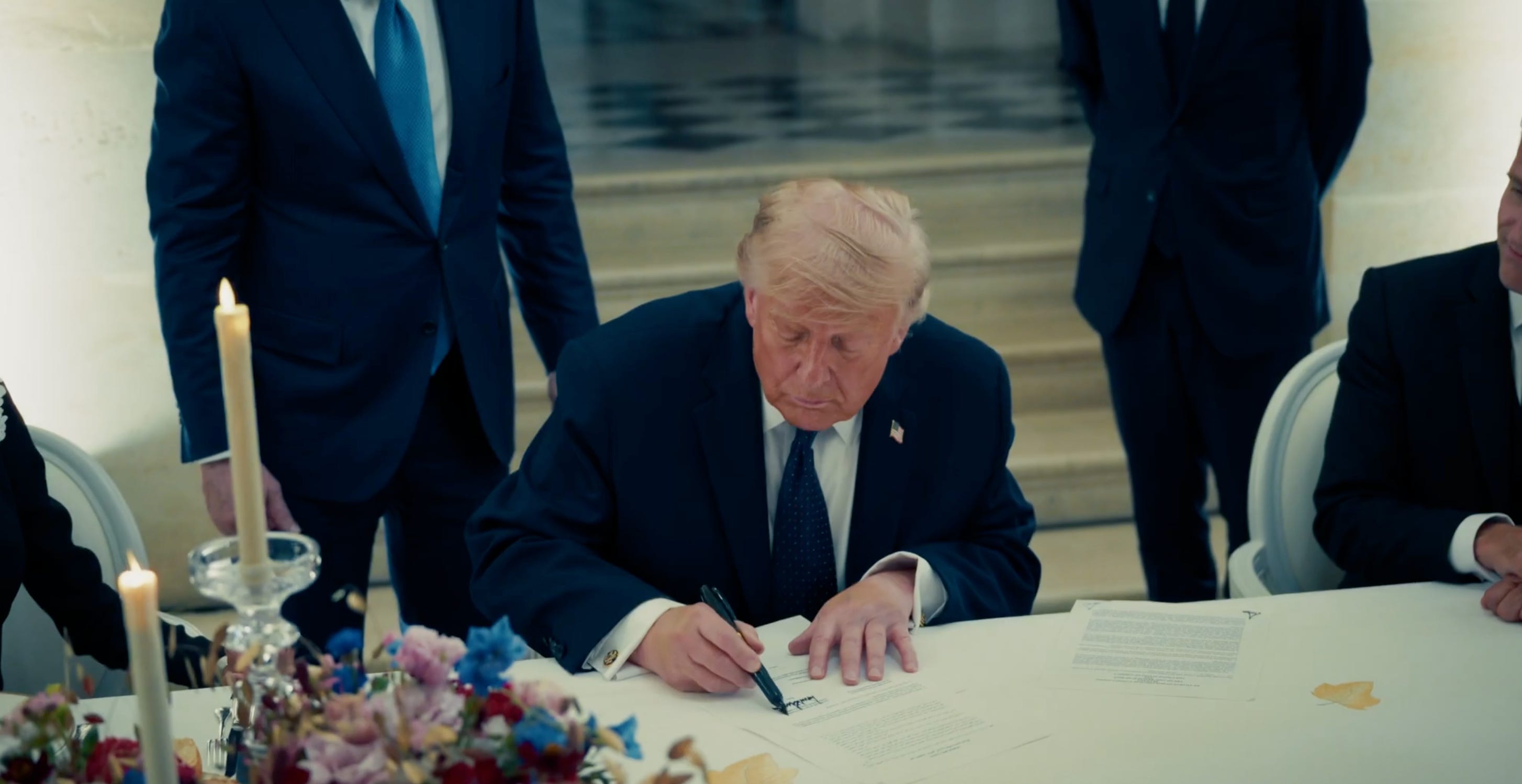
Here are six thoughts on the agreement:
#1: The Iran war is ending how it started. When the conflict began earlier this year, I called it “Trump’s Disembodied War” because of his bizarre disappearance from public view for its opening days. All of the normal features of a wartime communications strategy were absent: Trump gave no Oval Office address to announce the strikes; it took several days for the Pentagon to give a briefing; the Sunday shows that first weekend featured an interview with the foreign minister of Iran, but nothing from Trump, JD Vance, Marco Rubio, or Pete Hegseth. For several days, Trump spoke to the public through only pre-recorded videos or brief phone calls with reporters.
The result was a war that the public never really bought into, or understood the need for, partially because Trump never tried to sell it to them. According to Silver Bulletin, the war never reached higher than 40% support; for a while, it was mired closer to 35%. In a Reuters/Ipsos poll last month, only 31% of Americans said that Trump had clearly explained his goals in Iran. 66% said that he had not.
The peace has been every bit as confusingly (which is to say, barely) explained as the war. The U.S.-Iran memorandum of understanding (MOU) was signed electronically by both sides on Sunday. The text was not released until Wednesday, when (instead of simply publishing it) a Trump administration official read it over the phone to reporters.1 It was then signed again remotely on Wednesday night. The White House has refused to say if the document that was signed on Sunday was different than the document that was signed on Wednesday. A copy was not given to members of Congress until Thursday. When Israel, with whom the U.S. launched the war, initially asked for the text, they were reportedly rebuffed.
It is also unclear whether the MOU contains the full extent of what was agreed to. A senior U.S. official assured reporters in a White House briefing call on Monday that “everything we do will be transparent, there’ll be no side deals, the MOU will be released.” But VP Vance seemed to allude to unwritten Iranian commitments on Thursday, muddying the waters.
In all, it has been yet another shambolic public rollout, perfectly mirroring how the war itself was launched. It has also served to underline that Trump has lacked a consistent message on Iran this entire time, especially since his comments about the deal have only compounded the original confusion over why he launched the war.
In his statement announcing the first strikes, Trump warned that Iran was developing long-range missiles that would “soon” be able to “reach the American homeland,” which was one of the reasons why the U.S. had to go to war. “We’re going to destroy their missiles and raze their missile industry to the ground,” he said at the time.
During a press conference this week, however, Trump expressed openness to Iran retaining its missiles going forward. “I mean, they have to have some because other people have some. You’ve got to have some… Am I going to let Saudi Arabia have missiles, but they can’t have them?” he said. “Missiles aren’t the problem,” Trump added, despite the fact that destroying them was one of the few war aims that was clearly articulated. “They hurt a little location, but they don’t blow up the planet.”
In the last 48 hours, Trump has similarly left the door open to Iran continuing to enrich uranium for a civilian nuclear program (despite saying the opposite earlier this month) and downplayed the need for the U.S. to obtain material Iran has already enriched (which he had previously insisted on). If Trump does not even seem to know why he launched the war, or what he is demanding from Iran, how could he expect the American people to?
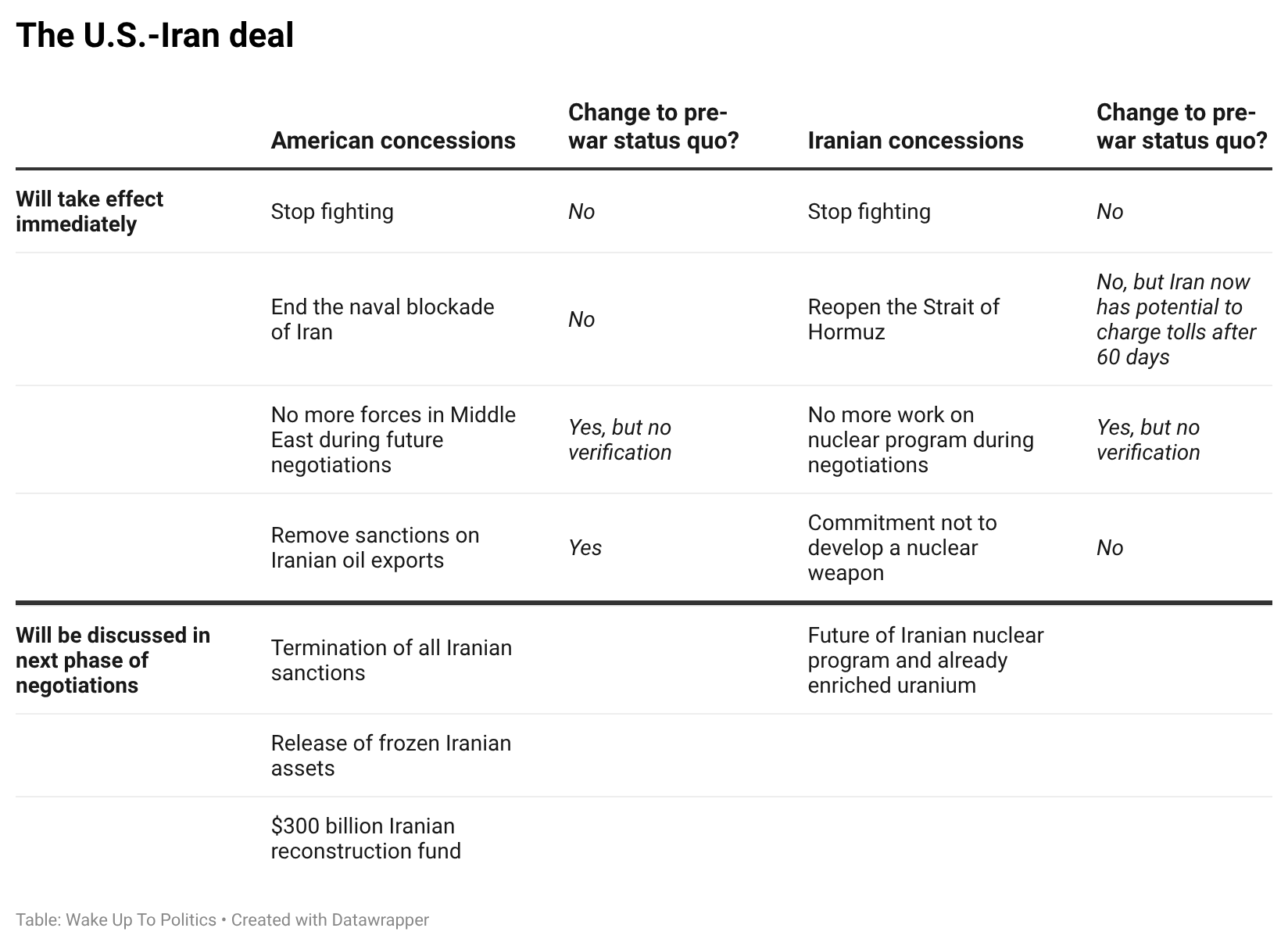
#2: Now, the deal itself. As part of the agreement, both the U.S. and Iran pledged to cease fighting and to reset to the pre-war status quo, with the U.S. ending its naval blockade of Iran and Iran reopening the Strait of Hormuz.
Notably, the MOU raises the possibility that Iran will be able to charge tolls for passage through the Strait of Hormuz down the line, by saying that Tehran commits to no-toll passage for 60 days and then to work with its neighbors to “define the future administration” of the strait after that. This opens the door to a significant change from the pre-war status quo, though it does not make clear whether it will take place.
In addition, the U.S. also pledged to immediately lift sanctions on Iranian oil, another change to the status quo favorable to Iran.
The MOU pushes everything else off to another round of negotiations, which it says will last 60 days (but will almost certainly take longer).2 Iran committed to discussing the future of its nuclear program and the fate of its already enriched uranium as part of those talks, while the U.S. said it would terminate all of its sanctions on Iran, release frozen Iranian assets, and work with regional allies on a $300 billion fund for Iranian reconstruction as part of the next agreement. The details of those concessions have not yet been finalized. (The White House has said that no U.S. taxpayer funds will be used as part of the reconstruction fund, though American companies are expected to invest.)
Iran also committed not to work towards developing a nuclear weapon, though this was its public stance already. The last notable feature is that, while the next phase of negotiations is ongoing, the U.S. said that it will not deploy more forces to the Middle East and Iran said it will not work more on its nuclear program (which it says is purely for civilian purposes). This is a change from the pre-war status quo, when the two sides were negotiating but without either committing to freeze their movements in this way (though there won’t be any way for either side to verify that the other is upholding these commitments).
#3: Where does that leave us?