A charismatic politician was about to appear on a late-night show at the Ed Sullivan Theater, but then CBS got cold feet about potentially running afoul of the equal time rule, and pulled the segment.
No, I’m not talking about Stephen Colbert and James Talarico. I’m talking about the “Singing Governor,” of course.
You know the song “You Are My Sunshine”? (🎶 “My only sunshine, you make me happy when skies are gray…” 🎶) Did you know it was first made famous by a governor of Louisiana?
Jimmie Davis was a prominent 20th-century country singer who helped popularize the genre across the United States. He didn’t actually write “You Are My Sunshine,” as he sometimes receives credit for, but he did buy the rights to the song for $35 in 1940. Davis and a partner recorded the song, and that’s what made it a hit.
At the time, he was serving as the Commissioner of Public Safety in Shreveport, Louisiana. In 1942, he was appointed to the statewide Public Service Commission. Two years later, he was elected governor. Davis would often play “You Are My Sunshine” at campaign stops. (His obituary notes that when voters would ask him “where he stood on a particularly contentious issue,” Davis would start singing. “It’s better in a political campaign to give folks very little talking and a whole lot of songs,” he said.)
Davis served as governor from 1944 to 1948 — at the time, Louisiana limited its governors to a single consecutive term — but he ran again (successfully) in 1960 for a second, non-consecutive term.
That’s where our story begins, because during that campaign, Davis was booked to sing “You Are My Sunshine” on “The Ed Sullivan Show,” which was hosted at the same network and same theater that “The Late Show with Stephen Colbert” is now. (Technically, it wasn’t called the “Ed Sullivan Theater” yet, but it was still the same building.)
At the last minute, CBS pulled the plug. The network worried that “his appearance ‘even as an entertainer’ might obligate CBS TV affiliates serving Louisiana to grant equal time, if requested, to qualified gubernatorial opponents,” the New York Times reported in 1960.
This is the earliest example I can find of the equal time rule being invoked in the context of late-night TV, which was only about a decade old at that point, and it seems to have come up less because a comedy show was trying to host a politician and more because a famous singer happened to be a political candidate.
What is the equal time rule? Has it been invoked against other late-night shows since then? Now that it’s being resurrected, could partisan hosts like Sean Hannity or Rachel Maddow be forced to interview their political rivals?
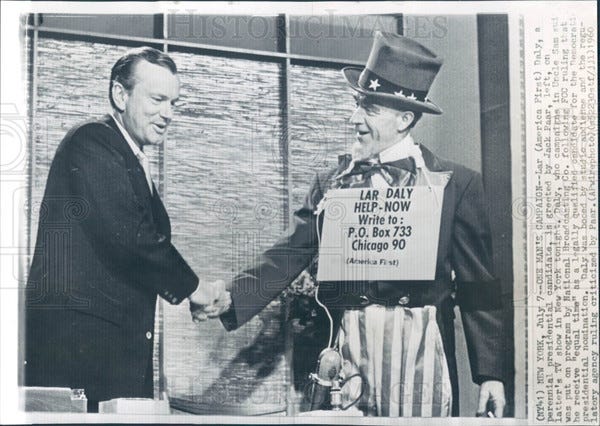
We’ll get into all of that and more beneath the paywall, including some stories you won’t read about in any of the other Colbert coverage, like Jimmie Davis and Ed Sullivan … and the time that the eccentric candidate below used the equal time rule to force his way onto the “Tonight Show,” forcing Congress to change the law not once, but twice …