



The Democratic establishment has been knocked back on its heels.
Colorado Rep. Diana DeGette was defeated in a primary challenge last Tuesday, the third House Democrat in two weeks to be ousted by a rival to their left. DeGette was bested by Melat Kiros, a 29-year-old lawyer and PhD student backed by the Democratic Socialists of America (DSA). The 15-term incumbent has been in Congress longer than Kiros has been alive.
Kiros’ primary victory followed those of Darializa Avila Chevalier and Brad Lander, who beat Democratic Reps. Adriano Espaillat and Dan Goldman, respectively, last month in New York. Chevalier and Lander were both endorsed by New York City’s democratic socialist mayor, Zohran Mamdani, as was Claire Valdez, a DSA member who won an open primary race in New York.
Also last Tuesday, Democratic Sen. Michael Bennet became the first senator in the post-World War II era to be defeated in an open gubernatorial primary when he lost in an upset to Colorado state attorney general Phil Weiser. His Senate colleague John Hickenlooper only narrowly survived a primary challenge from a progressive rival.
In recent weeks, Democratic voters have snubbed the picks of Democratic leaders in House primary contests in Maine and California, while the scandal-plagued oysterman Graham Platner emerged from nowhere to defeat a sitting governor in Maine’s Senate primary.
Still to come: Michigan’s Senate primary on August 4, where progressive public health official Abdul El-Sayed is currently favored to beat Rep. Haley Stevens, Chuck Schumer’s chosen candidate. A rematch between moderate Rep. Wesley Bell and his progressive predecessor Cori Bush will take place the same day. Then, one week later: Minnesota’s Senate primary will pit centrist Rep. Angie Craig against progressive lieutenant governor Peggy Flanagan. Other generational and ideological clashes loom.
What does this mean for the future of the Democratic Party?
The democratic-socialist left has been on a victory lap since its Colorado victory, attempting to flex its muscle and capitalize on the momentum from their series of wins. Rep. Alexandria Ocasio-Cortez made her first Senate endorsement of the cycle last week, attempting to circle the wagons around El-Sayed. Mamdani counterprogrammed Donald Trump with a speech marking America’s 250th birthday that sought to cement his status as a national leader. And their shared political mentor, Bernie Sanders, boasted on X that his movement “may be on the brink of the political revolution we have been fighting for.”
But if this is the Democrats’ Tea Party moment, as commentators on the left and right have said, then it is instructive to look at the original — the 2010s-era version on the Republican side, not the 1770s version in Boston — to see the unexpected places where a political movement of this sort can lead.
The 2010 GOP and 2026 Democratic Party rebellions started from roughly the same position, with political parties whose moderate standard-bearers lost the White House to a hated rival.
In both cases, the party bases quickly lost faith in their party leadership’s ability (or willingness) to stand up to the new president. Polls showing widespread discontent within the party soon gave way to primary races where incumbents were defeated in a wave of anti-establishment fervor.
From here, there are two strands to consider what the Republican Tea Party of the 2010s can tell us about the Democratic Tea Party of the 2020s.
The first is in Congress. In 2010, Republicans won a sweeping House majority, with some members aligned with the Tea Party and some not. The party’s then-leader, John Boehner, was easily elected speaker of the House. It would be, as former House GOP aide John Leganski recently pointed out, the last time a House speaker would be elected with the unanimous support of their party at the start of a Congress.
Boehner quickly began facing unrest from his more combative members, which has arguably never stopped: Boehner’s deputy, Eric Cantor, was defeated by a Tea Party rival in 2014; then Boehner himself was forced to resign in 2015; then his successor Paul Ryan stepped down in 2019; then his successor Kevin McCarthy was ousted in 2023; now the next man up, Mike Johnson, has effectively lost control of the House. (If Johnson lasts another Congress in charge of the House GOP, it will be the first time in the post-Tea Party era that House Republicans have kept a leader for longer than four years.)
If you want to know what it looks like for a House majority to feature a small group of extreme members, look no further than Capitol Hill right now, where Johnson has now scrapped his plans and sent lawmakers home early two weeks in a row because Rep. Anna Paulina Luna (R-FL) and others are holding the floor hostage until they see progress on the election bill known as the SAVE America Act.
If Democrats have a House majority come January 2027, unlike Boehner in 2011 — but like McCarthy in 2023 and Johnson in 2025 — Hakeem Jeffries will likely have a relatively narrow margin. (If Democrats win every seat that the Cook Political Report has labeled as leaning, likely, or solidly Democratic, plus every tossup, that would still only land them with 223 seats, five more than a majority.)
Of the progressive candidates listed above, Lander has committed to voting for Jeffries for speaker, but Kiros, Avila Chevalier, and Valdez have not. If Democrats win only a two-seat majority (meaning they lose three of the 18 Cook tossup seats, far from an unthinkable occurrence), that would be enough to either defeat Jeffries, or extract some serious concessions from him. And that’s not even factoring in the additional left-wing candidates who could win primaries this cycle (Cori Bush has also refused to commit to backing Jeffries), plus the so-called “Squad” members who are there already, like AOC, Rashida Tlaib, and Ilhan Omar.
In 2023, Kevin McCarthy was forced to promise that his allied super PAC would not take sides in open-seat primaries in safe Republican districts as a concession to win the speakership. I wouldn’t be surprised if the Squad+, if you will, makes a similar demand of Jeffries — or even tries to get the party to unilaterally disarm when it comes to accepting money from corporate PACs. (Kiros said this week that she will not support “anyone for leadership who takes corporate PAC money.”)
You could also see DSA-aligned lawmakers demand Jeffries promise floor votes that might divide the Democratic caucus, like on a Trump impeachment effort or bills related to Israel. (The Block the Bombs Act, restricting weapons sales to Israel, has become a litmus test on the left that these members could insist Jeffries hold a vote on.)
On the Senate side, despite having more candidates (including Platner) explicitly say they won’t support him, Chuck Schumer will have a somewhat easier road to keeping his position, since Senate leaders only need support from half their caucus, whereas House speakers need support from half the chamber (which is to say, in this era of small majorities, basically their entire caucus). There is a reason Mitch McConnell remained atop the Senate GOP from 2007 to 2025, even as House Republicans cycled through four leaders in that time; Schumer can suffer many more defections than Jeffries and still skate by.
That said, it isn’t only newcomers who are dissatisfied with Schumer: a group of Democratic senators including Elizabeth Warren and Chris Murphy have started back-channeling against Schumer as part of a group they call the “Fight Club.” In 2019, to win the speakership, Nancy Pelosi had to promise to only serve two more terms in the position. Perhaps Schumer will be forced to say that he’ll retire come 2028.
Don’t necessarily put much stock in promises from candidates that they won’t vote for a given leadership contender — 21 Democrats voted for Pelosi for speaker in 2019 after pledging not to, gambling that their constituents weren’t paying close attention — but do expect members on both sides of the Capitol to put a price on their vote, especially (on the House side) in a razor-thin majority.
In theory, leading a majority when the other party is in the White House should be less challenging. You have the security of knowing little that you pass will ever become law, which lessens the pressure somewhat and typically allows a party to focus on the one thing that unites them: investigating the other side. Then again, such unity wasn’t exactly McCarthy’s experience under Biden.
Speaking of: I haven’t seen any Democrats mention their plans for the motion to vacate (the procedural tool by which McCarthy was ousted from the speakership) if they retake the House majority. When Democrats last held the majority, they changed the rules so that a vote to oust a speaker could only be forced by a majority of a party caucus (in fact, moderates insisted on raising the threshold before electing Pelosi speaker). McCarthy then agreed to allow such a vote to be triggered by a lone member in 2023 (which ultimately proved his undoing). The threshold was raised slightly to nine members in 2025, where it remains today.
Will the Squad+ vie to keep the threshold low, to subject Jeffries to the same sword of Damocles that dangled over McCarthy? That will be one easy test for whether the left-wing Democrats are more willing to play ball with their party’s establishment, or if they’re just as scorched-earth as their right-wing counterparts in the House Freedom Caucus. If they opt for the latter route, expect a Democratic majority that suffers through some of the same struggles that have plagued Republicans since the emergence of the Tea Party.
That brings us to our second area of analysis: the presidential level.
District-level and national elections are very different, and the latter requires the ability to compete on different types of terrain. In 2010, candidates like Marco Rubio in Florida and Ron Johnson in Wisconsin were able to successfully use Tea Party backing to win Senate races in battleground states.
So far, the wins scored by the Democratic Tea Party have largely been in primaries in deep-blue territory, like New York City (which Kamala Harris won by 38 points in 2024) and, in the DeGette/Kiros race on Tuesday, Denver (which Harris won even more comfortably, by a 56-point margin). These are very progressive voters picking very progressive candidates.
Platner’s primary victory will offer a test of the left’s ability to play in more contested races, although that contest is still playing out in Maine, hardly a battleground state (Harris won the state by seven points). If El-Sayed wins his primary in Michigan — where he is favored, even after the last-minute exit of state Sen. Mallory McMorrow — that will be a better testing ground. A democratic socialist state legislator, Francesca Hong, also has a shot at Wisconsin’s Democratic gubernatorial nomination, potentially setting up another glimpse at the left’s ability to compete in an evenly divided state.
Then again, if we’re trying to game out the 2028 Democratic presidential primaries, that’s getting ahead of ourselves a bit, since the operative question will still be the mood of the Democratic primary electorate (though in more places than just deep-blue terrain), not necessarily who would perform well in a general election.
Interestingly, so far, the anti-establishment fervor seen in primaries in Colorado and New York doesn’t really show up in 2028 Democratic primary polls. According to the Race to the White House average, the top three contenders right now are establishment-aligned Kamala Harris, Gavin Newsom, and Pete Buttigieg, who combine for 53% of the vote. Ocasio-Cortez is in fourth place, with 10.8%. These surveys are much too early to be predictive of 2028, but they still give a decent snapshot of where the party stands in 2026; if the national party, not just in certain cities, was itching to “throw the bums out,” you might not see the former vice president and governor of California in the lead.
By comparison, at this point in the 2012 Republican primary cycle, there were polls showing the more Tea Party-aligned Sarah Palin and Mike Huckabee running even with or ahead of establishment darling Mitt Romney.
Of course, the end of that story, though, is that Romney ended up winning the 2012 GOP nod. Just two years after the Tea Party wave of 2010, the movement fractured between different candidates and didn’t end up being much of a force in the 2012 primaries. In fact, for all the power the Tea Party once wielded in the GOP, there has never really been a Tea Party-aligned presidential nominee — and at this point, there likely never will be. At the presidential level, time mostly passed them by, a cautionary tale for the DSA left this time around.
In the 2016 Republican primaries, many Tea Party leaders — including the group Tea Party Patriots, a key movement vehicle — endorsed Ted Cruz. Republican voters who identified with the Tea Party split roughly evenly between Cruz and Trump, despite the fact that Trump bucked against many of the movement’s tenets.
The Tea Party was all about limited government, cutting taxes, and balancing the budget; in his 2016 campaign, Trump was not shy about his vision of a strong central government, repeatedly spoke about raising taxes on the wealthy, and pledged to protect deficit-busting entitlement programs. He attracted support from much of the Tea Party despite diverging from the Tea Party ideologically.
The lesson here is that voters can come to a movement for all sorts of reasons. Many Tea Party voters undoubtedly believed in the ideological program of the movement — but many, clearly, did not, and were there more because of general, non-ideological dissatisfaction with the Republican Party leadership and a desire for a candidate who would fight more strenuously with Democrats.
As Rep. Thomas Massie (R-KY) memorably put it in 2017, after discovering that many voters he expected to support Rand Paul in the GOP presidential primaries were now supporting Trump: “All this time, I thought they were voting for libertarian Republicans. But after some soul searching I realized when they voted for Rand and Ron [Paul] and me in these primaries, they weren’t voting for libertarian ideas — they were voting for the craziest son of a bitch in the race. And Donald Trump won best in class, as we had up until he came along.”
It’s possible that a similar dynamic is true on the left, that some of the voters fueling recent primary victories are genuinely ideologically aligned with the victorious candidates, and some are merely hoping to signal their displeasure to the Democratic Party leadership as they throng to more combative candidates.
This would help explain the seeming disconnect between the recent victories by left-wing candidates, and the fact that, while a majority of Democrats and Democratic-leaning independents said they were dissatisfied with the party in a recent New York Times poll, that dissatisfaction didn’t seem to be rooted in an urgent desire for the party to move to the left ideologically.
According to the survey, just 25% of Democrats and Democratic-leaning independents want the party to move to the left, compared to 52% who want the party to move to the center. The same is true on most — but not all — issues. Although a plurality of Democrats want the party to move to the left on health care, and more than one-third say the same about the economy, the poll results on social issues do not suggest that the DSA’s proposed platform (calling to abolish the “carceral forces of the capitalist state” and for open borders) would be popular among Democratic voters.
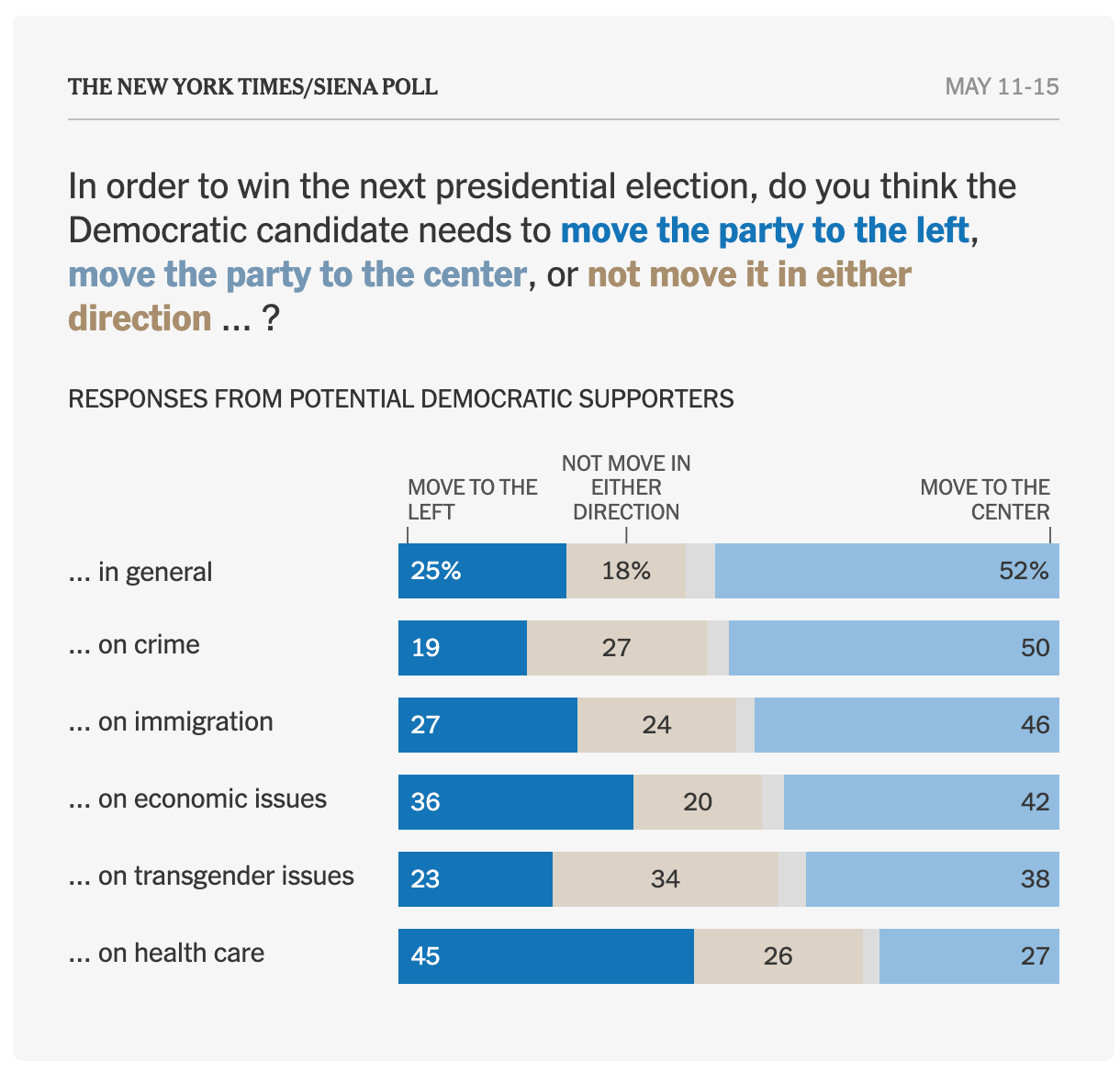
This data suggests that Democratic primary voters are voting for insurgent candidates and are fed up with their party, but aren’t necessarily looking to move in an ideologically extreme direction — not unlike Republicans a decade ago, when Tea Party leaders thought their voters wanted smaller government and a balanced budget, but it turns out many were just backing “the craziest son of a bitch in the race,” and jumped ship to an equally combative, but less ideologically orthodox, standard-bearer as soon as one became available.
When you whip up anti-establishment fervor among voters, it doesn’t always lead to the policy direction that activists expect. It sometimes spirals out of the activists’ control, and gets channeled (or co-opted) into something slightly different. “The Tea Party still exists, except now it’s called Make America Great Again,” Trump told journalist Tim Alberta for his excellent book “American Carnage,” which chronicles this evolution.
For Democrats, could this look like a Stephen A. Smith or Mark Cuban pulling a Trump? Maybe. Trump still shared at least one major policy critique of the establishment GOP with Tea Party activists (on immigration), and any insurgent outsider on the Democratic side would probably have to do the same (here, Israel policy is probably the most obvious ticket for admission).
Yes, it’s hard to imagine Democrats like Zohran Mamdani or AOC signing on with a Smith or a Cuban just because they share their anti-establishment sentiment — but, then again, many Tea Party politicians never fully embraced Trump either. Think of Massie, or Rand Paul, or Justin Amash, all of whom went from Tea Party politicians to some of Trump’s top critics in the GOP. Trump basically drove Charles Koch, who bankrolled much of the Tea Party and was once the most powerful donor in the GOP, out of partisan politics.
To return to the available 2028 polling, it is revealing that Cory Booker’s stock jumped in April of last year, after his 25-hour stemwinder against Trump, while Newsom spiked last August, as he began trolling Trump on social media.
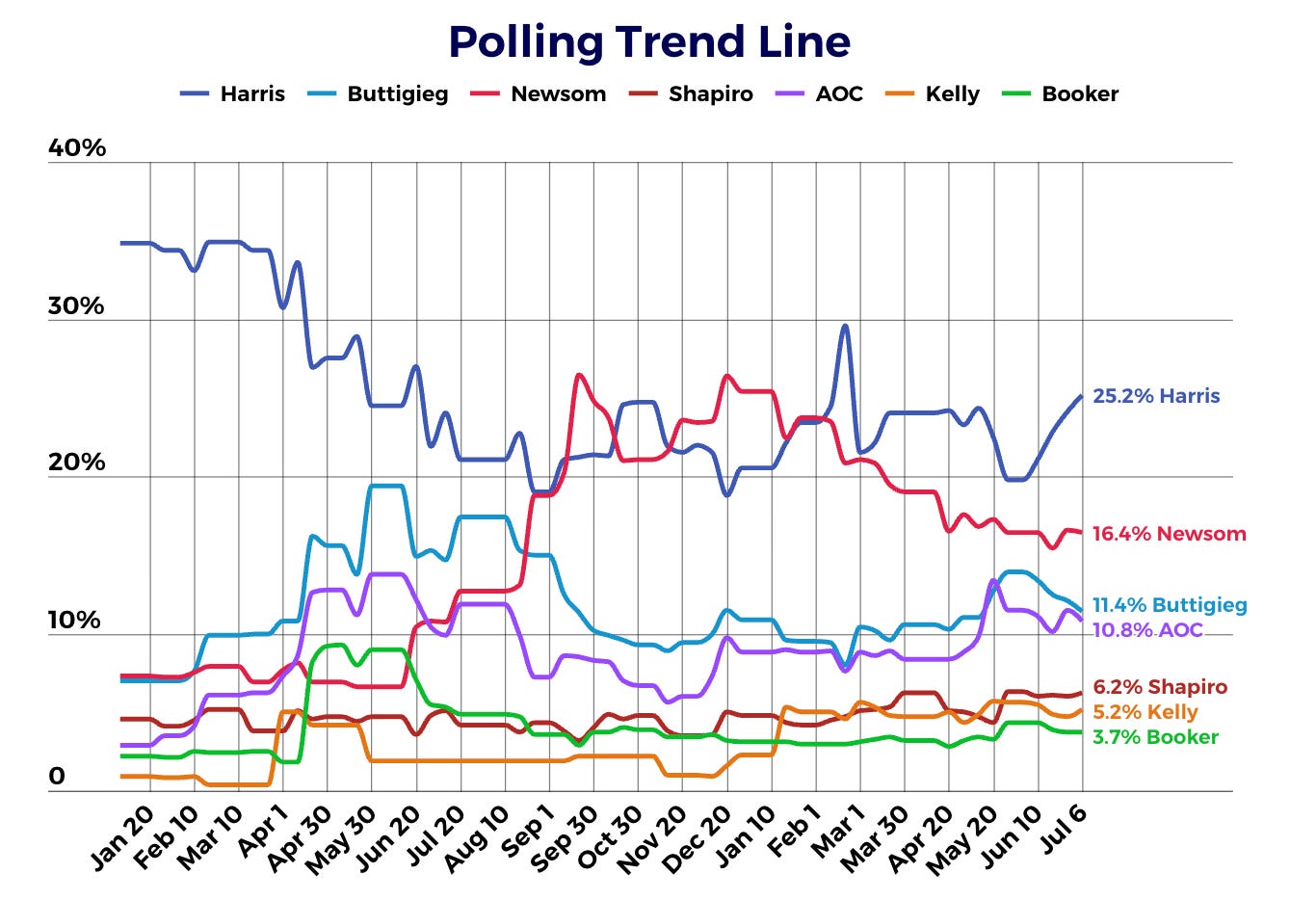
This offers more of an attitudinal message than an ideological one: above all, Democratic voters (like Republican voters a decade ago) are looking for a fighter. We know from experience that, even if that fighting spirit temporarily aligns ideologically rigid activists with these disaffected voters, their paths could soon diverge — and lead to all sorts of unexpected places.
I think you're correct--we are massively over-focused on this apparent shift, which is really about internal Democratic success in areas that are already largely Democratic-leaning. Who moves the middle will decide the next national election (assuming we have one). I do think that folks are tired of the way things have been the last few years and are looking for someone who will fight for something that looks like normalcy. That's tough to do. Though a lifelong Democrat, I can't think of a single national Democratic figure whom I would support for president without having to hold my nose. Of course, I've had to do that a lot over the past few cycles. But I'm also pushing 75 and am likely not at all a typical Democratic voter any more--too old.
I also think sadly, there is an increase in antisemitism in New York, on both the right and the left but since most Jewish voters have notoriously been liberal democrats it stings more. The Jewish editorialists and political leaders considered more “ establishment “ needed to speak out harshly against the right wing and immoral Netanyahu administration and in my mind only Thomas Friedman did this repeatedly. Most Americans had no idea that Netanyahu supported Hamas with oodles of money, because his nasty racism included a hatred of the “ two state solution”. He stupidly believed he could control Hamas because his vitriol toward Palestinians blinded him and clear thinking went right out the window. He is to blame in large part for the Hamas massacre of innocent civilians and like Trump, he is a narcissistic, power hungry, womanizer that wants to stay out of jail because he is also a grifter.