


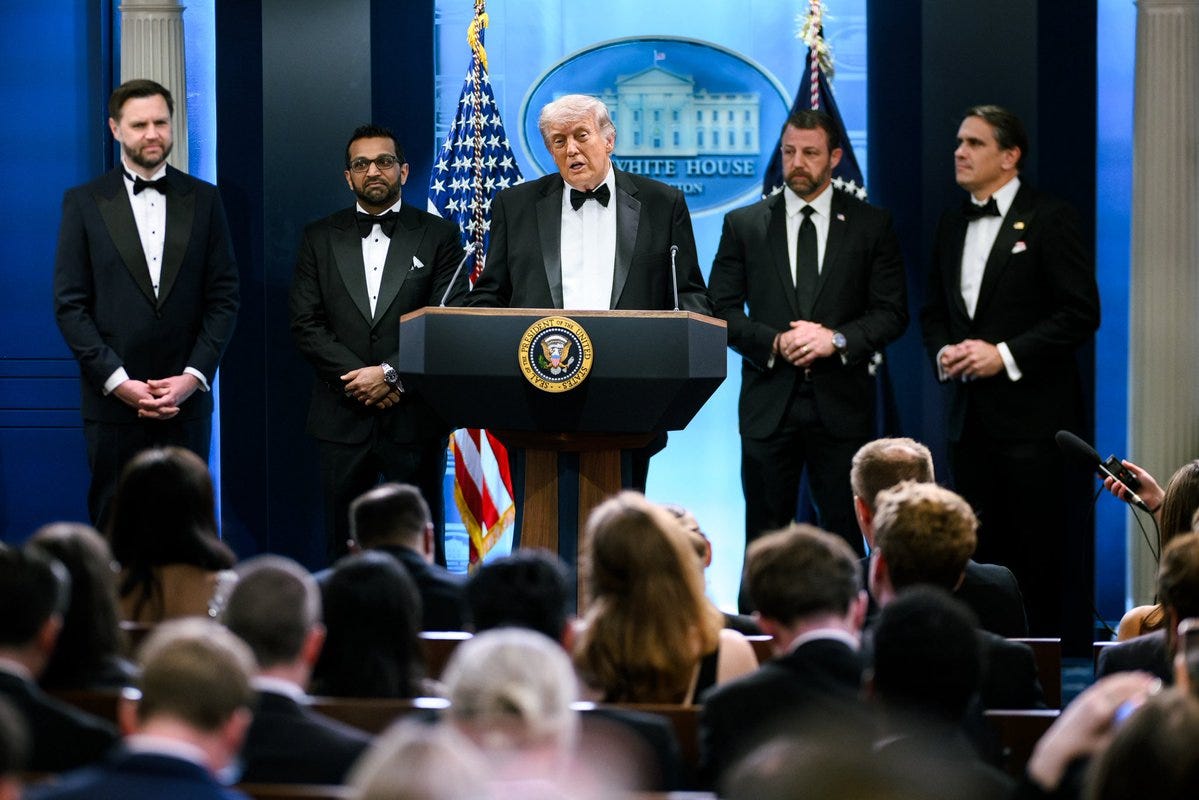
Washington remains shaken this morning after the familiar ritual of the White House Correspondents’ Dinner took a dark turn on Saturday night, as a gunman raced through security attempting to wreak havoc.
The suspect, a 31-year-old California teacher named Cole Tomas Allen, was quickly tackled to the ground. Inside the ballroom, top officials including President Donald Trump (attending the dinner for the first time as president), Vice President JD Vance, and Secretary of State Marco Rubio were hustled to safety. Journalists and other top Washington power brokers cowered under tables. It was the third assassination attempt against Trump in two years.
One Secret Service agent was shot, but was saved by a bulletproof vest and has already been released from the hospital. No other injuries were reported. Allen is set to make his first appearance in court this morning.
I was not at the dinner, though I’ve attended in the past and can confirm that it’s a chaotic environment, with many pre-parties taking place at the same venue (the Washington Hilton, which is also where Ronald Reagan was shot in 1981) and a minimal security presence to enter the hotel itself. On Saturday night, I was at Substack’s “New Media Party,” which was held during the dinner, at a venue right across the street from the White House (about a mile and a half from the Hilton).
Because of its proximity to the White House, the party was placed on lockdown for more than an hour, with no one allowed in or out as the Secret Service sealed off the entire area, following their protocol after an attack on the president. Our phones buzzed with updates as Trump’s motorcade whizzed past the building, returning to the White House, where he addressed reporters (still clad in black-tie attire) later that night. By the time we were allowed to leave the party, it was like walking into a ghost town; the Secret Service had shut down every street within a five-block radius of the White House, on guard against any further threats.
Here are six thoughts on the weekend’s alarming events:
#1: The Secret Service has come under close scrutiny in the aftermath of the shooting, although Trump administration officials have expressed confidence in the agency’s handling of the attack. “The system worked,” Acting Attorney General Todd Blanche declared on Sunday, noting that Allen was quickly apprehended and never made it into the ballroom where the dinner was being held.
To give you a sense of where Allen was in relation to the president: In the floor plan below, the Correspondents’ Dinner is held on the Hilton’s “Concourse Level,” in the cavernous “International Ballroom.” The magnetometers are set up in the “Terrace Level,” one floor above the dinner. That’s as far as Allen made it. Above that is the lobby and 12 floors of rooms.
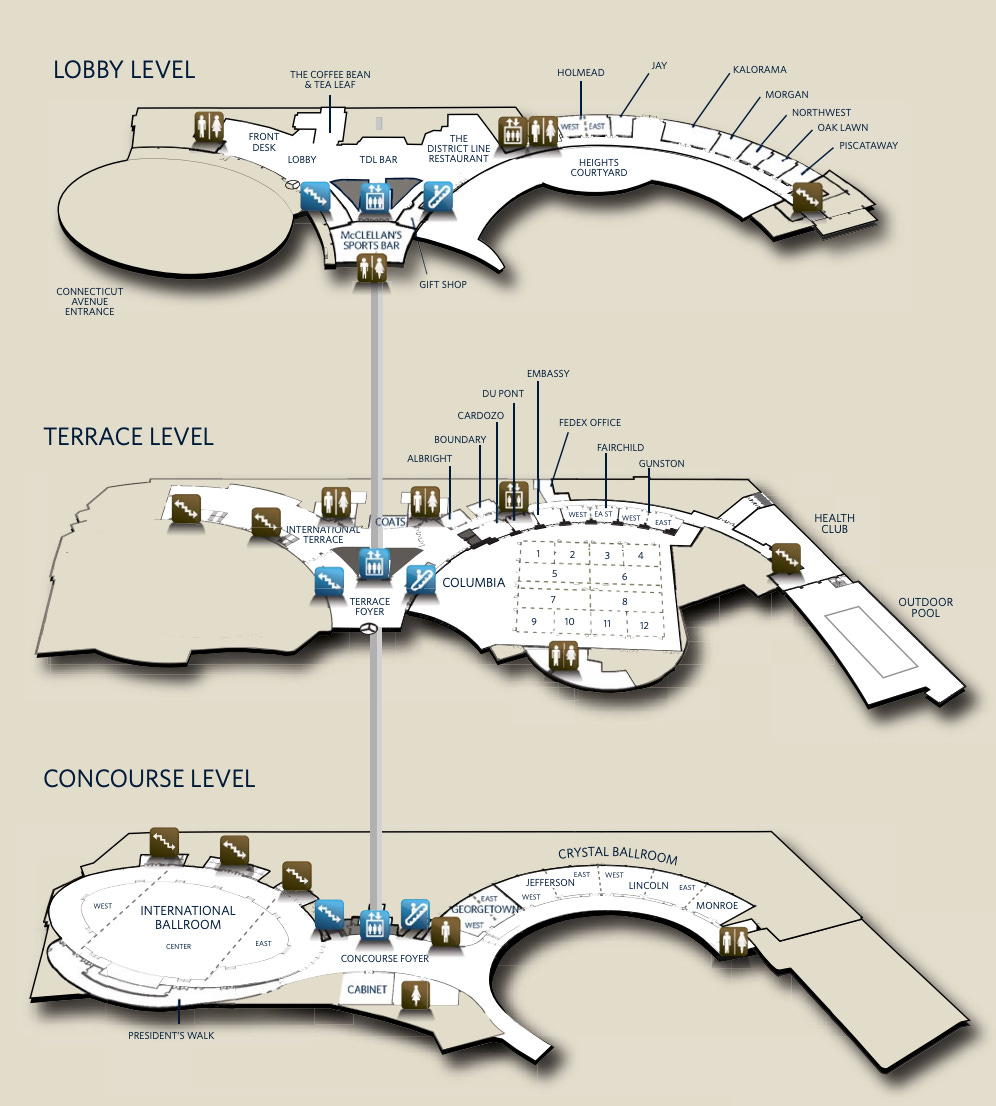
Allen reportedly checked into the hotel as a guest on Friday, spending the night in a room on the 10th floor. Per CBS News, he then used an interior stairwell to evade security stationed in the lobby, while carrying a shotgun, a handgun, and several knives in a black bag. The stairwell spit him out at the “Terrace Level,” where everyone had to go through security before going down another set of stairs into the ballroom. He tried to dash through the magnetometers, but was quickly tackled to the ground. At that point, Allen was very close to the stairs that would have taken him into the ballroom itself — though he never made it that far.
“The system worked,” then, in the sense that Allen never set foot inside the ballroom. He was stopped at the exact security checkpoint that was supposed to stop him. But should the point that stops an armed assailant be farther than it was from the president and most of the top officials in the government?
In Allen’s manifesto, first reported by the New York Post, he gloats that he was able to bring weapons into the hotel the night before the event, without any security screening whatsoever. “Like, the one thing that I immediately noticed walking into the hotel is the sense of arrogance,” Allen wrote. “I walk in with multiple weapons and not a single person there considers the possibility that I could be a threat.”
For Allen to have been stopped earlier than he was would have required a dramatically different security posture. Should the president of the United States never be able to give a speech in an active hotel, without every guest’s luggage being screened upon arrival? Should there be metal detectors and ID checks at the front door of every building he speaks at, not just — as is sometimes the case when other things are happening inside a building — outside the specific room he’s speaking in?
Clearly, in this day and age, none of these are insane expectations to have; perhaps some of them should be adopted. But it would require a complete rethinking of the types of venues a president is allowed to speak at, with the goal of the Secret Service going from securing a room to securing a building, and shutting down activities in the rest of the building while the president is there.
If our expectation is that the room the president is in should be secure, then the system worked. If our expectation is that any building the president is in should be sealed off, without any unchecked bags or unidentified people, then we would need a new system — and maybe we do, but that is a larger conversation that calls for a broader set of norms. (On the identification point, I will note that at the Substack party on Saturday night, I had to show ID while someone checked to make sure I was on the list. No such precaution is taken at the Hilton, where anyone arriving on Saturday night needed only to flash a ticket to the dinner or a pre-party to enter the building, in addition to the hotel guests like Allen already inside.)
As we consider these questions, it’s worth noting that — once again — we seem to have gotten incredibly lucky that this wasn’t worse. What if, instead of a lone teacher, a team of trained Iranian assassins had checked into the Hilton on Friday night? If all of them charged the security checkpoint at once, might one of them have been able to slip down the stairs and into the ballroom with the president? What if Allen, having made it into the building with no screening of his luggage, had brought a bomb? What if he had gone into the lobby or the security area earlier, where he wouldn’t have encountered Trump — but would have been face-to-face with some of the top-ranking members of the government, and clearly would have been able to be armed? I remember seeing a host of boldface names in the chaos of that same security line; Allen wouldn’t have needed to show any ID or ticket to get to the point where he was standing with them. It is easy to imagine an attack on a Cabinet secretary or the speaker of the House playing out.
According to the Washington Post, the Correspondents’ Dinner was not designated a “National Special Security Event,” the high-security classification given to events like the State of the Union or an inauguration where several top officials gather (nor is the dinner typically given that designation). Maybe it’s unreasonable to expect screening of every person who enters a building where the president is speaking (or, again, maybe it isn’t) — but it seems much less unreasonable for an event attended by the president and the three officials who come after him in the line of succession. Maybe events of those sort should be held in dedicated buildings, rather than active hotels where any manner of other events can be taking place.
Tourists can’t just waltz into the U.S. Capitol for the State of the Union. The Correspondents’ Dinner is thought to be a much less formal affair — but if the ballroom is similarly studded with important figures, perhaps it should have a similar security posture? Allen wrote that he noticed a “sense of arrogance” upon entering the Hilton, which does speak to the fact that whenever attacks like this occur, it seems like the relevant security officials are in place but not necessarily behaving like they actually believe the worst could happen at any moment: recall the Capitol Police officers who seemed woefully unprepared on January 6th, or the agonizing failures that allowed Thomas Matthew Crooks to shoot a bullet at Trump in the 2024 campaign and hit him in the ear.
Similarly, a current Secret Service official told MSNOW that the checkpoint staff “wasn’t paying close attention” when Allen arrived because the dinner had already started; indeed, they had started to take down the magnetometers (though that also meant they had simultaneously closed the doors of the ballroom itself to “harden” the security presence around the room). Other officials raised red flags about the awkward evacuation process, which seemed difficult to carry out in the packed room; videos showed Health and Human Services Secretary Robert F. Kennedy Jr. being taken out before Defense Secretary Pete Hegseth, and Vice President JD Vance being taken out before the president.
#2: Of course, the attack is not only another bracing reminder about security, but about political rhetoric as well.
We know nothing (still) about Thomas Matthew Crooks, the gunman who shot Trump in Butler, Pennsylvania. But Allen’s manifesto makes it clear that he believed it necessary to harm Trump and officials in his administration because of disagreements with their policies.
“On to why I did any of this: I am a citizen of the United States of America,” he wrote. “What my representatives do reflects on me.”
In his manifesto, Allen calls Trump a “pedophile,” repeating an allegation that has marinated in left-wing media but has never once been proven.
Allen had clearly consumed information — some correct, some not — that drove him, in his words, to “experience rage thinking about everything this administration has done,” and made him believe that emotion merited not voting against politicians he disagreed with, but killing them.
It is an opportunity for figures on both sides of the political aisle — and all of us — to stop before espousing heated rhetoric and think, *I* know that this comment is intended simply to get those listening to vote against a certain politician or political party. But is it stated in such a way, and using enough existential framing, that someone with mental illness might hear it and think it describes a situation that licenses violence? If so, how can I make changes that avoids that all-too-real possibility?
We all lose when any segment of the country looks at political problems and believes violence is an answer to them. It is easy to say that. Harder is making the changes in our own rhetoric that would ensure no listener could walk away and think we are urging them towards drastic action.
#3: The fact that Trump himself is one of these figures who could take a closer look at his rhetoric does nothing — absolutely nothing — to change that broader takeaway. On Saturday night, Trump made an admirable request that “all Americans recommit with their hearts in resolving our difference peacefully.” The next day, in an interview on “60 Minutes,” Trump called journalist Norah O’Donnell “disgraceful” and said that the media are “horrible people,” the sort of rhetoric which has led to threats against journalists, just as overheated rhetoric towards Trump has led to threats against him.
We can all think harder before attacking opponents in personal terms or making unfounded allegations, rather than merely expressing our disagreements. I am also tired of seeing more examples of political violence being treated as a team sport, with either side treating this as a Democratic problem or a Republican problem, rather than as an American problem that plainly exists within both party camps.
#4: Trump also used his Saturday night remarks to repeat his call for a White House ballroom. “It’s actually a larger room and it’s much more secure,” Trump said, describing his planned ballroom. “It’s drone proof, it’s bulletproof glass. We need the ballroom. That’s why Secret Service, that’s why the military are demanding it.” On Truth Social, Trump derided the plaintiffs who have brought a “ridiculous” lawsuit attempting to stop the ballroom’s construction. This is an interesting legal debate, but largely a non sequitur.
There are plenty of good reasons, from security to aesthetics, to have a ballroom on the White House grounds. Judge Richard Leon, in halting construction, has merely ruled that these arguments must be hashed out in Congress, which he has said has the authority over such construction. Notably, even when faced with that adverse ruling, Trump has never attempted to follow its advice, and even see whether Congress might sanction the ballroom.
That might change this week, with Sen. Tim Sheehy (R-MT) announcing plans to request unanimous consent to pass a bill approving construction of a ballroom. According to the judge’s ruling, that’s all that had to happen this whole time! Now we’ll see whether Democrats will object to the donor-funded project.
But, either way, this has little to do with the Correspondents’ Dinner, which is hosted by the White House Correspondents’ Association, not the White House. When the president attends, he does so as the guests of the reporters, not the other way around, which means there is little reason to believe that this particular dinner would be held at the White House, even if there was a place to do it. Trump has talked about his ballroom seating around 1,000 people; the Correspondents’ Dinner typically hosts more than double that number of attendees. Whether or not the White House should have a ballroom, and who should have to approve it, is a conversation worth having. But even if such a ballroom existed, Saturday night’s dinner almost certainly wouldn’t have been held in it.
#5: I will be curious whether Saturday’s attack ricochets in Congress in other ways. I have yet to see any evidence that the Department of Homeland Security shutdown — now in its 73rd day — played any role in the security posture at the Correspondents’ Dinner, but the attack may nevertheless increase pressure on Congress to approve funding for the agency, which includes the Secret Service.
The current plan is for Republicans to fund immigration enforcement agencies through the party-line reconciliation process, while both parties approve funding for the rest of DHS (including the Secret Service) through the normal process. However, some GOP lawmakers have said they won’t approve the second batch of funding until they are sure the first batch will go through. In addition, Rep. Chip Roy (R-TX) said yesterday that the reconciliation measure should include authorization for the White House ballroom, which could further complicate attempts to pass the reconciliation bill and then fund the rest of DHS.
#6: In the meantime, here’s one legislative proposal that should be considered: it’s time to change the presidential line of succession.
If the very worst-case scenario had played out on Saturday, President Trump and both of the first two figures in the line of succession — Vice President Vance and House Speaker Mike Johnson — were all in attendance. Who is third in line? Senate president pro tempore Chuck Grassley, who is 92 years old.
Despite its high placement in the line of succession, the position of Senate president pro tempore is traditionally given to the senator in the majority party who has served in the Senate the longest. That’s currently Grassley, who has been a Republican senator from Iowa since 1981.
By all accounts, Grassley himself is in great shape, but there is no reason that we should risk a national crisis ending in the presidency being handed to the occupant of a position frequently held by someone in their 80s or 90s. At one point, in 2001, Sen. Strom Thurmond (R-SC) held the position at age 99 and in reportedly failing health.
Even ignoring the age issue, there are already problems with both the House speaker and Senate president pro tempore being in the line of succession. First, legally: according to the Constitution, no one can serve in two branches of government at once, which means Johnson or Grassley would have to resign from Congress to assume the presidency. But by the time they have resigned, they would no longer be in the line of succession. It would be sort of a Schrödinger’s President situation.
But, more importantly, it creates the possibility that the presidency could be handed to someone of the other party in the middle of a term. This would obviously cause confusion in terms of policy direction, and arguably subvert the voters’ will — but it also creates a nightmarish incentive structure, when the speaker of the House is from one party and the president and vice president are from another (which happens all the time). In this situation, a deranged person of the sort we have been talking about would know that if they kill the president and vice president, they could install someone of their party in the White House. Not really a possibility we want hanging in the air.
And then you add back in the age factor — if disaster had struck on Saturday night, we might have ended up with a 92-year-old president — and the imperative becomes even stronger. It might surprise you to learn that the line of succession (beyond the vice president) is written nowhere in the Constitution, so this wouldn’t require a constitutional amendment or anything like that.
The U.S. has had three Presidential Succession Acts: the first, in 1792, listed the Senate president pro tempore and then the speaker of the House (with a provision stating that they should hold office temporarily, until a special election could be held to elect a new president and vice president). The second, in 1886, took out the lawmakers and listed Cabinet departments in order of their establishment, starting with the Secretary of State. The most recent, in 1947, added back in the speaker and the Senate president pro tempore (but reversed their order) and put them before the Cabinet.
Congress could pass a bill tomorrow that would revive the 1886 line of succession, removing any legal or political headaches that come with including members of Congress — and taking away the risk we briefly had on Saturday of a nonagenarian being suddenly elevated to the presidency.
Not necessary to have the President, VP and Speaker at the event.
And why were any of the people in that room more important than students in school who have to fear this will happen to them one day?