


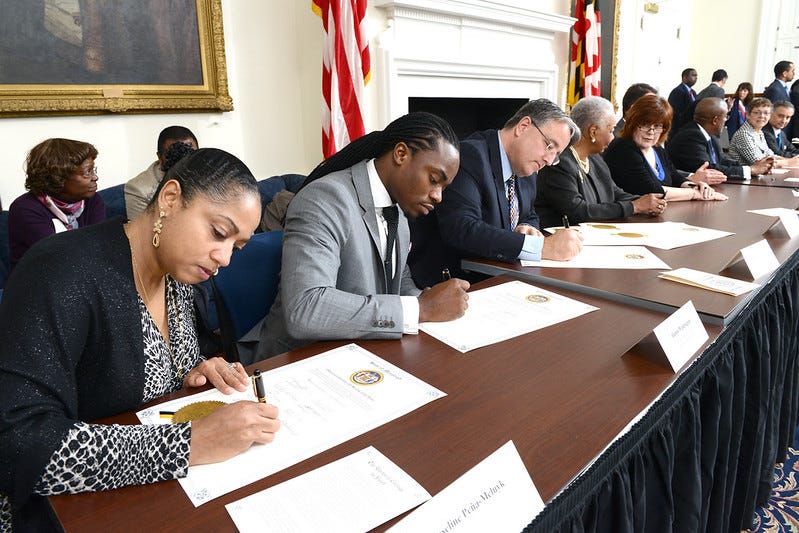
After the “blue tsunami” that crested in this year’s midterms, many Democrats are thinking big about how to remake public policy on issues from health care to immigration.
Could they also be on the verge of upending the system we use to elect our presidents?
I know what you’re thinking: the Electoral College is baked into the Constitution, which means it can’t be abolished unless two-thirds of both chambers of Congress and three-fourths of the state legislatures ratify a constitutional amendment. Democrats may have won big, but they didn’t win that big.
But some activists believe they’ve found a workaround. Enter the National Popular Vote Interstate Compact.
Under Article II, Section 1 of the Constitution, it’s entirely up to each state legislature how they assign their state’s electoral votes for president. They can assign them to the winner of the popular vote in their state, as 48 states do. They can take into account who wins each of their state’s congressional districts, as Maine and Nebraska do. The legislature can even decide to just pick the electors themselves — no voters needed — as half of states did as late as 1812 (though no state has done so since 1876).
The idea behind the National Popular Vote compact is that state legislatures could commit to awarding their electoral votes to the winner of the national popular vote. If states adding up to 270 electoral votes (the number needed to win the presidency) sign on, then that would guarantee that the person who wins the national popular vote also wins the presidency (which is what usually happens anyway, with five key exceptions: 1824, 1876, 1888, 2000, and 2016). In essence, it works within the confines of the Electoral College to make the Electoral College obsolete. But it only takes effect if enough states have signed on to reach the crucial 270 mark.
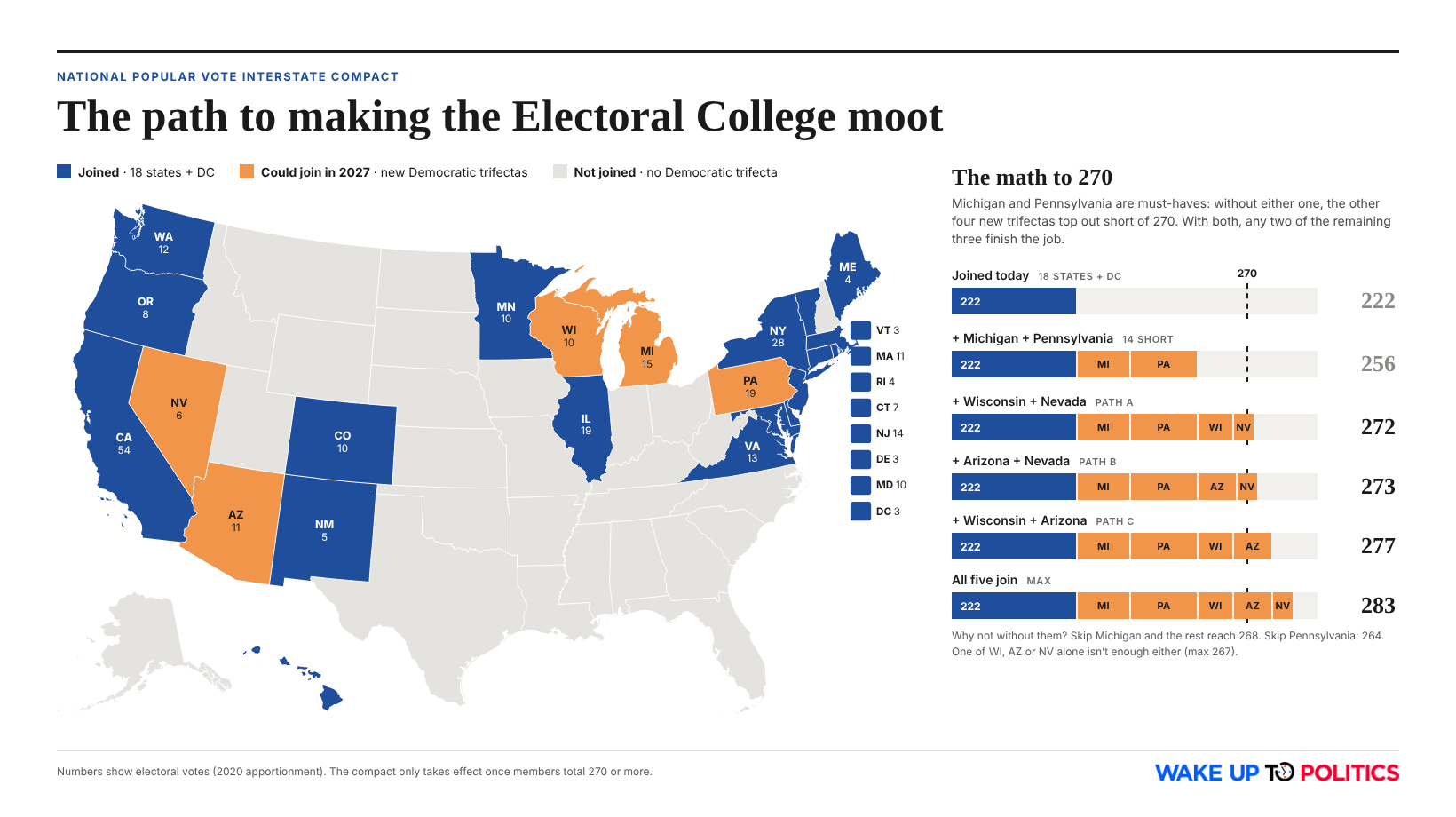
Since the compact was first proposed in 2001, organizers have spent years slowly working to build support in state capitals. The first state to sign on was Maryland, in 2006. 18 states (plus the District of Columbia) have now joined, bringing the compact to 222 electoral votes — a mere 48 away from the threshold.
Democrats just won trifectas (control of the governorship and both chambers of the state legislature) in five states that haven’t signed: Arizona, Michigan, Nevada, Pennsylvania, and Wisconsin, which control a combined 61 electoral votes. If these states sign on, a 25-year-long pipe dream to disrupt presidential elections could become reality.
“I’ve never been more confident in my life,” Pat Rosenstiel, a longtime leader of the National Popular Vote movement, told me in an interview this week.
Although most backers of the compact are Democrats — after all, they were the party that lost out in the last two popular vote/Electoral College splits — Rosenstiel is a Republican, who spent most of his career as a GOP political consultant. He was recruited onto the popular vote effort in 2007, and has been involved ever since. “When I started, I was like, ‘Oh, this will be cool if it happens,’” Rosenstiel told me. “Now, it’s when it happens, it’s going to be the most important political reform in my lifetime.” He believes that 2028 will be the first presidential election in U.S. history in which the candidate backed by a majority of American voters will be guaranteed to win.
Is he right? From my perspective, there are four major hurdles that the Popular Vote compact faces — including legal obstacles that could prevent it from becoming a reality, and the logistical complications that could emerge if it does get enacted.
In today’s newsletter, I’ll break down each one, and explain what advocates and critics of the compact think. Then, I’ll give some insight into my own thinking. This is a major change to our politics that really could be in place by 2028, which means it’s time to start thinking deeply about what it would look like and how the coming fights will play out.
The full edition is available for paid subscribers: this is the type of bonus content that you get when you sign up, to help you see around corners in American politics. Want to wow your friends or colleagues with your knowledge of how the popular vote compact would (or wouldn’t) work? Become a member of Wake Up To Politics today.
Hurdle #1: The remaining states
To quickly reiterate the math, every state that currently has a Democratic trifecta has signed onto the compact, landing it at 222 electoral votes. (No states with Republican trifectas have signed on, although New York’s approval did take place when the state Senate was controlled by Republicans.)
To get to 270, the compact’s backers absolutely need the new Democratic trifectas in Pennsylvania (19 electoral votes) and Michigan (15) to join, and then they need at least two out of three other new Democratic trifectas: Nevada (6), Wisconsin (10), and Arizona (11).
Several of the Democrats poised to lead the new trifecta states have expressed openness to the plan, though none of them have made a firm commitment.
Notably, these are arguably the exact states that have the most to lose by retiring the Electoral College. The popular vote movement’s whole pitch revolves around the fact that (by their count) 94% of the events held by presidential candidates in 2024 took place in just seven states; a national popular vote, they argue, would incentivize candidates to pay attention to the other 43 states, too.
But these new trifectas that we’re talking about? They’re all in the Lucky Seven! They are the swing states that get showered with attention during presidential campaigns, precisely because of the Electoral College. Are they really going to want to do away with it?
The last time Democrats held a trifecta in Nevada, its state legislature approved the compact but then-Gov. Steve Sisolak vetoed it, worrying that the proposal would preference large states like California and Texas and “diminish the role of smaller states like Nevada.” Nevada’s new Democratic governor, Aaron Ford, seems more supportive, but you could see someone like Pennsylvania Gov. Josh Shapiro or Michigan Gov.-elect Jocelyn Benson getting cold feet, worried about losing their prestigious place in our political culture.
That’s the first hurdle to keep in mind — the fact that the exact states the compact needs are also the exact states that might be least incentivized to sign on. But let’s say the needed states do approve the compact. What then?