


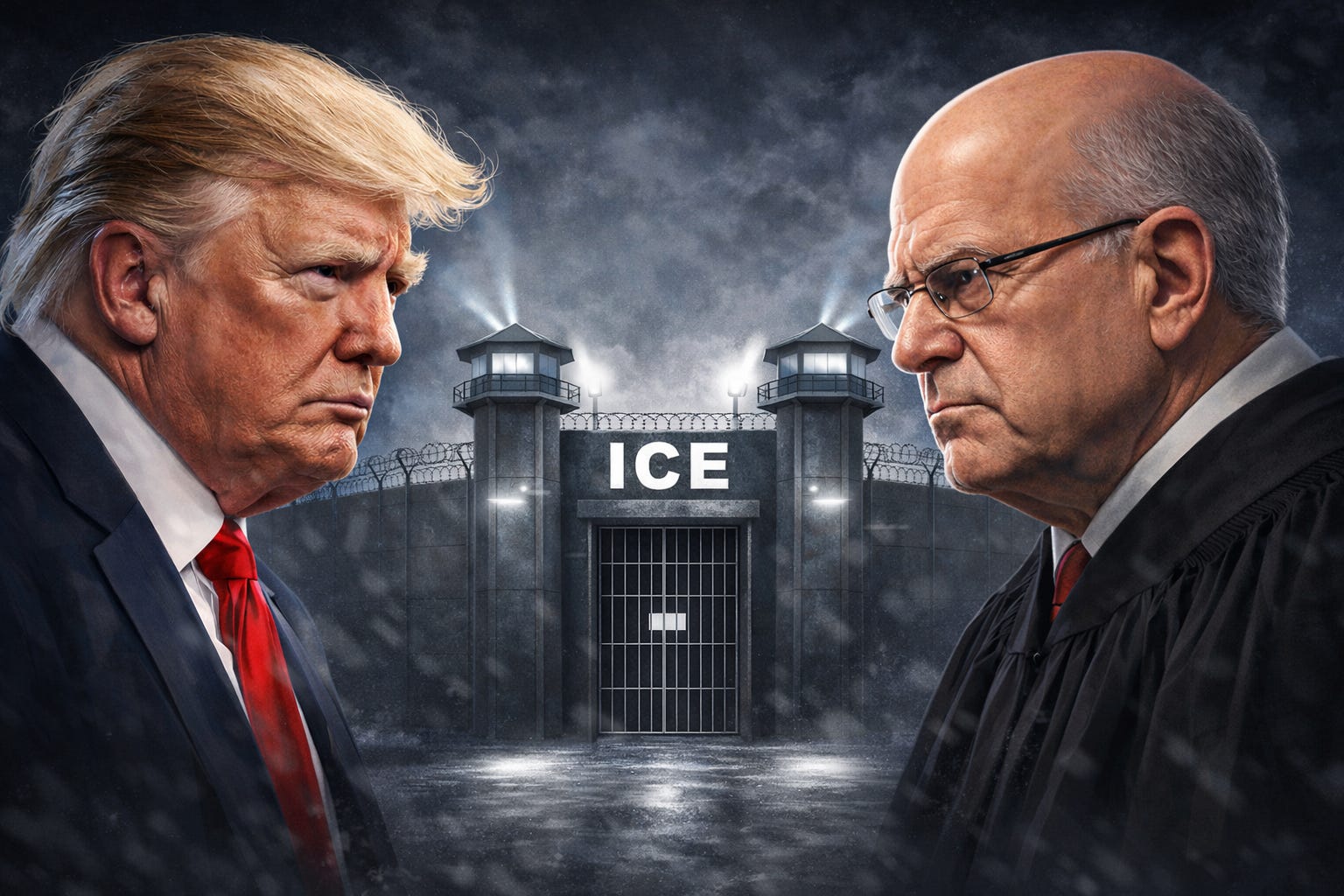
Happy Friday! In this week’s paid-subscriber deep dive, we’ll take a look at allegations that the Trump administration is flouting court orders in immigration cases — and examine the key legal dispute that has created these hundreds of cases in the first place.
Over the last year, I’ve been closely tracking an important question: whether the Trump administration is complying with the (many) court orders ruling against its actions.
My basic thesis has been this: There is no question President Trump is pushing the bounds of executive action in many areas. In some ways, what he is doing is unique. But in others, it represents a years-long trend of presidents trying to find ways to implement their agendas without Congress. As with his predecessors, many judges are striking down Trump’s most creative uses of executive action. As long as Trump complies with these rulings, I’ve written, his administration should be understood as an exacerbation of these confrontations between the executive and judicial branches, but not necessarily as a break from how they have historically played out. It would mean that Trump is trying to push the guardrails, but ultimately staying within them when they push back.
On the other hand, if he were to flout court orders, that would be crossing a big red line. It would mean there is little that could hem the president in, if he tries to subvert Congress and continues doing so whether or not his actions are blessed by the courts. It would mark the president as fundamentally lawless, every bit as free from checks and balances as his supporters boast and his opponents fear.
At the highest level, the Supreme Court, we know that Trump has (begrudgingly) complied with adverse rulings. The court ruled that the National Guard should be removed from Chicago, and it has been. The court ruled that Kilmar Abrego Garcia should be brought back to the U.S., and here he is. The court ruled that, at least for the time being, he cannot remove Fed governor Lisa Cook; she remains in office, and continues to vote on interest rates.
In perhaps the highest-profile example, exactly one week ago, the Supreme Court struck down the president’s signature economic policy, his sweeping global tariffs. Trump said that the justices were “an embarrassment to their families,” “a disgrace to our nation,” “disloyal to the Constitution,” and “swayed by foreign interests.”
But that was all rhetoric. In a legal sense, what mattered was Executive Order 14389, which was issued shortly after the ruling. “In light of recent events,” the executive order said, the tariffs imposed under nine previous executive orders — the ones at issue in the Supreme Court case — “shall no longer be in effect and, as soon as practicable, shall no longer be collected.”

I agree with the assessment of Jack Goldsmith, the former Bush-era Justice Department official:
The Trump press conference was an amazing portrait of a president who claims to be unbound by law seethingly acquiescing in a court ruling on “an important case to me” that he abhorred with every fiber of his body. It is clear the administration will use every alternative legal tool at its disposal to replicate or go further in deploying international economic weapons. That is its legal prerogative. But still, Trump’s anger combined with his acquiescence in the ruling elevated the Court and was a remarkable testament to its power.
Trump’s comments about the court only made him seem small. He can complain all he wants, in as hyperbolic terms as he wants, but at the end of the day, when the court told him to stop collecting certain tariffs, he did. Even Trump, as powerful as he imagines himself to be, has been too meek to cross that big red line, proving who (still) wields ultimate power in our system and who is left on the sidelines complaining about it.
As Goldsmith wrote, this analysis is not impacted at all by the fact that Trump is now using other statutes to impose other tariffs. The Supreme Court did not say “you can’t impose tariffs”; it said “you can’t impose tariffs under the International Emergency Economic Powers Act.” The court freely acknowledged that there are other statutes that do allow the president to impose tariffs (although, importantly, all of those statutes come with limits), and explicitly said that it was not ruling on the legality of Trump using those.
This is similar to how the Supreme Court did not tell Joe Biden “you can’t cancel student loan debt”; it said “you can’t cancel student loan debt under the Higher Education Relief Opportunities for Students Act.” Biden then tried to cancel student loan debt in other ways, which sparked their own legal battles, just as Trump’s newest tariffs will likely be met with court challenges as well.
But all of this has been about the Supreme Court, which is only one of more than 100 courts in our federal system.
Over the past few weeks, several of the judges in these lower courts have raised concerns about the Trump administration — and, specifically, Immigration and Customs Enforcement (ICE) — complying with their orders. In some cases, this has led to judges threatening to find the administration in contempt, the main weapon in a judge’s arsenal when met with a noncompliant litigant.
Many of these cases have involved the immigration crackdown in Minnesota; two judges in the state have gone so far as to find the Trump administration in civil contempt.
All of these allegations of noncompliance spring from cases dealing with the same, very specific legal dispute: a fight over the Trump administration interpreting a decades-old immigration statute in a new way. Many news outlets have covered the contempt findings, but few have gone into detail explaining the underlying dispute.
Below the fold, we’ll answer these questions: What is the important legal disagreement driving these cases? What does it mean for the administration to be held in civil contempt? Is it working?
Let’s dive in…