


Early last month, President Trump made a bold announcement on Truth Social.
Trump wanted the election bill known as the SAVE America Act to be passed by the Senate “immediately,” and he was prepared to amp up pressure on Congress to make it happen. “I, as President, will not sign other Bills until this is passed,” Trump threatened, a pledge that quickly made its way into headlines on NPR, NBC, Axios, and other outlets.
Seven weeks later, the SAVE America Act has not been passed. (In fact, the Senate hasn’t held a vote related to the bill in more than a month, ending a halfhearted attempt to consider the measure.) And yet, Trump has dropped his promise: since saying he would stop signing bills into law, the president has signed eight bills into law.
The most recent was on Monday, when Trump signed a measure undoing a Biden-era ban on mining in a Minnesota wilderness area. He has also signed bills awarding Medals of Honor to three veterans and posthumously promoting another, reauthorizing a program for small businesses, helping families recover art stolen in the Holocaust, and temporarily extending a key surveillance authority — all in violation of his March 8 pledge.
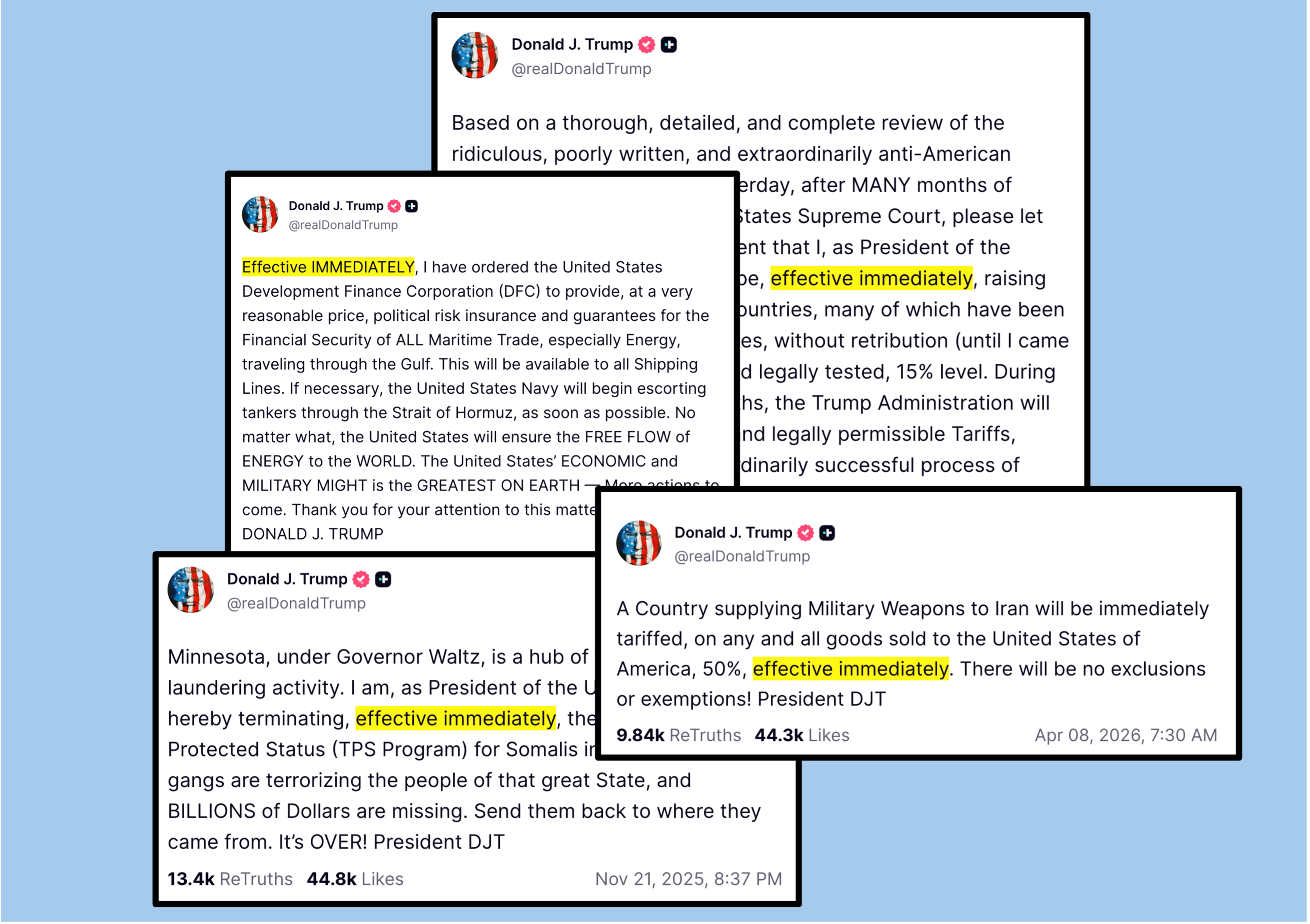
This has become a familiar pattern throughout the second Trump administration: The president announces a new policy initiative on Truth Social, often saying it will be “effective immediately.” News outlets send out “breaking news” alerts. Members of Congress issue statements. Furor ensues. And then … nothing happens. No executive order is signed. No new policy is put into place. Very rarely do news outlets return to their earlier stories broadcasting Trump’s initial missive and clarify that the thing he was announcing never came to pass.
According to a Wake Up To Politics analysis, since returning to office, Trump has issued 29 Truth Social posts announcing that policies would be “effective” or “starting” either immediately or on an upcoming date. Only nine of those actually happened as announced. Two-thirds of the time, when the president unveils a new initiative on social media, it does not materialize as promised.
There are different versions of this. Sometimes Trump will announce something, and literally nothing will happen, as if the president is just posting into the void. After the Supreme Court on February 20 struck down his tariffs imposed under the International Emergency Economic Powers Act (IEEPA), for example, Trump announced that he would impose a new 10% global tariff using a different legal authority. Trump signed an executive order implementing the policy that very evening.
But the next day, Trump announced that “effective immediately,” he would be raising the new global tariff to 15%. This time, however, no executive order followed. On March 4, Treasury Secretary Scott Bessent said the change would come that week. Nothing. On March 25, White House trade adviser Peter Navarro said Trump still planned to make the increase and that it was “in process” to take effect. (“I wouldn’t get too lost in the details on that,” Navarro said.) Still nothing. More than two months after Trump said the global tariff level would be raised to 15%, it remains at 10%.
Similarly, on April 8, Trump posted that any country “supplying Military Weapons to Iran will be immediately tariffed, on any and all goods sold to the United States of America, 50%, effective immediately.” It was not clear how Trump intended to impose such duties, since he doesn’t have much ability to tariff individual countries without IEEPA. White House economic adviser Kevin Hassett even suggested that Trump might actually use IEEPA, despite the Supreme Court’s ruling. But he hasn’t. Three weeks after Trump announced the 50% tariffs, they have yet to be put into effect.
I emailed the White House about these two tariff announcements — which Trump issued as fact, no caveats attached — in case I had missed any developments or they had any updates to share. “The Administration continues to work on the President’s policy initiatives to strangle the Iranian terror regime and defend American workers,” a spokesperson told me, offering no specific progress on a pair of policies Trump had promised to execute “immediately.”
Then there are policies that Trump announces that end up being much more limited than he described. On March 3, Trump announced that the Development Finance Corporation (DFC) would be offering “political risk insurance and guarantees for the Financial Security of ALL Maritime Trade, especially Energy, traveling through the Gulf” region. Three days later, the DFC announced a plan to offer reinsurance, not insurance, and only to certain vessels, not “ALL” of them.
On January 14, Trump announced that “EFFECTIVE FEBRUARY FIRST, NO MORE PAYMENTS WILL BE MADE BY THE FEDERAL GOVERNMENT TO STATES FOR THEIR CORRUPT CRIMINAL PROTECTION CENTERS KNOWN AS SANCTUARY CITIES.” On January 22, the White House ordered a review of federal funding for 14 Democratic-led states and Washington, D.C., though the memo made clear that it was a “data-gathering exercise only” and “does not involve withholding funds.”
As far as I can tell, no further steps have been taken to effectuate the payment cut-off Trump announced. “President Trump and his entire Administration have been clear that sanctuary cities put innocent Americans at risk and they cannot continue to ignore the rule of law,” the White House told me when I double-checked, again offering no specifics.
There are also initiatives Trump has announced that have been carried out, but not on the timeline that he promised. “I am, as President of the United States, hereby terminating, effective immediately, the Temporary Protected Status (TPS Program) for Somalis in Minnesota,” Trump wrote on November 21 last year, even though such a decision, by law, can only be made by the Secretary of Homeland Security and can’t be enacted immediately. The president had incorrectly written online that an entire group’s legal status in the country had been revoked, causing uncertainty for a whole population. Eventually, on January 14, then-Secretary Kristi Noem signed an order terminating TPS for Somalis, to take effect on March 17, almost four months after Trump’s original “effective” date. (A judge then paused the termination order. The Supreme Court will hear oral arguments today on the legality of two other TPS terminations.)
Last September, Trump announced that “starting October 1st, 2025,” 50% tariffs would be imposed on kitchen cabinets and bathroom vanities and 30% tariffs would be imposed on upholstered furniture. He then issued a proclamation issuing 25% tariffs on kitchen cabinets/bathroom vanities and upholstered furniture, stating that both would go into effect on October 14 and then rise to 50% and 30%, respectively, on January 1, 2026. The day before that deadline, on New Year’s Eve, Trump delayed the increases for another year, quietly punting tariffs that were supposed to take effect on October 1, 2025 to January 1, 2027.
At times, even when Trump has posted that “no extensions will be granted” to a certain deadline, a six-day extension to the deadline materializes, as happened with Trump’s global tariffs last summer.
Occasionally, Trump’s threats have been dropped because a deal with an adversary was struck before a deadline — although, just as often, they are dropped without any explanation, or the “deal” that was made ends up proving to be less than initially described.
On January 17, for instance, Trump said that tariffs against European countries would go into effect on February 1 in protest of the fact that the U.S. had not been given Greenland. Four days later, the threat was dropped after Trump announced that he had inked the “framework of a future deal” on Greenland. The details of the framework were never specified, and the “future deal” has not emerged or been mentioned by Trump since.

It’s important to note that I am not referring here to policies that Trump has tried to implement by executive order but was foiled by the courts, though that has happened too. This is a whole separate category of policies that haven’t even made it into an executive order: things that Trump said he would do, and then he himself failed to follow through on, or only followed through to a limited extent or after a delay.
Unlike in cases tied up in court, for instance, it is unquestionably within Trump’s power to stop signing legislation if he so chose. But even after making such a pledge, Trump has continued signing bills into law, without any acknowledgement that his highly publicized promise has fallen by the wayside.
The fact that the president announcing something does not necessarily mean that thing will happen (in fact, it usually means that thing won’t happen) is especially notable when that president is conducting a war, a time when Americans rely on the commander-in-chief for accurate information. But Trump’s narration of the war in Iran has often proven as flexible as his policy announcements.
It has now been 12 days since Trump told CBS News that Iran had “agreed to everything,” including removing its enriched uranium. No evidence has emerged in the intervening period to suggest that Iran has conceded to all (or any) of Trump’s demands as he claimed. Instead, negotiations continue — never mind that Trump said a month before that the war would only end in “unconditional surrender” by Iran, not by negotiated settlement. Trump wrote on Truth Social yesterday that Iran had informed him that “they want us to ‘Open the Hormuz Strait,’ as soon as possible.” It was not clear whether the president was communicating a genuine desire by our adversary for the critical channel to be opened, or merely making things up as he went along, even though that issue is one of the most sensitive points of the negotiations, with a large impact on stock markets and oil prices.
These episodes tell us something about the president, and something about covering him.
First, Trump is truly the Ad-Lib President. Presidential policy announcements and war updates were once picked over by several layers of advisers, lawyers, and generals. Now, they are dispensed by the president over Truth Social or brief phone interviews, apparently without much thought as to whether the thing being announced will actually take place. What was once the sturdy Word of the President has become flimsy and ephemeral, tumbling out of Trump’s mouth or social media feed but not always standing the test of time. Presidential announcements about rescinding pardons or reopening Alcatraz or offering stimulus checks have come and gone, without any sign that they lead to action in the White House.
Since many of these announcements have been threats, foreign adversaries like Iran or participants in trade negotiations are surely following this trend closely. The Madman Theory only works if your opponent takes you seriously, and thinks there is a sizable chance your words will be converted into actions.
Second, this is a lesson for news outlets covering the president. None of this means if the president announces something on Truth Social, it shouldn’t be covered. But there is a way to cover it responsibly, noting whether or not the policy is attached to a real executive order, and then whether that executive order is attached to a real statutory authority. Too often, news outlets fail to travel down that chain of reasoning. (In an age where many news consumers read only headlines, it is also important that caveats be added at the top, not just in paragraph 15.)
On January 9, for example, the White House shared a Truth Social post on X, writing: “President Donald J. Trump announces a one year cap on Credit Card Interest Rates of 10% effective January 20, 2026.” But if one read the Truth Social post, they would have seen that he had actually said “effective January 20, 2026, I, as President of the United States, am calling for a one year cap on Credit Card Interest Rates of 10%.” (Emphasis mine.) He was calling for a cap to be imposed, not imposing one (and confusingly adding an “effective” date regardless).
Some outlets took the White House’s word for it, however, giving Trump the headline he wanted: “Trump says he will temporarily cap credit card rates,” Politico blared. He has not done so, however, nor does he have the power to. No 10% cap on credit card interest rates has been put in place.

When journalists fail to report responsibly, you also have the tools to investigate yourself. If Trump makes an announcement on Truth Social, you can go to WhiteHouse.gov. Check under the “News” page and see if you see an executive order or proclamation that effectuates what was announced on social media. If you don’t, it may not actually be happening (and certainly not “immediately”). Even if you do see such an order, check whether it’s announcing a preliminary review or something like that, or actually carrying out Trump’s word.
The president’s social media feed is closely watched — and a key driver of clicks, headlines, and commentary — but there is no guarantee that a policy announced there will transpire in the way he says it will.
In fact, there’s a two-thirds chance it won’t.
I recall some months ago asking on one of your posts why trump’s Truth social posts were being used as a source for this reason. Do you think you are alone as a journalist in your questioning of using it as a source to respond to every time there’s a post or are others catching on?
Thank-you for putting this together in such an easy to follow summary of what is (or isn't!) going on.
Just the other day my wife and I were talking about Tariffs and whether the "basic" ones were 10% or 15%... each of us was convinced it was a different number. And, I guess we were both right.
Personally, when I see these pronouncements ~ many arriving in the middle of the night ~ I try to follow-up on them to understand what they really mean but it is a daunting task as so much of it is disconnected to anything real. And certainly not the legislative or regulatory process: much of it is the power of "magical thinking" by a man who is loath to do the work or handle the follow-up.
Clearly our Media needs to do a better job of tracking these "effective immediately" annoucements after they are announced.
This is a good piece of reporting by WUTP as it clearly places us in the real world of what is and not the world of "magical thinking" that the President simply wishes it was.