


Good morning! It’s Monday, July 20, 2026.
Probably the most common question I receive from readers, in regard to all sorts of different news stories or events, is: Is this normal? It’s one of my favorite roles to serve at Wake Up To Politics: offering the historical context to be able to say whether something truly lacks precedent, or whether it just feels unusual.
In the 250-year annals of American politics, there is usually some parallel that can be drawn. History does tend to repeat itself.
This morning, I’ll be answering two such reader questions: one about family members being appointed to succeed their deceased relatives in the Senate, the other about whether this Supreme Court overturns more precedents than the court has in the past.
But first, some headlines:
Three U.S. service members have been killed in the Middle East since Friday, two in an Iranian strike on a base in Jordan and one during a controlled detonation of an Iranian drone in Iraq. That brings the total American casualties in the war with Iran to 17.
Andy Burnham is the new Prime Minister of the United Kingdom, the country’s seventh leader in 10 years.
Former state Senate president Troy Jackson has emerged as the presumptive Maine Democratic Senate nominee, after several of his top rivals ended their campaigns once the Graham Platner-aligned candidate received the support of a majority of delegates to next weekend’s state convention.
Vice President JD Vance and Second Lady Usha Vance welcomed their fourth child, Alec Neel Vance, on Sunday. Vance is the first vice president to have a child in office since Ulysses S. Grant’s VP, Schuyler Colfax, in 1870.
If you want to support my work bringing historical context to the news, you can click here to become a paid subscriber:
Now, let’s dive in:
All in the family
Q: I’d love to hear more about what if any precedent there is for family members of deceased politicians being appointed to finish their terms. I remember there being movement to have Cindy McCain finish her husband’s term when he passed away but that never came to fruition unlike with Lindsey Graham’s sister being appointed to his seat.
When Darline Graham was appointed last week to finish the term of her brother, the late Sen. Lindsey Graham (R-SC), she was joining a long historical tradition of relatives (usually wives) being appointed to succeed deceased senators.
In fact, this practice (known as “widow’s succession”) was once the most common pipeline for women to enter the Senate. Of the first 14 women to serve in the U.S. Senate: six were appointed to succeed their late husbands, a seventh won a special election to succeed her late husband, and an eighth was a congresswoman whose political career started when she won her late husband’s House seat.
Two more were appointed to the Senate by their husbands (who were serving as governors at the time), and a third was the daughter of a former governor in her state, which means 11 of the first 14 female senators had some sort of political familial connection.
There are no interim appointments for vacant House seats, but 18 of the first 32 congresswomen similarly entered the House by winning seats previously held by deceased relatives.
Over the years, this sort of succession has elevated wives, daughters, sons, brothers, and grandsons. Darline Graham is the first sister to enter Congress in this fashion.
Some of the “widow successors” simply finished the term of their late husband and then left Congress. Others went on to illustrious political careers in their own right, sometimes serving even longer than their husbands ever had. Margaret Chase Smith is one example of this: the Maine Republican was elected to her late husband’s House seat, then went on to serve nine years in the House and 24 more in the Senate, where she served in GOP leadership and became an early critic of Joe McCarthy with her famous “Declaration of Conscience.”
Another example is Edith Nourse Rogers, who won her late husband’s House seat in a special election and went on to serve for 35 years in Congress. Rogers was one of the first lawmakers to speak out against Nazism during Adolf Hitler’s early rise; she introduced a bill in 1939, shortly after Kristallnacht, that would have brought 20,000 Jewish children to the U.S. from Germany. The measure never passed. (Rogers also once talked down a gunman who entered the House chamber in 1932, using her training as a counselor to shellshocked World War I veterans.)
When Darline Graham was first appointed, it was assumed that she would serve merely as a placeholder until South Carolina elects a new senator in November. Now, however, it looks like she might stick around Washington for longer: President Trump has said if Graham runs for a six-year term in the seat, she would have his endorsement. She has not yet announced her plans.
GOP Reps. Russell Fry and Ralph Norman have both announced campaigns for the seat, despite Trump endorsing Graham. Sens. Mike Lee (R-UT) and Rick Scott (R-FL) have endorsed Norman, breaking with the president.
Although it used to be common for relatives to succeed deceased members of Congress, one reason the Graham succession might have struck some people as unusual is that, at least in the Senate, it hasn’t happened for a while. The last time it happened in the Senate was 1999, when Lincoln Chafee was appointed to succeed his late father, or 2001, if you count Jean Carnahan being appointed to fill the seat left empty by the death of her husband, a senator-elect who died shortly before Election Day (and still won!) but never technically held the seat himself.1
There are more recent examples in the House, including sitting Reps. Doris Matsui (succeeded her late husband), Adelita Grijalva (succeeded her late father), André Carson (succeeded his late grandmother), and Julia Letlow (her late husband was a congressman-elect).
One more thing to note. There is also a tradition in Congress known as a “death gratuity,” which is when a sitting senator or House member passes away and their colleagues pass a law giving their heirs a one-time payment equal to their full annual salary (generally $174,000).
This tradition dates back to at least the 19th century; according to the National Taxpayers Union Foundation (NTUF), Congress has approved more than $7 million in these payments since 2000. As the NTUF notes, although this started as a way to help widows who were struggling to make ends meet after the death of their husbands, it now generally has the effect of helping families who are already multi-millionaires.
Sure enough, the new government funding bill proposed by House Republican leaders includes death gratuity benefits for the widow of the late Rep. David Scott (D-GA), who died in April, and for the “heirs at law of Lindsey Graham.”
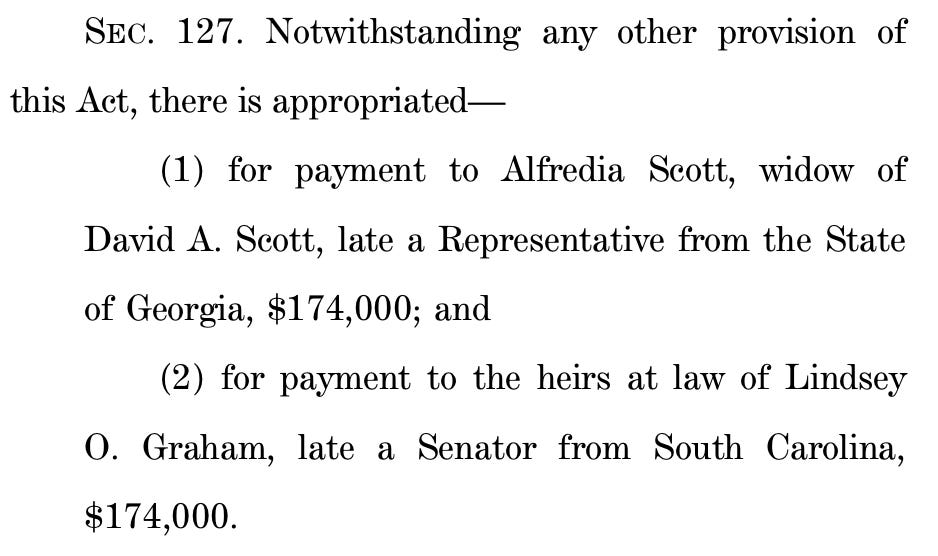
If the funding bill passes, that means Darline Graham would be receiving a salary as a senator as well as an entire year’s salary of her brother’s. The death gratuity benefits are not considered taxable income.
The precedent of overturning precedent
Q: I’m interested to know more about the precedent in the Supreme Court with regards to overturning precedent. I understand that stare decisis is not an absolute and there are many examples (Brown v. Board, Citizens United, Dobbs) where prior decisions have been overturned. What I’m curious to know is how common it is.
It feels like the Roberts Court has overturned precedent quite a lot, but is that just because of the political nature of the cases overturned (e.g. Roe, Humphrey’s Executor) or is there something more there?
Stare decisis (Latin for “to stand by things decided”) is the broad principle that the Supreme Court will generally abide by its own precedents when substantially similar cases come before them — though, as the questioner notes, it is not absolute and there are exceptions in every generation.
This term alone, the justices overturned a 1935 case called Humphrey’s Executor when ruling (in Trump v. Slaughter) that the president could fire independent agency officials and a 2001 case known as Colorado II when ruling (in NRSC v. FEC) against limits on how much money political parties can spend in coordination with their candidates.
In recent years, the Roberts Court has also overturned major precedents like Roe v. Wade (on abortion rights, in 2022) and Chevron v. NRDC (on deferring to agency interpretations when ruling on regulations, in 2024).
However, the answer is that the Roberts Court does not overturn precedents any more frequently than other modern iterations of the court.
As this chart from Pew Research Center shows, since John Roberts took over as Chief Justice in 2005, 1.4% of Supreme Court cases have overturned an earlier decision. That is slightly less than the two 20-year periods between 1965 and 2004, and on par with the two 20-year periods between 1924 and 1964. It is more than was the norm in the 1800s and early 1900s, though in fairness, there were fewer precedents to overturn back then.
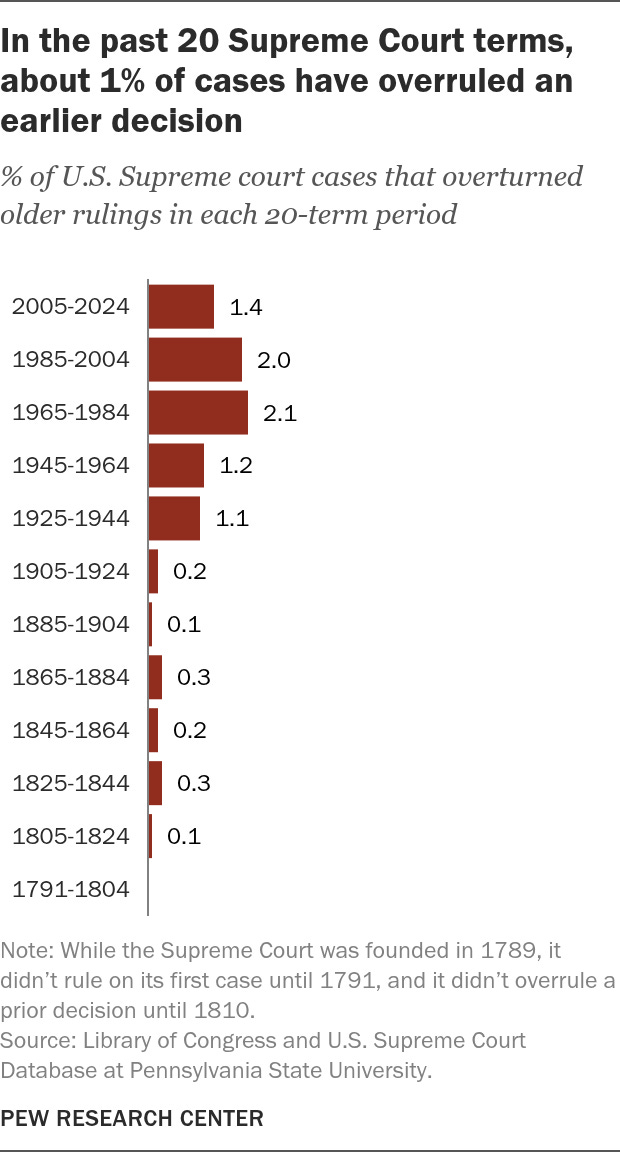
The point is, however: the Roberts Court overturns precedent at the same rate (or slightly less) as the court has for the last century.
There was also a 2024 study that looked at the court by chief justice, and came away with similar findings: the Roberts Court (2005-present) has overturned an average of 1.6 precedents per term, fewer than when the court was led by Chief Justices Earl Warren (3.1/term, 1953-1969), Warren Burger (3.4/term, 1969-1986), or William Rehnquist (2.4/term, 1986-2005). The study also noted that, in just the years between 2017 and 2024, the Roberts Court had overturned 2.2 precedents per term — representing a slight uptick since the conservative majority began to be solidified during the Trump era, but still down from previous chief justices.
If you’re wondering whether the difference is the salience of the overturned precedents, the study looked at that too. Measuring salience by whether the overturning of a precedent received front-page coverage in the New York Times (a fairly common political science measure), the overrulings were on salient cases 61% of the time during the Warren era, 28% of the time during the Burger era, 42% of the time during the Rehnquist era, and 41% of the time during the Roberts era.
So, again, the Roberts Court does not stick out as much of an outlier.
One thing I will note is that these stats are generally drawn from lists of cases where the court completely and explicitly overturned an earlier precedent (one such list is here). But the court can also substantially weaken or alter a precedent without entirely striking it down.
We saw several examples of that in recent terms, like when the Supreme Court (in Louisiana v. Callais this year) changed the framework for considering racial gerrymandering set by Thornburg v. Gingles (1986) without overturning the case outright. “This interpretation of [Section 2 of the Voting Rights Act] does not require abandonment of the Gingles framework,” Justice Samuel Alito wrote in the majority opinion. “We need only update the framework so it aligns with the statutory text and reflects important developments since we decided Gingles 40 years ago.”
Justice Elena Kagan, in dissent, accused the court of overturning Gingles without admitting to it. “The upshot is that the majority, without any good reason, has overturned Congress’s studied determination—along with this Court’s precedents upholding it—about how to rectify racial inequalities in electoral politics,” she wrote, adding: “Under the guise of ‘updat[ing]’ the Gingles framework, the majority transforms it.”
A similar back-and-forth took place in Students for Fair Admissions v. Harvard (2023), when Justices Sonia Sotomayor (in dissent) and Clarence Thomas (in a concurrence) expressed their belief that the court was functionally overturning its precedents on affirmative action, even though the majority opinion by Chief Justice John Roberts did not do so explicitly.
This is reason to believe that the number of decisions that overturn previous rulings might be slightly higher than the studies say (if you choose to include weakened precedents as well as formally stricken ones), but not necessarily a reason to believe it changes the analysis of which iterations of the court have been more likely to break with precedent, since the court engaged in this same practice under previous chief justices as well.
In general, if you’re wondering when the court overturns precedent and when it doesn’t, Alito’s majority opinion in Dobbs pretty comprehensively lays out the five factors the current iteration of the court uses (or, at least, says it uses) when considering whether to put stare decisis aside. Keep in mind when reading this, if stare decisis is coming into play, the assumption is already that the current court thinks the previous court got something wrong (if they got the old case right, you wouldn’t need stare decisis, you would merely reaffirm the precedent on its own merits).
But the court uses these five factors to decide how wrong the previous court was, and whether that wrongness tips into needing to overrule the precedent:
“The nature of the Court’s error.” (How damaging has the wrongness been?)
“The quality of the reasoning.” (How badly did the court get it wrong?)
“Workability.” (Did the court set out a standard that can still be practically applied?)
“Effect on other areas of law.” (Has the court’s wrongness had negative effects on other case law?)
“Reliance interests.” (How many people have made plans or decisions that rely on the precedent remaining in place?)
According to the available stats, on average, about once or twice a term, the Roberts Court looks at those five factors and decides that a previous ruling is so egregiously wrong that it’s got to go.
There is also Lisa Murkowski, who was appointed by her father Frank to fill the remainder of his seat after he left the Senate to become governor in 2002, though that wasn’t because of a death.
Thank you for starting with the observation that feelings are a terrible guide to reality. If only people would quit relying on feelings instead of reality, maybe our times wouldn’t feel so fraught (pun intended).
Okay, so I guess a separate question is, how often has this Court ignored, overridden, or struck down federal or state laws compared to others?