


What a strange, improbable adventure we have all been on together for the last decade and change.
If you told someone in April 2015 that — outside of friends and family — one of the people they would spend the most time thinking, talking, and hearing about for the next 11 years would be the New York real estate developer Donald Trump, they surely wouldn’t have believed you.
Trump was already well-known, of course, but the idea that he would not only win the presidency (unlikely in itself) but then wedge himself into the national psyche to the degree that he has would have seemed fantastical. But here we are. For the last decade, Trump has loomed inescapably not just over American politics, but often American business, academia, culture, and sports as well.
At this point, the only thing that sounds more fanciful than telling someone c. 2015 that Trump would have such an impact on American life is telling someone now that it might not last for very long.
But come January 2029, Donald Trump will not be the president anymore. (Even he no longer pretends a third term is a possibility.) He will still hold influence within his party, of course, but at age 82 and with his popularity likely to be middling to low, his political strength can be expected to ebb.
It’s worth beginning to discuss what this handoff will look like. After (by that point) 14 years of Trump as the central figure of American politics, what will he have changed for good? What will prove to only have been Trump-specific aberrations? Today, we’ll look at two facets of Trump’s political style — personality and ideology — and probe whether he is likely to leave a lasting mark.
Personality
There is a widespread impulse to look at Trump’s relative political success and declare the death of the political scandal.
This is understandable: after all, Trump has been impeached twice (for attempting to coerce a foreign country to investigate his political rival and for standing by while a mob attacked the U.S. Capitol in hopes of blocking the certification of his re-election loss); indicted four times (twice for those efforts to overturn a presidential election, once for hoarding classified documents, and once in relation to hush money paid to a porn star he allegedly had an affair with); and found himself ensnarled in countless other, typically-career-ending controversies (from being accused of sexual assault to profiting off his office to repeating thousands of documented falsehoods).
And yet, here he is, serving his second term as president.
But, so far, politicians who have tried to ape Trump’s abrasive personality or his response to political scandal (deny, deflect, double down) have largely failed. In competitive states, MAGA acolytes like Kari Lake and Blake Masters (Arizona) or Doug Mastriano and Dr. Oz (Pennsylvania) have gone down in flames, as have scandal-plagued candidates like Herschel Walker (Georgia) and Mark Robinson (North Carolina). Even in non-competitive states, we saw deep-red Alabama elect a Democrat in Doug Jones rather than an alleged child molester in Roy Moore in 2018.
If you need more evidence, just look at the twin resignations yesterday of Reps. Eric Swalwell (D-CA) and Tony Gonzales (R-TX) for, respectively, allegedly sexually assaulting multiple women, including one who says that she was drugged, and allegedly having an affair with a staffer who later killed herself.

Did it take too long for the behavior of both men to be made public and acted upon? Yes. Are there cases where politicians mired in scandal manage to hang on? Also yes: think Democrats like Ralph Northam or Jay Jones, or Republican Cory Mills right now (though Mills faces the same threat of potential expulsion that Swalwell and Gonzales did before resigning).
But those are the exceptions that prove the rule. The political graveyard is littered with recent politicians who thought the rules of scandal no longer applied and then learned otherwise: Andrew Cuomo. Eric Greitens. Bob Menendez. Duncan Hunter. Al Franken.
There is also a special class of Democrats and Republicans who were such pure creations of the Trump era: politicians, many of them scandal-plagued themselves, who tried to channel Trump’s combative energy into political success and media prowess on the left and right. So many of them (Matt Gaetz, Cori Bush, Madison Cawthorn, Jamaal Bowman, George Santos, Jasmine Crockett, MTG) have since flamed out.
Why has Trump succeeded where others have failed?
Maybe he has forged a unique connection with his party’s voters that is just hard to replicate. Maybe voters view him as a celebrity, not a politician, and therefore hold him to different standards. Maybe his scandals really have hurt him, but he’s managed to scrape by: after all, you could argue that the elections in 2016 (after eight years of Democratic rule) and 2024 (after a deeply unpopular Democratic administration) should have been larger Republican victories, and maybe they would have been with a less controversial GOP candidate.
Either way, the future does not look bright for Trump imitators, since so few of them have achieved success over the last 10 years, and certainly not in the competitive states needed to win the presidency. I have no doubt we’ll see candidates who will try out this lane in the years to come, and perhaps the strategy will work better for a celebrity-turned-politician (Stephen A. Smith? Tucker Carlson? Mark Cuban?)
But, for the most part, the rules of politics seem to be largely unchanged from where they were in 2016, with a big, Trump-shaped exception. I’m sometimes asked if I think every president will just try to name buildings after themselves now, or roll out their own cryptocurrencies. And my honest answer is “no.” Perhaps it’s naive — and, again, if it’s a celebrity like one of those above, then my answer might be different — but when I look around at the leading candidates likely to emerge in 2028, from JD Vance to Gavin Newsom, Trump’s personality, shamelessness, and in-party immunity by way of rock-solid support from a committed base really does seem completely sui generis.
There are no other major politicians for whom it would even occur to them to do something like post a photo of themselves as Jesus, much less be able to get away with it (to the extent that deleting the photo amid backlash, and polling at 40% is “getting away with it”). These parts of Trump are the ones that have, largely, worked against him: not enough to keep him out of the White House, but enough to make him persistently unpopular the whole time he’s been there. There is a reason why, even when politicians like Newsom have tried to copy the style, they’ve stopped after a while. When was the last time you heard about a Newsom-as-Trump post? Almost every other major politician today, besides the president, came up within the political system, which means they just instinctually adhere to a different set of norms. The ones who have tried departing from them have largely realized, when anyone else does it, it comes off as ineffective or inauthentic.
Trump is one of one, and at least with the potential contenders we have right now, there isn’t much reason to believe the next president will be anywhere near as brazenly self-promotional or scandal-plagued. It is a fascinating sociological phenomenon that Trump has been able to remain so powerful in politics for so long despite these controversies, but it appears to be one specific to him and him alone.
This doesn’t mean everything will snap back to “normal” the minute Trump leaves office. Politics have, in many ways, grown angrier over the last decade, and a lot less buttoned-up. Social media has become a more important mode for politicians to communicate with their followers, often in Trump’s style of less nuanced, more emotional bursts — though that presumably would have happened without Trump, and the medium that he excelled at (short-form text posts) already seems to have been made outdated by short-form video (think Zohran Mamdani).
But there is little reason to believe the Trump strategy of barreling through scandals, or doing needlessly inflammatory, self-serving things (like selling their own Bibles or reveling in the death of a political foe) will appeal to other politicians, or work out for them. That stuff is only Trump. There is truly no other politician on the scene like him, and those who have tried, have failed. It appears that the personal style of American politicians after Trump will be less changed by his 14 years of dominance than one might otherwise have thought.
Ideology
Here is a question from a reader I recently received:
Can you assess whether groups like the DSA (which I see as an equal/opposite reaction to MAGA) will continue to rise in power/see greater numbers elected to office? Are we in a 20-30 year cycle of MAGA v. DSA w/ no middle?
The DSA is the Democratic Socialists of America, the leftist group that counts Bernie Sanders, AOC, and Zohran Mamdani as members.
Another assertion frequently heard about the Trump era is that it has ushered in an age of extremes, in which American politics will now be gripped by a contest between the far-left and the far-right, with the center squeezed into extinction.
Clearly, even if the type of personalities that succeed in American politics have more or less remained the same since 2015 (outside of Trump himself), the sort of ideas on offer have undergone a change. Trump has shifted the Overton window of acceptable policy ideas within the GOP, and that same window for the Democratic Party has shifted in response.
However, when we look at swing states, we once again see the limits of that logic, at least in terms of what it portends for national politics. Here are the top statewide elected officials in the seven states that perennially decide the presidency:

There are 15 Democrats, none of whom are DSA-aligned: the one who comes closest, ironically, is Pennsylvania Sen. John Fetterman, a onetime Bernie Sanders supporter who was seen as the left-wing choice when he ran in the 2022 Senate primary but who has since fallen out with the left over Israel and moved much more to the ideological center.
The story for the six Republicans is a bit more complicated. Two of the six (term-limited Georgia Gov. Brian Kemp and retiring North Carolina Sen. Thom Tillis) are clearly not MAGA; in fact, they have repeatedly clashed with Trump. The other four could all be considered MAGA to some degree, but none fit the image of a pure Trump booster.
Nevada Gov. Joe Lombardo has tried to distance himself from Trump, bashing his election denial efforts and saying in 2022 that he wouldn’t call Trump a “great” president. (“He was a sound president,” Lombardo compromised.) North Carolina Sen. Ted Budd and Pennsylvania Sen. Dave McCormick are both Trump allies, though — as a former congressman and a former hedge fund manager, respectively — they very much fit the mold of Republicans who would have been elected before Trump. And they’ve both split with him at times: Budd has criticized the Trump administration’s immigration enforcement, while McCormick is a Russia hawk who has defended Volodymyr Zelensky against Trump’s criticism.
Wisconsin Sen. Ron Johnson is the only member of the group who’s held his current position since before Trump took office, and yet he is probably the Trumpiest among them. (“Ron, is there any conspiracy you don’t believe?” Mitt Romney once asked him.) Even he, though, has raised concerns about Trump’s tariffs. Johnson’s Senate website still has language up that refers to the “self-inflicted harm from the trade war and tariffs” of Trump’s first term.
(Then again, what does it mean to be “MAGA” at this point, and who would be considered a pure distillation of it? At one point, you might have pointed to someone like Marjorie Taylor Greene; clearly, not anymore. The number of Republicans who march lockstep with Trump, so high a year ago, is dwindling, such that it’s now impossible to point to a potential Trump successor who would cleanly export his checkered ideology. A Carlson or a Vance would likely handle a situation like Iran differently; a Marco Rubio would approach the Ukraine war and NATO from a very un-Trump lens; a Ted Cruz wouldn’t impose tariffs. Republican elites have bought into some parts of Trumpism, but he hasn’t really persuaded any of them to embrace the full package, another reason to doubt the staying power of his thinking.)
But back to swing states. The reason I focus on those seven states is that the road to the presidency runs through them, so they give us an idea of the sensibilities and ideologies that can work, not just in deep-red and deep-blue districts, but on the national level. Of course, presidential elections are different than statewide elections: they attract different electorates, and because of the higher stakes, voters might feel more compelled to support their party’s nominee, even if a low-turnout primary process produces a candidate too extreme for their tastes.
So none of this should be read to rule out prominent MAGA or DSA politicians, or even presidential nominees, down the line. But the fact that you don’t see many of these types excelling in the decisive states is one reason to wonder whether our political future will be gripped by the far-right and the far-left, rather than the more mild-mannered and ideologically centrist Dave McCormicks or Elissa Slotkins of the world. Once again, Trump emerges not as a rule but an exception: really the only pure example of a politician to come out of either movement and go on to find (razor-thin) success in the states that decide control of the Senate and the White House.
Still, you cannot look at American politics today and pretend that MAGA and the DSA are not substantial forces; indeed, one controls the levers of the Republican Party (though it’s unclear what that will mean after Trump: is there a set ideology that indicates, or was it just fealty to a person who will have left the stage?) and the other came relatively close to winning two successive Democratic presidential nominations. Will the influence both achieved over their party ideologies in the Trump era continue once he’s gone?
Directionally, I do think it’s clear that these movements represent where both parties (and our country) are drifting to some degree. The historian Gary Gerstle has defined a “political order” as a “constellation of ideologies, policies, and constituencies that shape American politics in ways that endure beyond the two-, four-, and six-year election cycles.” Importantly, he adds, a way of thinking has only made itself into a political order when it permeates the ideology of both political parties.
I like to think of this as a political lingua franca, or common tongue. So, for example, Gerstle says that America was defined by the New Deal order from roughly the 1930s to the 1970s. You can think of this as meaning that both parties spoke the common language of the New Deal: they might have interepreted it differently, but they were working within a shared framework of government intervention, whether it was FDR and LBJ setting up big-government programs or Eisenhower and Nixon keeping them in place and, at times, expanding them. (Which president built the interstate highways, or founded the EPA?)
Then, from roughly the 1980s until the 2020s, America was defined by a neoliberal order, Gerstle writes, in that leaders of both parties — be they Ronald Reagan and George W. Bush or Bill Clinton and Barack Obama — shared a basic faith in free markets. They obviously did not agree all the time, but they shared a common tongue and common baseline, leading to bipartisan free-trade deals like NAFTA and declarations like “the era of big government is over” (a Clinton line that just as easily could have been from Reagan).
Now, it seems likely that the new political order will be populism, the common tongue that increasingly binds together many in both parties — and is spoken most fluently by disciples of MAGA and the DSA.
If that’s the case, then this will likely be Trump’s greatest legacy, ushering the neoliberal political order out and a populist political order in. How much credit should he truly receive for that? I think it’s open for debate: after all, populist forces were already brewing here and abroad before Trump’s first term, and the feedback loop of political orders suggests that they may have seized hold even without him. (Just as the failings of laissez-faire governance gave way to the New Deal and the failings of big-government gave way to neoliberalism, the failings of free-market fealty likely would have anti-establishment energy and a desire for greater government intervention before long.)
Trump has also been a very imperfect populist: his One Big Beautiful Bill fits much more neatly in the neoliberal order; he no longer seems so interested in antitrust enforcement; his efforts to block AI regulation hardly seem in line with the populist energy of the moment.
The New Deal order began under FDR and the neoliberal order began under Reagan (not coincidentally, the recent political leaders who held center stage for almost as long as Trump). But the seeds were started to be sown under their predecessors, from Herbert Hoover’s public works programs to Jimmy Carter’s deregulation. Another academic, Stephen Skowronek, has referred to Hoover and Carter as “disjunctive” presidents for their awkward attempts to straddle two regimes.
If we are, indeed, on the cusp of a populist order, then my guess is Trump will be seen as the one who brought it into being — though he may be more accurately categorized as a president who started to sow the seeds of something new, but never fully committed to it himself, having (like Hoover and Carter) come up during the old order.
This all depends, of course, on who comes after him. If Trump is succeeded as president by JD Vance or Tucker Carlson from the right, or Alexandria Ocasio-Cortez or Ro Khanna from the left, then they could end up marking the true beginning of a populist order, building on the trail Trump blazed but never completed.
On the other hand, there is a class of potential Trump successors who would make Trump seem less like a bridge to a populist order and more like a bridge to nowhere. Potential 48th presidents like Marco Rubio or Ted Cruz on the right, or Kamala Harris or Gavin Newsom on the left, are all figures who easily could have been presidential nominees in 2012, before Trump was on the stage. If they are elected, they might make some moves away from their party orthodoxies, but it would suggest that Trumpist populism was more of a flash in the pan, and American politics is actually about to revert to an ideological arrangement closer to the Bush- or Obama-era status quo.
There are also candidates who fit more of a middle ground, like Ron DeSantis (a largely pre-Trump figure who has nevertheless embraced the anti-woke element of Trumpism) or Chris Murphy and Jon Ossoff (who have tried to reinvent themselves as populists in the last year).
Echelon Insights, the Republican polling firm, arranges American voters into four groups based on how they answer 18 questions on social and economic policy: those who are culturally and economically conservative (“Conservatives”), culturally and economically liberal (“Liberals”), culturally liberal and fiscally conservative (“Libertarians”), and culturally conservative and fiscally liberal (“Populists”).
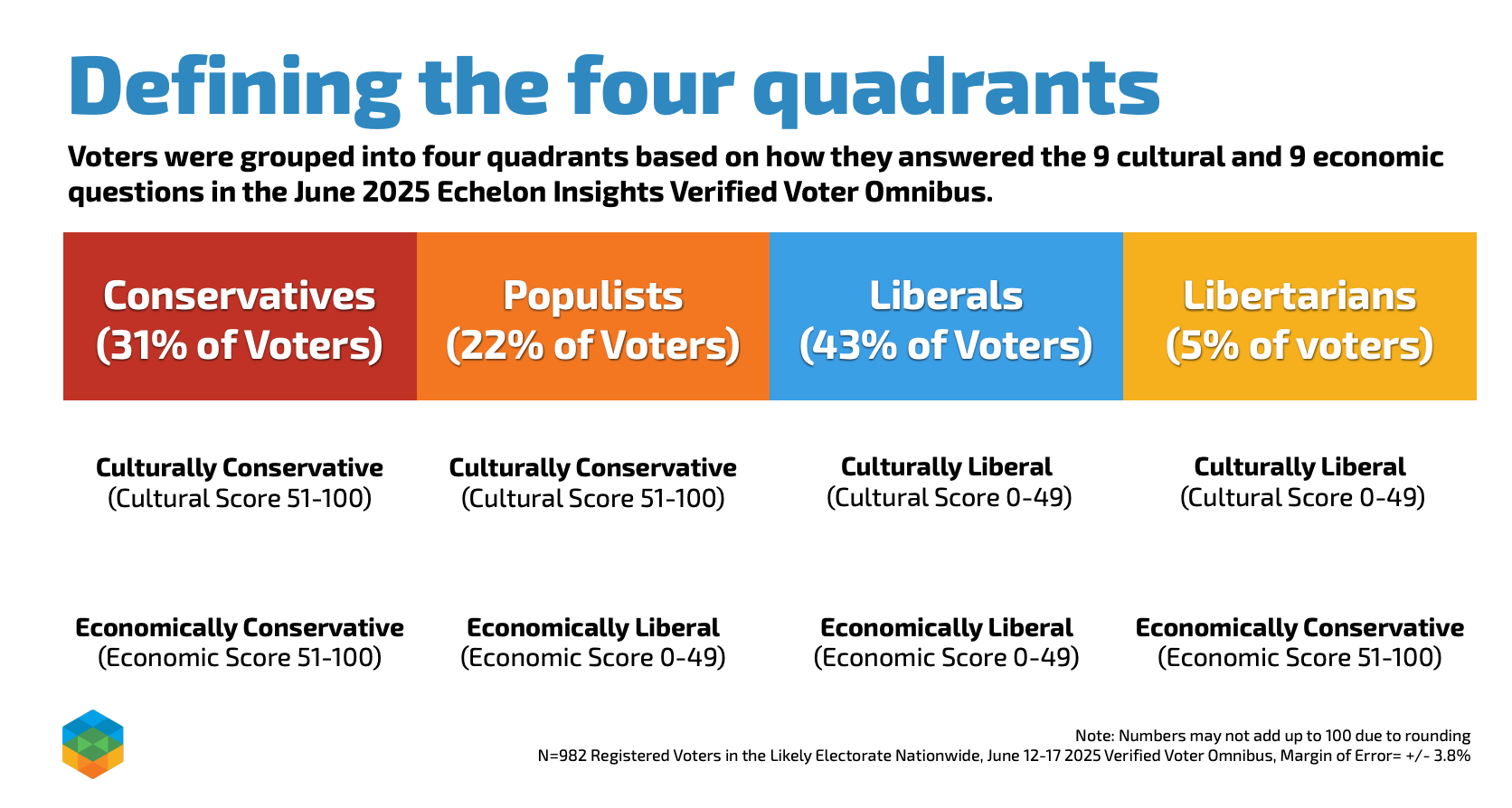
Conservatives and Liberals, unsurprisingly, voted near-unanimously for Trump and Harris, respectively, in 2024. The true swing voters are the Populists, 66% of whom voted for Trump in 2024 but only 56% of whom approved of his job performance as of an Echelon poll last year. (Libertarians are also politically divided, but at 5% of the country vs. Populists’ 22%, they make up a much less meaningful slice of the electorate.)
Echelon also found that the median American’s ideology is closest to the socially conservative/economically liberal Populist pairing: majorities of voters sided with the conservative view on five of the nine social policy questions they asked, and with the liberal view on eight of the nine economic policy questions.
It’s clearly a politically potent combination; one question I have for the years ahead is whether either party ever tries it out. Trump had a chance to seize this mantle, but has never been as economically liberal as his campaign rhetoric suggested. (Unlike, for example, JD Vance, who reportedly pushed for tax hikes on the rich in the Big Beautiful Bill). Most leftist Democrats, meanwhile, are far from socially conservative (although an earlier, pro-gun, anti-immigration iteration of Bernie Sanders came close).
Whether MAGA or the DSA gets there first — or, at least, whichever one moderates their economic or social policy, respectively, in a way that manages to simultaneously appeal to their party base and to independent voters — may dictate who controls the future of American politics. (And just as the New Deal and neoliberal orders contained their share of bipartisan successes, it is possible to glimpse similar cross-party efforts if populism becomes the common tongue. Look no further than the recent MTG/Khanna publicity tour, or Josh Hawley’s work with Sanders or Elizabeth Warren.)
But, at this late stage, it doesn’t seem like the politician to reach that fusion will be Trump. Is it possible to rule over American politics for this long and leave only a limited impact? Sure: Grover Cleveland, who similarly served two terms over a 12-year period, is hardly regarded as a transformational figure. Cleveland, like Trump — and unlike transformative presidents like FDR or Reagan — never managed to form a large majority behind his views. Cleveland served in a time of peak division, which ended up being broken not by one man’s extended time in office but by the realigning election of William McKinley, his successor.
Trump is fundamentally disinterested in policy, abhors bipartisanship, avoids the work of building broad-based consensus among voters or legislators, has not tried to build a bench of ideologically similar heirs (caring only if up-and-coming politicians are loyal to him personally), and often prefers to focus either on private efforts to aggrandize himself or temporary executive orders, which limits his ability to join the pantheon of transformative presidents like FDR or Reagan, for whom the opposite qualities were true, and whose policies and lasting legislative packages set the terms of debate in American politics for decades as a result. (Trump is also personally wealthy and enamored of industry and military force in ways that made him a poor fit specifically for the populist economic and foreign policies of the moment.) Even given opportunities, almost in spite of himself, to usher in major legislative compromises or realign segments of the electorate in a lasting way, Trump opted against doing so.
Especially if he is succeeded by a candidate in the populist mold — on the left or right — Trump, by dint of his dramatic rise and outsized personality, will likely receive credit for ushering in a new era. Some of it will be deserved. But does that mean the new order will revolve around his policy views, with Trump setting the boundaries of debate for the near future? In areas like immigration or “wokeness,” possibly. In areas like taxes, trade, or military intervention, probably not, since his views on these issues are either situation-dependent or unpopular within the country or his party.
Rather than initiating a broader era that goes beyond him, Trump is likely to leave office with enormous questions looming about the future of politics that he shows no interest in answering. The real work of cobbling together the electoral and legislative majorities that would cement a new political order — and define the ideological confines of what it will contain — he seems poised to leave to someone else.
Love this long-distance, objective view of things - really helpful and insightful as ever Gabe!
Love these big-picture articles. Hard to find stuff like this in the mainstream press (it does exist, but often gets buried beneath all the day-to-day news).