


Good morning on a very newsy Wednesday! Presidents Trump, Xi, and Putin are sitting down together in Shenzhen for the first-ever trilateral summit between the leaders of the U.S., China, and Russia. Mary Peltola has been declared the winner in the Alaska Senate race, officially giving Democrats a 56-seat Senate majority. House Democrats are poised to nominate Hakeem Jeffries as their candidate for Speaker later today, after he backed a progressive plan to expand Medicare. And everything seems to be breaking.
But today, we are returning to a regular topic here at Wake Up To Politics: young voters. Specifically, what did we learn about Generation Z — my generation — in this year’s election?
As always, my goal is to deliver more context and nuance than you can find from other outlets, so we’re going to do this in three parts: the past, present, and future of the youth vote.
Past
The first thing I always like to remind people is that the “youth vote,” as a concept, is a relatively new phenomenon. Young people have always voted, of course (or at least some of them have), but they didn’t used to do so in a particularly interesting way.
The below chart by Professor Patrick Fisher, the chair of the political science department at Seton Hall University (who has literally written the book on generational voting trends), tells the story pretty well. From at least the 1950s to the 1990s, there really wasn’t much of a gap between how voters younger than 30 and older than 30 cast their ballots. Occasionally you would see slight divergences — particularly in 1964 and 1972, when young Americans voted to the left of older voters — but even in those years, the under-30 and over-30 votes tracked each other pretty well, moving left and right in unison. (In this chart, a move upward means that a group voted more Democratic; a move downward means they voted more Republican.)
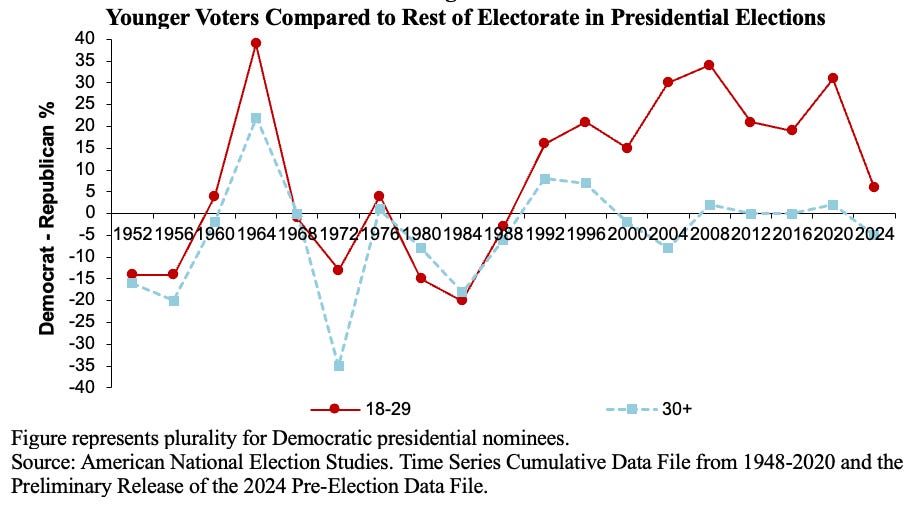
“Political scientists didn’t historically look at a generational gap because there wasn’t one,” Fisher told me in a recent interview. Other demographic lines (gender, race, etc.) were much more useful in decoding the electorate, since they produced genuine splits between, say, Black voters and white voters or male voters and female voters that just weren’t there when you looked at young voters vs. old voters.
That started to change in 1992, when 46-year-old Bill Clinton ran against 68-year-old George H.W. Bush. That’s when you can start to see a divergence open up between the under-30 and over-30 vote, which only gets stronger in the 2000s, especially during another generational clash in 2008, when 47-year-old Barack Obama ran against 72-year-old John McCain.
From then on, young voters have been firmly planted in the Democratic column — which is why it registered as such a shock to the political world when voters under 30 swung 17 points to the right in 2024. Young men went from voting for Joe Biden by 9 points in 2020, to then voting for Donald Trump by 14 points in 2024, a 23-point shift.
Historically, it’s useful to remember that “young people voting basically in line with older people” is pretty typical, but after politicos became accustomed to 30 or so years of a generational gap with young voters favoring Democrats, 2024 landed as a clean break from recent practice.
Present
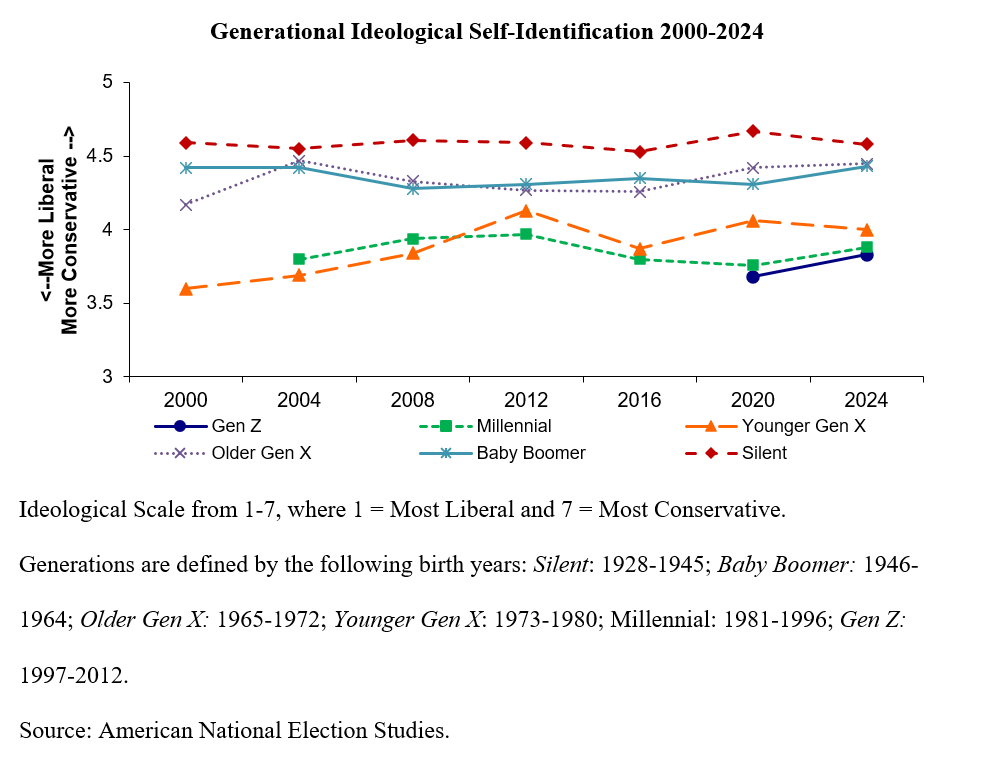
One interesting thing Fisher noted to me was that, in 2024, if you look at measures of ideological self-identification — such as the American National Elections Studies (ANES), which asks voters to rate themselves between 1 and 7 (with 1 being most liberal and 7 being most conservative) — Gen Z moved to the right, but only slightly.
Even as Democratic operatives like David Shor fretted that Gen Z had become “potentially the most conservative generation that we’ve experienced maybe in 50 to 60 years,” Gen Z was still the most ideologically liberal, by self-identification, of any of the age cohorts.
Going back to at least the 1970s, when ANES began collecting this data, “there hasn’t been a similar example” of a generation swinging so sharply in their presidential vote without a similar change in their ideology, Fisher told me.
The reasons for this are, by now, familiar: Trump may have been old (he was 78 in 2024) but Biden was even older (81). Biden’s vice president, Kamala Harris, did little to separate herself from his unpopular administration. And, above all, Gen Z voters (like all voters) were angry with Democrats’ handling of the economy, as inflation soared to its highest level in 40 years.
“It was mostly economic backlash, hoping for something different than what was happening the past few years, and it wasn’t a hard ideological vote because Trump himself is not a very ideological candidate,” Charlie Sabgir, the 25-year-old director of the left-leaning Young Men Research Project, told me.
It shouldn’t be terribly mystifying, then — unless you misinterpreted the 2024 swing to be a strong Gen Z endorsement of the broader Trump agenda, as many in both parties did — to see that yet another another swing took place in 2026, after Trump spent the intervening two years imposing tariffs and starting a war, which had the effect of raising the prices that had so frustrated Gen Z voters (and all voters).
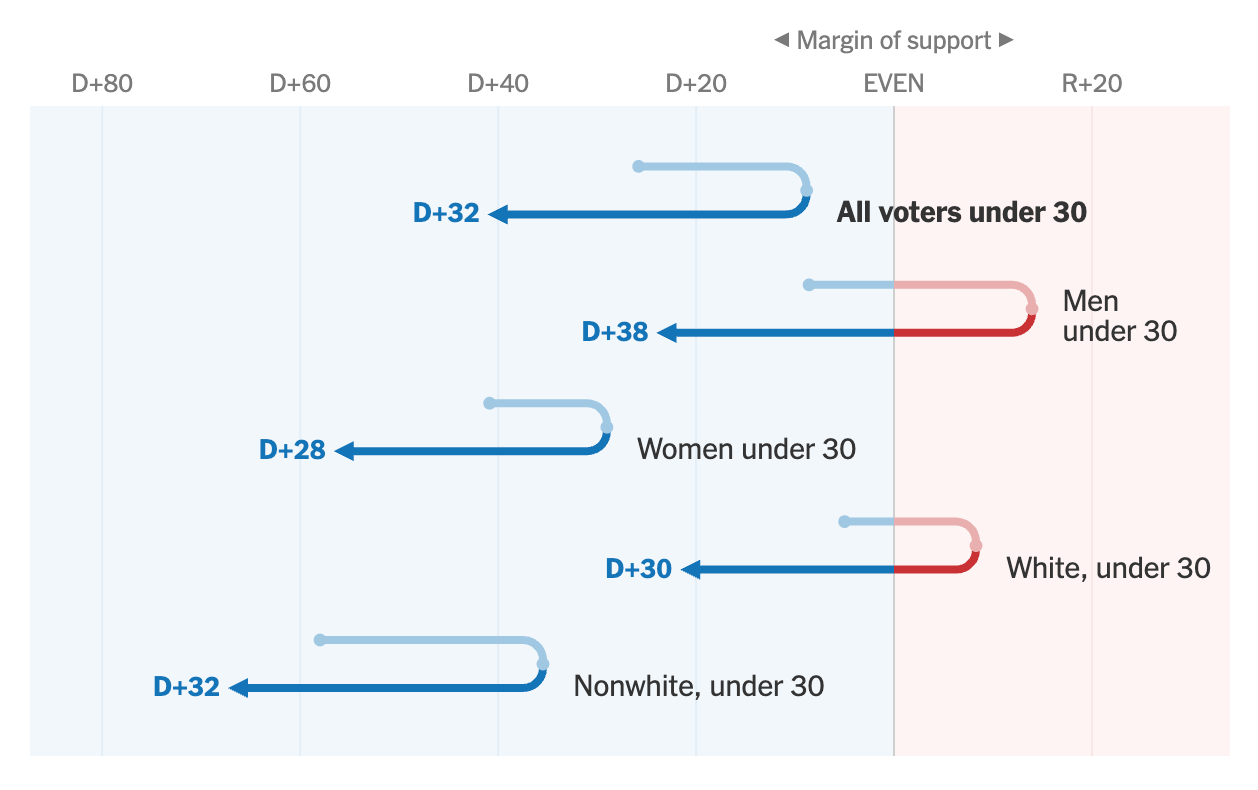
Below is a chart by the New York Times, showing how subgroups of young Americans voted in the 2020 presidential race, the 2024 presidential race, and the 2026 midterms (according to the Times’ estimates). This time, the boomerang swung back even farther: young voters shifted 32 points to the left between 2024 and 2026; the shift among young men was 38 points, as the demographic went from the GOP column in ’24 to the Democratic fold in ’26.
Brilyn Hollyhand, 20, was the co-chair of the Republican National Committee’s Youth Advisory Council during the 2024 campaign. He helped hone the social media strategy the Trump team used to target young voters during that campaign; he then spent 2026 traveling to college campuses to build support for GOP candidates. (Last year, a New York Times profile asked whether Hollyhand was the “next Charlie Kirk.”)
There were two clips of Trump that came up “almost every time” he would speak with students on the campaign trail this year, Hollyhand told me. Generally, the students had seen the clips on TikTok.
“The first one was obviously when the president played the clip and he said that affordability is a ‘hoax,’” Hollyhand said. “That frustrated young people, and it’s obviously not a hoax. Young people can’t pay for gas. They can’t pay for groceries. Young people have to set up a permanent renting because they can’t go buy a house out of college and start a family.”
Trump “kind of slapped voters in the face and said, ‘Oh, that’s a hoax,’ and it made them feel like they weren’t being heard,’” Hollyhand added.
The other clip, Hollyhand said, was when Trump cast the increase in gas prices driven by the Iran war as an exchange of “short-term pain…for long-term gain.” Hollyhand compared it to the Covid-era messaging of “14 days to stop the spread,” which “kind of kept dragging out,” as voters were continually told to suffer “temporary” consequences in the name of future benefits that weren’t always obvious.
That messaging was especially ill-suited to Gen Z, which has been raised to expect “instant gratification,” Hollyhand said. “I’ve never lived in a world where I can’t get anything at my fingertips,” he explained. “So I’ve got my iPhone, I’ve got DoorDash on it, I’ve got Uber on it, I’ve got Amazon. I can tap a button and a coffee, a pair of jeans, a car are all outside waiting for me, within seconds.” Many young voters expect their government to work the same way; hearing that they would have to wait months for an inflationary foreign conflict to pay off didn’t sound especially appealing.
Future
One thing that remains unclear is whether Gen Z’s 2026 swing back to Democrats was a result of a turnout differential (young Democrats storming the polls while young Republicans stayed home) or individual voters actually changing their minds (a significant number of young voters backing Trump in 2024 but then casting ballots for Democrats in 2026).
Although the real answer is likely some combination of both, Sabgir (the left-leaning researcher) said that the data he had seen so far suggested that 2026 was more a story of Democratic turnout than persuasion. While there was “some level of vote-switching,” he told me, “from the polling we’ve seen specifically with young men, I think the larger takeaway we have is that there was this motivation gap, and that the larger swing came from more committed [Democratic] voters showing up and showing up in force, versus this massive conversion of 2024 Trump voters to the Democratic ticket.”
It will be some time before we have a firm answer to this question, as it takes months for more rigorous studies of the electorate (as opposed to preliminary exit polls) to be released.
Either way, there are two paths the future of the Gen Z vote could take. In Path 1, Gen Z votes in 2028 (and beyond) roughly how it did in 2020 and 2026. In this view, 2024 would be a blip, a one-off desertion of Democrats by young voters.
In Path 2, 2024 wouldn’t be the blip: the last 30 years would be. As we know, for most of the 20th century, the youth vote wasn’t particularly special: it never veered that far to the left or right of the country as a whole. Perhaps the 1990s and 2000s, driven by older Gen Xers who came of age under Clinton and Millennials who came of age under Obama, were the exception, the rare time that the youth vote had a distinctive (pro-Democratic) flavor. Maybe young voters going forward won’t be especially conservative or liberal, as used to be the norm.
It should be noted that this path could be proven true whether the explanation for 2026 is turnout or persuasion. Whether young voters, because of their expectation for instant gratification, stay home when the politicians they support don’t immediately make good on their promises, or whether that leads them to constantly switch their support between the parties, either of these explanations would still produce a pretty swingy generation.
Or perhaps there was just one swing, in 2024, and a swing back in 2026, on the route to becoming a reliably Democratic generation like the Millennials before us. There’s no way to know yet.
One theory of generational voting I’ve always been intrigued by comes from the research of Yair Ghitza and Andrew Gelman, who have found that the events that take place when a generation is in their teenage and early adult years can form them politically for the rest of their lives.
I think of this as the political version of this amazing chart by Andrew Van Dam (then of the Washington Post), who found that when Americans are asked when the U.S. was at its most moral, or had its best music or TV or food, people will reliably answer whatever year it is was that they were about 10 or 15 years old.

It turns out, Americans look at politics the same way. If you grew up under FDR, you are more likely to have a fond impression of Democrats for the rest of your life. If you grew up under Reagan, you are more likely to become a loyal Republican. As we know from looking at young voters, this doesn’t necessarily kick in immediately, but the impressions that start to form in those years can stay with a generation for decades.
However, Ghitza and Gelman note, “when we think about generations of presidential voting, it is important not to think about a single defining political event. Rather, generations are formed through prolonged periods of presidential excellence: FDR and the New Deal, Eisenhower, Kennedy and Johnson’s Great Society, the Reagan/Bush conservative revolution, and the Clinton years. Each is characterized by long periods of high approval ratings. Each defined a generation by slowly and steadily winning over the electorate’s most impressionable voters.”
From this lens, the theory of Gen Z as a particularly swingy generation starts to look more viable. If previous generations were formed by a particular president boasting a high approval rating early in their life, and by a sustained period of control by that president’s party, well: Gen Z has come of age at a time when no president has been especially popular and no party has had much of an upper hand in political contests.
If you grew up in a country that loved a Democratic president, you are more likely to become a Democrat. If you grew up in a country that loved a Republican president, you are more likely to become a Republican. Perhaps, then, an era in which the country was evenly divided and frustrated with both parties will inherently produce a disillusioned generation that feels no fealty to either party label.
I put this theory to Professor Fisher, who has also studied this idea of generations being “socialized” in their politics by their growing-up years. “It is possible, Gen Z, that they’re being socialized to be swingy, which is kind of interesting because I can't say I can think of another generation like that,” Fisher said.
In short, both parties have gotten Gen Z wrong over the last decade. First, progressive activists assumed that Gen Z would be one of them, even though — if you scroll back up to the ideological self-identification — while Gen Z is the most liberal generation compared to the others, even in 2020, they didn’t describe themselves as particularly liberal on the scale of 1 to 7. Then, MAGA activists assumed that the swings in 2024 meant that young voters had suddenly been Trumpified, but that wasn’t quite right either.
A poll released yesterday by Echelon Insights found that 18-to-34-year-old Republicans were the members of the party most likely to identify more as “supporters of the Republican Party” than as “supporters of Donald Trump.” Only 28% of the youngest cohort identified as Trump supporters first, compared to 34% of both 35-to-49-year-old Republicans and 50-to-64-year-old Republicans, and 42% of Republicans aged 65+. Although young Republicans are the segment of the party that grew up with Donald Trump in office, and are sometimes assumed to be farther-right as a result, it is actually the opposite: MAGA is a movement made up more of older Fox News viewers than of young Nick Fuentes fans.
Similarly, a recent NORC survey found that 18-to-24-year-old Republicans were the most likely age group of Republicans to say they want the next president to mimic neither Trump’s policies nor his style. (Again, 65+ Republicans were the age group that most wanted the party to continue in Trump’s vein.)
On the Democratic side, the NORC survey found that 18-to-24-year-old Democrats were the segment of the party least supportive of a government-run health care system.
Young voters are still more likely to identify as Democrats than Republicans — potentially, an argument against the “swingy generation” theory, in favor of the “2024 was a blip” theory. But it is also easy to see how either party could squander away potential gains among young voters by continuing to misunderstand what drives them.
As Rachel Janfaza has written, young voters in previous election cycles rated a slew of cultural issues as their top concerns in polls (abortion, climate, guns), giving Democrats great optimism. But they celebrated too early: economic issues have now firmly supplanted cultural issues in young voters’ eyes, which (as we have seen in the last two election cycles) can boomerang against either political party. Social issues rigidly divide the country. But elections focused on economics, like 2026, are much more liquid, expanding the electoral map and opening voters’ minds to new options. An entire generation focused on the economy could prove even more liquid still.
Democrats offered Gen Z “KamalaHQ” and “Brat Summer” on social media in 2024; Republicans gave them video games about immigration and hype videos about the Iran war. But neither appeal, framed in cultural terms, worked on a generation that is focused squarely on the cost of living, something more substantial than a TikTok trend.
As a political activist, Hollyhand told me, he hopes that Gen Z doesn’t prove to be perpetually swingy. “That’s just got to be exhausting, the back and forth, back and forth,” he said. But he admitted it was possible. “I think the first party that actually fulfills promises of making the American dream more attainable, and just simply gives [young voters] that, is going to be a party where they probably stay for decades,” Hollyhand said.
The race is on: according to Ghitza and Gelman, the years that are most politically formative for people are between the ages of 14 and 24. The oldest Gen Z voters are already 29. Maybe politicians should start focusing their energies on Gen Alpha (the oldest of whom will be eligible to vote in 2028) instead.
At the 2008 convention Caroline Kennedy said something to the effect about how her father excited and inspired people and with Obama we have someone who will do the same for my generation
I just wonder what "Democrat" or "Republican" even means to Gen Z. The parties themselves don't have the meanings that they used to. I'm not even sure what either stands for anymore. (I'm kind of, just a little bit old.) The Democrats are seemingly the party of the working people and the environment, yet they are now, for the most part, clearly beholden to big money. The Republicans were the party of business, personal liberty, and states rights, and now they are also the party of big money and ostensible Christianity and Executive control.
So being swingy is understandable. And, indicative of the current morassy nature of each party.