


The 2026 midterms are just 95 days away.
That’s about three months until 435 House seats, 33 Senate seats, 36 governorships, and thousands of state legislative seats are up for grabs. The fate of President Trump’s final two years in office and the future of the two parties are on the line.
With the primaries almost over and the general election starting to heat up, I thought now would be a good time to level-set and look at what we know about the 2026 midterms — and what we don’t. Here are the four questions I’m watching as campaign season kicks into gear:
1. Can Democrats win converts, not just preach to the choir?
At the highest level, the question is not really whether Democrats will win the House this November. They almost certainly will. Historical trends and voter enthusiasm tell us that much. (Democrats boast a 20-point edge among voters who say they are “extremely motivated,” per a new CNN poll.)
A combination of angry Democratic base voters rushing to the polls and disengaged Republicans staying home will likely be enough for Democrats to win the House gavel: if the party only wins the seats labeled “Lean,” “Likely,” or “Safe Democratic” by Split Ticket, that would be enough for a 223-seat majority, which is perfectly reasonable by modern standards. That’s about as many seats (222) as Democrats won in 2020 and Republicans in 2022. Republicans won 220 in 2024. (Anything after 218 is a majority.)
The real questions are how big a House majority can Democrats win and whether Democrats can flip the Senate along with it, both of which require more than just turning out the Democratic faithful. It requires playing in deep-red territory — like House seats in south Texas or rural Iowa, or Senate seats in Ohio or Alaska — and persuading voters who cast a ballot for Trump in 2024 (and maybe even in 2016 and 2020) to now pull a lever with a “D” next to it.
Luckily for Democrats, with the Iran war, Trump is giving his opponents a generational opportunity to win over his supporters. Four separate polls were released this week — by AP, CNN, Quinnipiac, and YouGov — showing that the president’s support has shrunk to just one-third of the country, a notably smaller contingent than the 40% that was thought to represent his polling floor in the first term.
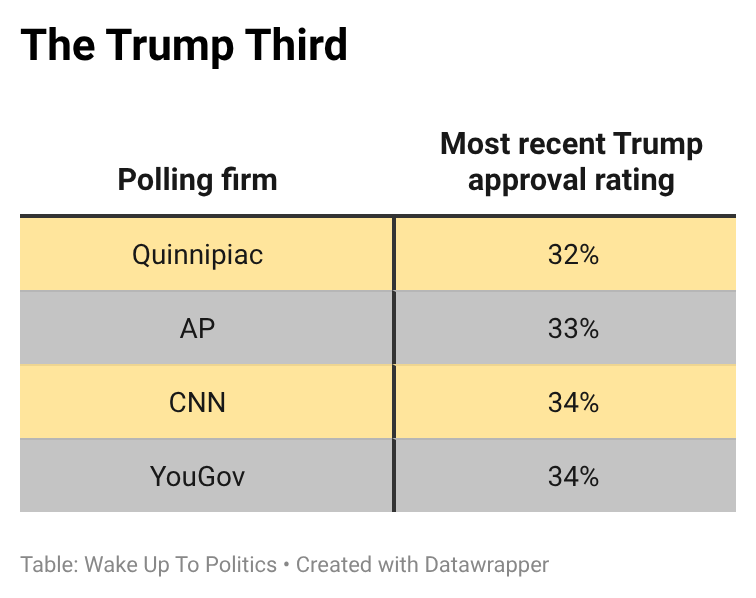
Of particular interest has been his drop in support among white working-class voters, the key group that has powered Trump’s political success since 2016. According to averages calculated by the Cook Political Report, Trump is now at a nine-point deficit among white voters without a college degree, a stark turnaround from the 13-point advantage he boasted among this demographic at the start of his second term. It is the first time in Trump’s political career that polls have consistently showed a majority of white non-college voters step outside his camp.
But disapproving of Trump is different than voting for a Democrat. A recent Washington Post poll showed only 76% of Trump disapprovers planning to vote for congressional Democrats in November. (By comparison, 86% of Biden disapprovers voted for congressional Republicans in 2022, according to the exit polls, while 88% of Trump disapprovers voted for Democrats in 2018.)
To win more than just a slim House majority, and to flip the Senate, Democrats will need to persuade these former Trump supporters who are now disillusioned with the president but uncertain about voting for the Blue Team. The path to the Senate majority runs through these voters, especially because Democrats will likely have to win at least two states out of a quartet (Ohio, Alaska, Iowa, Texas) where white working-class voters are so prominent.
The party still has work to do. Last month’s New York Times/Siena polls found that 48% of white non-college voters in Iowa disapprove of the president, but only 41% of the same demographic back Democratic Senate candidate Josh Turek. In Ohio, Trump’s disapproval among white non-college voters was at 40%, but Democratic Senate candidate Sherrod Brown’s support was at 35%. In Alaska: disapproval of Trump is at 37%, support for Democratic Senate candidate Mary Peltola is at 32%.
Democrats will have to get those numbers closer together if they want an expansive House majority or an advantage in the Senate. Trump has taken the first step for them, by softening these voters up more and more as the Iran war continues. Democrats will have to do the rest.
2. Can the DSA play in purple territory?
We know that democratic socialists can win in upper Manhattan, and also lower Manhattan, and also Brooklyn. How about the Rust Belt?