


Are you getting ready for a good night for your political party two weeks from tomorrow? Probably, you are.
According to a new paper by University of Connecticut political science professor Seth Warner, Americans’ expectations that their preferred candidate will win on Election Day have skyrocketed in recent years.
Using data from the American National Election Studies — one of the most widely trusted stores of public opinion research, with political data stretching back to 1948 — Warner shows that voters have always been more likely to think that their preferred presidential candidate would win. But the level of “partisan wishful thinking,” as he calls it, soared to near-unanimity in 2012 and has stayed there ever since.
In 2024, fully 90% of Americans expected their preferred candidate to emerge victorious.
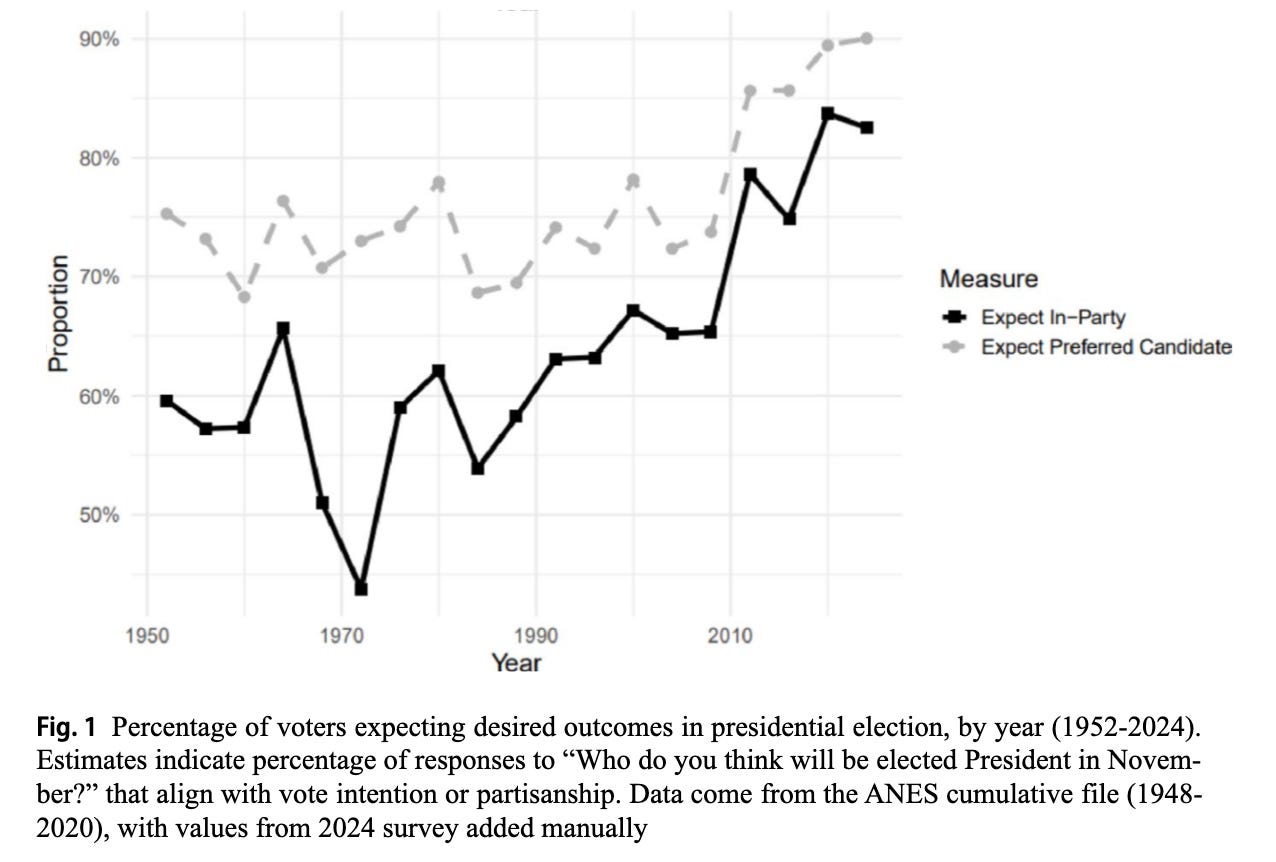
To be fair, the 2024 election was a genuinely close one: it was defensible for either party to expect to win, since polls showed that both parties had a clear route to victory (although, of course, it’s still interesting that almost all voters responded to that jump-ball scenario by thinking their side would win, rather than the competitiveness leading some voters to be pessimistic and some to be optimistic).
However, Warner thought of this. In one measure in his paper, he takes this into account, and even after adjusting for what the polls were saying in a given year, voters still had massively inflated expectations for their own party — an inflation that, once again, soared to a strikingly higher rate in 2012. Americans have started going far beyond the evidence in believing that their political party will be rewarded at the ballot box.
The same bifurcated expectations are at play this year as well. According to a recent Politico poll, 90% of Democrats and 88% of Republicans think their party will win the House in November, while 82% of Democrats and 85% of Republicans think their party will win the Senate. Only minuscule proportions of either party are projecting a successful year for their opponents.
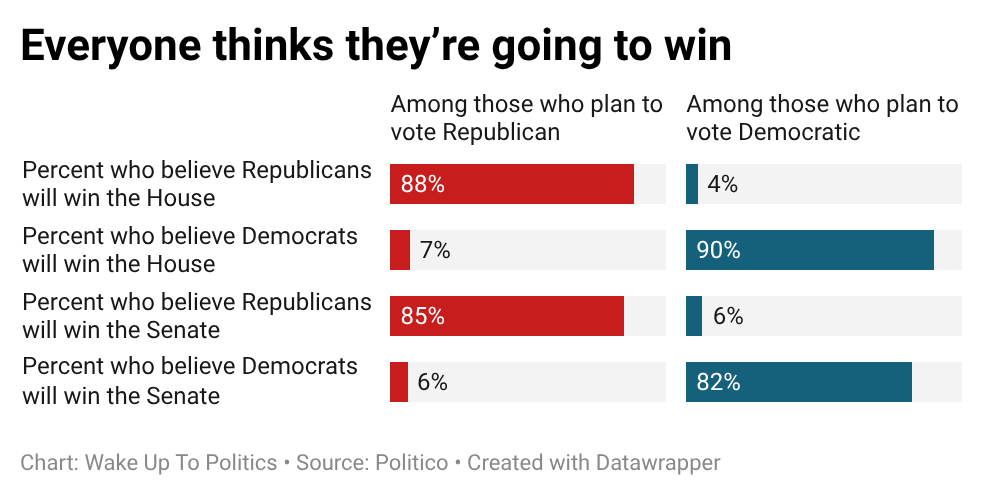
Of course, this means about half of the country is about to be caught off guard by the election results (or, in the case of one party winning the House and the other party winning the Senate, everyone will be surprised by something).
Currently, election forecasters expect the disappointed party to be Republicans. Nate Silver’s model, for example, currently projects 94% odds that Democrats will win control of the House and 75% odds that Democrats will win the Senate, a striking degree of certainty.
Warner explores several theories for the modern uptick in partisan optimism. Of the factors he tested, the most predictive was how negatively a voter felt about the other party, which did not lead to any increase in belief that one’s party would win in 1980 but was much more indicative of partisan optimism by 2020.
He also found that voters’ thinking here is somewhat circular: according to Warner’s findings, negative feelings about the other party make someone more likely to believe their party will win — and then, when the other party wins, the fact that they didn’t see it coming makes them feel even more negatively towards the victorious party. It’s a vicious feedback loop.
“You know, we’re all a little grumpy when things don’t go as planned,” Warner told me in an interview. But in this case, the grumpiness could have large-scale democratic consequences, especially if it’s fueling partisan polarization, undermining trust in elections, and perhaps even supercharging election denialism. It’s going to be much easier to prime voters to distrust the results of an election they were sure they were going to win, versus one they had already steeled themselves to lose.
“It is an empirical regularity that you know if your expectations aren’t met, then you’re going to be more surprised, and more skeptical of what actually happened and its veracity,” Warner said.
Another factor Warner tests is “news interest”: are people who follow politics more closely also more likely to think their party will win elections, regardless of what the available evidence is indicating?
He found that the answer was “yes”: although it wasn’t as predictive as feelings about the opposing party, higher news engagement was also positively associated with a belief that one’s party would win.
“Media outlets, it seems to me, keep their readers in sort of this seesaw between hope and despair,” Warner told me. “I read the New York Times primarily. It knows that its audience is primarily liberal, and it’s almost a coin flip, if you go on the New York Times homepage, if it says, ‘Trump has endangered democracy today,’ or if it says, ‘You know what, Trump’s coalition might finally be falling apart,’ or maybe ‘his entire Cabinet’s going to resign very soon.’” Fox News does much the same thing, but in reverse, reporting alternately that Democrats are in shambles or on the verge of achieving a socialist takeover.
“It’s a coin flip, and gradually I started catching on,” Warner added. “I’m like, it’s not literally one or the other every day, right?”
To be an engaged news consumer in 2026 often means to encase yourself in a partisan media bubble, which means to be taken on this rollercoaster ride of being pumped with optimism or pessimism for your party — varying by the day, often depending on which is better for an outlet’s engagement.
Because of the psychological phenomenon of wishful thinking, Warner posits, most voters take in this slurry of positive and negative stories for their side, and settle on the positive as their expectations for election results, partially because — as voters increasingly feel more hostile to the other party — the thought of their opponents winning control seems so apocalyptic that they refuse to even entertain the possibility.
I’m always fascinated by results like this, which suggest (at least in some cases) that the more people read the news, the less informed they can become. As a journalist, there’s nothing that haunts me more.
Especially when looking at Warner’s polling-adjusted results, it’s clear that as polls have become more plentiful, Americans have become less savvy consumers of them, increasingly spurning our increasingly sophisticated knowledge of the American electorate in favor of base assumptions of their own party’s success. (Of course, low trust in the polls also likely plays a role: we may have more polling data than ever, but that doesn’t mean people believe the numbers are reliable.)
In the final two weeks of the election cycle, a word of advice: don’t be dragged around from hope to despair and back again (no matter what a hopeful or despairing outcome would be for you). Be cautious of media outlets that are trying to manipulate your expectations — and of politicians who might try to feed off those expectations, by seeding mistrust in outcomes that don’t go how you thought they would on November 3. Try to have a clear head when assessing the latest news and polling information, without letting your partisan proclivities cloud your analysis of what you’re reading.
And hang in there: we’re almost at the finish line.
I read primarily liberal sites but I am an outlier. I am suspicious that they are overly optimistic about the blue wave in my state. I hope its coming but this