



Happy Friday! I have a jam-packed mailbag edition for you this morning, answering many of your great questions on the next Congress and what it will look like.
But first… some news: Sen. Chris Van Hollen (D-MD) announced last night that he is challenging Sen. Chuck Schumer (D-NY) for the role of Senate Majority Leader. Sen. Bernie Sanders (I-VT), who caucuses with the Democrats, and Sens.-elect Abdul El-Sayed (D-MI) and Peggy Flanagan (D-MN) quickly announced their support for Van Hollen’s bid.
One dynamic I’ll be watching: What do the other newbies do? Several of the new red-state Democratic senators declined to commit to backing Schumer on the campaign trail, or outright said they will oppose him, including Sens.-elect Annie Andrews (D-SC), Scott Colom (D-MS), Adam Hamilton (D-KS), James Talarico (D-TX), and Josh Turek (D-IA).
But is Van Hollen who they had in mind when they said that? Van Hollen is more progressive than many of these incoming senators, and he could make their lives more difficult than Schumer: both by pushing the national image of the Democratic Party even further to the left (which would make it harder for them to win re-election) and by being more likely to hold floor votes that will put them in a difficult spot (requiring them to pick between either casting votes that are unpopular in their states or facing the ire of progressive activists).
Remember: the Majority Leader will be chosen by secret ballot, which means senators can theoretically vote for Schumer privately while insisting they voted against him publicly. The election is currently scheduled for December 1; support from a simple majority of the Democratic caucus (likely to be 29 senators) is needed to win.
And now, on to our mailbag, where we’ll discuss:
The true story of what happened with the Hegseth impeachment vote this week
Whether either party is better at getting what they want done in Congress
Where the Democratic center of gravity will lie in the next Congress: how many Blue Dogs will there be, versus DSA, and so on
What will happen to the Hegseth impeachment efforts now
And more!
Hegseth vote
Q: I would like to read a deeper dive into the failure of Hakeem Jeffries to build a sufficient coalition to impeach Pete Hegseth. Who were the Democrats who didn’t show up?
Q: Please explain why the votes were not in the House to impeach Hegseth. And did Nancy Pelosi fly home instead of voting? Are there shenanigans going on with the Democrats?
Q: Why did the Dems not show up for Hegseth impeachment vote? What were they possibly thinking?
This was the most popular question I received this week (the above is just a sample), and Wake Up To Politics is nothing if not a democracy, so let’s get into it. To make a long story short, I think the coverage on this has been really misleading.
For those who missed this story, outgoing Rep. Thomas Massie (R-KY) triggered an effort this week to impeach Defense Secretary Pete Hegseth for “waging war in contravention of the War Powers Resolution” and other charges. The House voted on Tuesday on whether to refer Massie’s proposal to the Judiciary Committee, which would effectively kill the impeachment push.
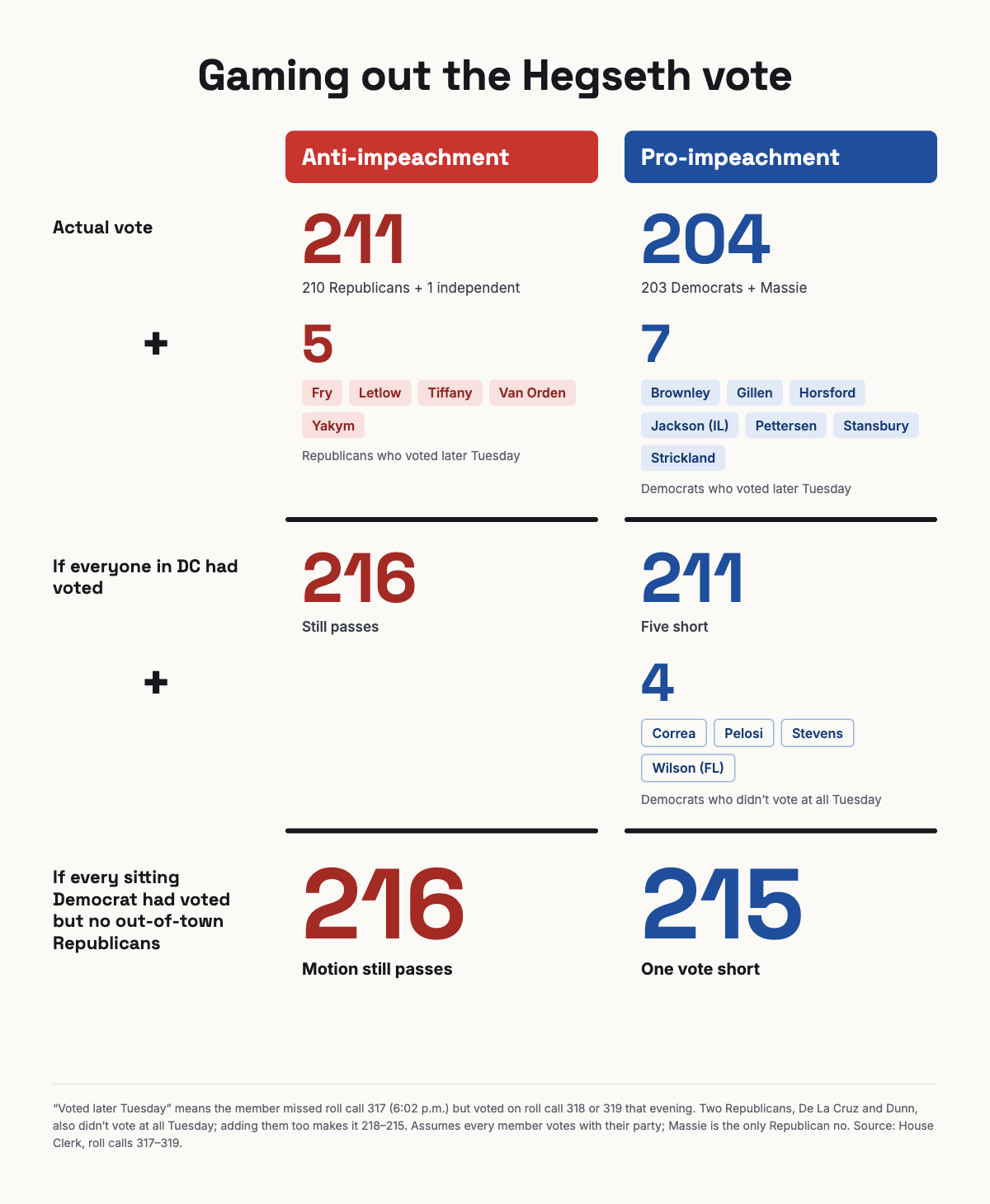
The vote was 211-204 in favor of bottling up the impeachment in committee, with all voting Democrats plus Massie opposed, all other voting Republicans in favor, and 11 Democrats and 7 Republicans absent.
The main thrust of the news coverage on this was that Democratic absences doomed the impeachment effort: after all, if the 11 absent Democrats had shown up, and been added to the 204, that would have made 215 pro-impeachment members, more than the 211 anti-impeachment votes that were cast.
Several of the Democrats said they missed the vote because they were stuck in traffic while coming back from a reception, for which they were excoriated online. Some have even put out apology videos.
For the record, I think members of Congress are often too blasé about missing votes, and they should be held accountable for each one they aren’t at. (It’s not uncommon for dozens of members to fly into D.C. late and miss the first vote of a week.) Members of Congress are paid to represent their constituents by voting on important issues, and they should always be expected to be there to cast a “yea” or “nay,” whether or not their presence changes the outcome.
But it should be noted, since so many people are saying otherwise, that this isn’t a case where the absences changed the outcome.
The Hegseth vote was scheduled to last for 15 minutes, but in Congress, time is a lie, and votes can be held open for as long after that as the majority party (in this case, Republicans) wants them to. (The person who wields the gavel and presides over the chamber is always a member of the majority.)
And remember: there were absent Republicans, not just absent Democrats. If all the absent Democrats had shown up for the vote, the GOP leadership simply would have held open the vote a little longer to make sure the absent Republicans could get there too (instead of closing the vote after about 25 minutes, as they did on Tuesday).
This wouldn’t have even been much of a lift. There were two other votes held in quick succession on Tuesday night, which gives us an idea of how many members were in D.C. and could theoretically have made it to the vote if it were held open. In total, seven of the 11 Democrats who missed the Hegseth vote showed up in the House at some point that night, as did five of the seven Republicans.
There is no world in which Republicans would have kept the vote open long enough for the Democrats who were in town to show up, but not long enough for the Republicans who were in town as well. So we can be certain that if the in-town Democrats had all shown up (bringing the pro-impeachment total to 211), all the in-town Republicans also would have been able to vote (bringing the anti-impeachment vote to 216). That’s a closer margin, but the same result.
But what if every Democrat had been in town? Let’s say we add back every sitting Democrat to the party’s total, even the ones who weren’t in D.C. that night, like Nancy Pelosi (who was back home getting a lifetime achievement award). Here, we won’t even include any of the out-of-town Republicans, so we’re pitting every single sitting House Democrat against every in-town Republican who could have cast a vote if needed.
Even in this lopsided hypothetical, Democrats still lose the vote: that only gets Democrats up to 215 votes, still one short of the 216 in-town Republicans. The impeachment still would have died. Republicans had enough members in D.C. that night to defeat any permutation of Democratic attendance, up to and including full Democratic attendance. The absences didn’t make a difference.
You would not have known this by reading most of the coverage after the vote. See, for example, the Wall Street Journal:
But on the Democratic side, 11 members weren’t present for the roll call—potentially more than enough to have swung the result their way, angering activists and bewildering colleagues who wanted to maintain the pressure on the Pentagon chief.
Or ABC News:
Tuesday night’s House vote on a procedural motion to kill the impeachment of Defense Secretary Pete Hegseth could have gone a different way had it not been for 11 Democrats missing the vote -- with several saying a traffic incident near the Capitol kept them from casting their votes.
Or MSNOW:
But the outcome could have been different with better attendance: Had the 11 Democrats who missed the vote been there and sided with the party, the impeachment resolution would have advanced, setting up votes on punishing the embattled defense secretary.
No, it couldn’t have! Why give people this incorrect impression? All sorts of reasons. It makes for an interesting story. (Even members of Congress get stuck in traffic!) It feeds into an emotional response (anger, frustration) that will drive clicks and attention. It adds drama and suspense, by making it seem like the vote could have gone a different way, if only this tiny thing had gone differently.
But reporting on the vote this way really ignores how Congress works, by eliding the fact that if the absent Democrats had voted, the GOP could (and almost certainly would) have used their control of the gavel to simply wait a few minutes for all the in-town Republicans to vote too, killing the impeachment push.
I think the misreporting on this also feeds into a misperception that members of both parties often hold: that there is one neat trick that could save their prospects on a given issue — that if only their party stuck together, or had done X, Y, or Z, they could have won the day.
In reality, the boring truth is that in Congress, majorities almost always beat minorities. If you don’t have enough votes, there generally isn’t a nifty workaround. In this case, Democrats only persuaded one Republican (Massie) to support impeachment. That wasn’t enough. That only created (at most!) 215 pro-impeachment votes, which is a minority of the House, a problem attendance couldn’t fix. Even if Democrats had been at full strength, and Republicans had simply had the members who were in D.C. that night, Democrats still would have had to persuade at least one more Republican to join their side. There is no easy hack that prevents you from needing to win over a majority.
I’m going to circle back to the Hegseth vote a little later, because I got a few other questions on whether another impeachment effort is still viable, but first: I want to stick with the theme of in-party frustrations, by tackling our next question:
Is either party better at Congress?
Q: It feels like Republicans have consistently out-maneuvered Democrats in both houses of Congress in recent decades: Republicans block more successfully than Democrats when they’re in the minority, and overcome procedural obstacles more readily when they’re in the majority. Is that sense borne out by data?
One of my favorite polling questions is this one from Pew Research Center, which has regularly asked partisans over the last 10 years whether they think their side has been “winning more often than losing” or “losing more often than winning” on the issues that matter to them.
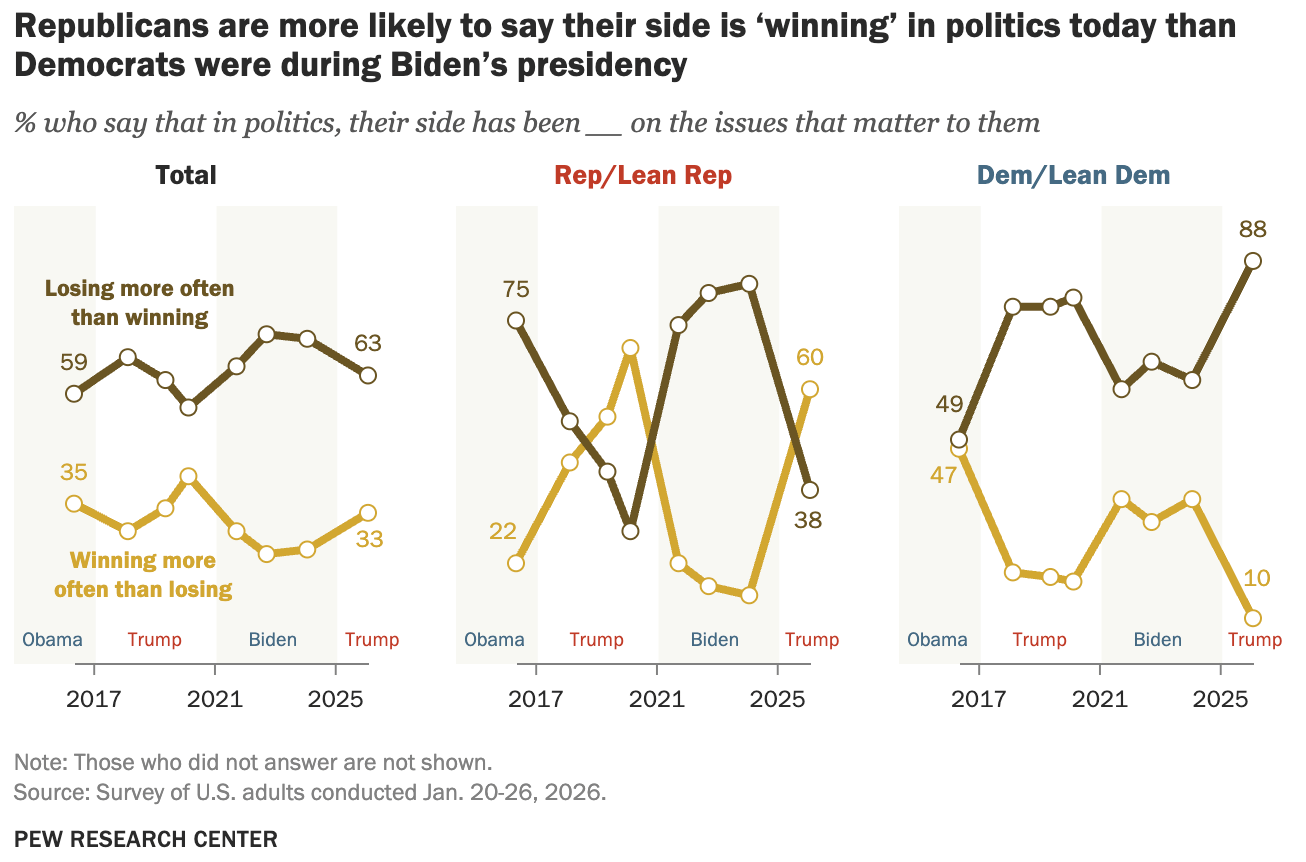
As we can see from the chart above, there is a distinctly pessimistic strain that runs through both parties. The most recent time this survey was conducted, in January of this year — when conservatives controlled all three branches of government — Republicans were still only split roughly 60-40 in favor of saying their side was winning. That’s a somewhat dour view, considering the circumstances!
But it’s not nearly as dour as the Democrats, who not only overwhelmingly said they were losing more often than winning when Trump was in the White House — as might be expected — but who also said the same thing for all four years that Joe Biden was president! At no point in the last decade have Democrats felt like their side was winning.
That polling data provides a good backdrop for this next question, which effectively asks: Is either party winning or losing more often on their issues?
Let’s think through this.