


President Donald Trump has always styled himself as the ultimate dealmaker. This week, two sets of negotiations — one that he’s apparently killed, another that he surprisingly revitalized this morning — are poised to dominate the news, with big consequences for the future of Trump’s administration.
Let’s see where we are on both:
#1: Iran. The war in Iran has entered its fourth week, nearing the point that Trump originally said the conflict would come to a close. (He told the Daily Mail at the outset of the war that it would be “about a four-week process,” though he later clarified to the New York Times that it could last “four to five weeks,” while White House press secretary Karoline Leavitt then stretched the timeline to “four to six weeks.”)
In recent days, Trump has continued to zig-zag. He wrote on Truth Social on Friday that the U.S. is “getting very close to meeting our objectives as we consider winding down our great Military efforts in the Middle East”; the next day, however, he signaled plans to potentially ramp up attacks.
“If Iran doesn’t FULLY OPEN, WITHOUT THREAT, the Strait of Hormuz, within 48 HOURS from this exact point in time, the United States of America will hit and obliterate their various POWER PLANTS, STARTING WITH THE BIGGEST ONE FIRST!” Trump threatened at 7:46 p.m. ET on Saturday.
Then, this morning — about 12 hours before the deadline — Trump made a surprising announcement: the U.S. and Iran have been having “VERY GOOD AND PRODUCTIVE CONVERSATIONS REGARDING A COMPLETE AND TOTAL RESOLUTION OF OUR HOSTILITIES IN THE MIDDLE EAST,” he said.
As a result, Trump said that he had instructed the military to postpone any strikes against Iranian power plants and energy infrastructure for at least five days, while negotiations continue.
There is a lot that this announcement leaves unclear. Will the U.S. be changing its strategy for other attacks during the five-day period, or simply staying the course while holding off on attacking energy infrastructure? What will be the state of the Strait of Hormuz, Iran’s key bargaining chip, during this period? Will Israel also hold off on attacking Iran’s power plants in conjunction with the U.S.? What does a “complete and total resolution” look like?
In regards to that last question, Trump laid out his five key war objectives in his post on Friday:
(1) Completely degrading Iranian Missile Capability, Launchers, and everything else pertaining to them.
(2) Destroying Iran’s Defense Industrial Base.
(3) Eliminating their Navy and Air Force, including Anti Aircraft Weaponry.
(4) Never allowing Iran to get even close to Nuclear Capability, and always being in a position where the U.S.A. can quickly and powerfully react to such a situation, should it take place.
(5) Protecting, at the highest level, our Middle Eastern Allies, including Israel, Saudi Arabia, Qatar, the United Arab Emirates, Bahrain, Kuwait, and others.
Notably, the list did not mention anything about Iranian regime change, despite Trump’s comments at the beginning of the war calling for new leadership. (No popular uprising has broken out on the ground in Iran thus far, despite optimism by U.S. and Israeli officials at the beginning of the war that the military campaign would spark internal rebellion.)
Adding further uncertainty, Iran is denying Trump’s claim that ceasefire talks are taking place. “There have been no negotiations and there are none underway,” an Iranian official told the Iranian news agency Tasnim.
Both sides appear to be broadcasting for domestic audiences: Iran is promoting Trump’s backing away from his 48-hour ultimatum as a victory, with state TV brandishing the headline, “US President Retreats After Iran’s Decisive Threats.” (Iran had said it would respond to any attacks on its energy infrastructure with attacks on energy infrastructure used by the U.S., Israel, and other American allies in the region.)
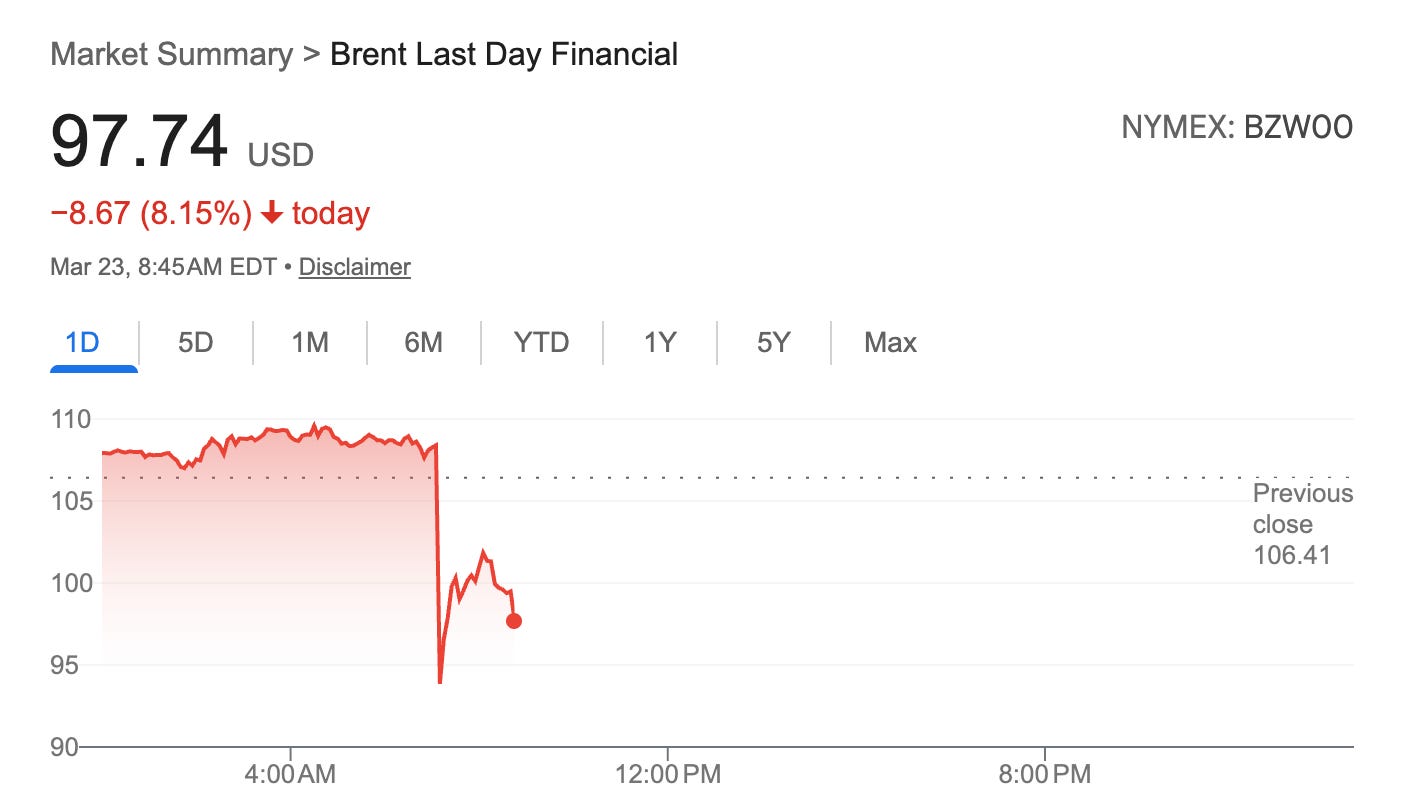
Meanwhile, Trump’s announcement of the five-day extension came before markets were set to open this morning — and investors reacted with the relief he may have been hoping for. The Dow Jones Industrial Average futures jumped 1,000 points in pre-market trading after Trump’s announcement, while the price of Brent crude — the global benchmark for oil prices — dropped immediately, from $108 a barrel to $93 a barrel.
In all likelihood, the truth is probably somewhere in the middle of Trump’s rosy outlook and Iran’s insistence that no negotiations are taking place. According to Axios, there has not been direct contact between Washington and Tehran, but Egypt, Qatar, and the United Kingdom have all passed messages between the two.
If one accepts the premise that indirect talks are happening, but are likely closer to being in a preliminary phase than a “COMPLETE AND TOTAL RESOLUTION,” the question then becomes: What happens if Trump’s five-day window comes and goes without any substantial progress?
It’s possible that this could lead to an even more volatile stage of war.
About 4,500 U.S. sailors and Marines are currently headed for the Middle East, and Pentagon officials are reportedly making “detailed preparations for deploying U.S. ground forces into Iran,” according to CBS News. A potential operation to seize Kharg Island, Iran’s main oil export hub, is said to be under consideration.
Then again, anyone who has paid attention to Trump’s tariff negotiations over the last year knowsf that a five-day pause can easily become a 10-day pause, which can become a one-month pause, all depending on whether Trump is satisfied with the state of negotiations and views the prospect of a ceasefire (whether military or economic) as less risky than continued aggression.
In this case, it’s not surprising to see that Trump is starting to look for off-ramps, as the war in Iran increasingly starts to look like a political headache Trump can’t afford heading into the November midterms. A CBS News poll released yesterday found that 57% of Americans believe the war is going badly for the U.S., compared to 43% who believe it’s going well. Asked in the poll whether Americans should be willing to pay higher gas prices during the conflict, a whopping 67% said “no.”
As long as Iran can keep the Strait of Hormuz closed — recall that U.S. allies rebuffed Trump’s belated plea for help securing the vital channel — it can continue to exact economic costs that may make Trump more interested in dealmaking than warmaking. Executives are already preparing for the impact of the war on oil and gas prices to potentially last for months, and even longer if peace talks stall and the U.S. and Iran end up following through on their threats to target energy infrastructure.
#2: DHS. At the same time as Trump continues to lead a war abroad, he is also facing a growing headache here at home: airport lines.
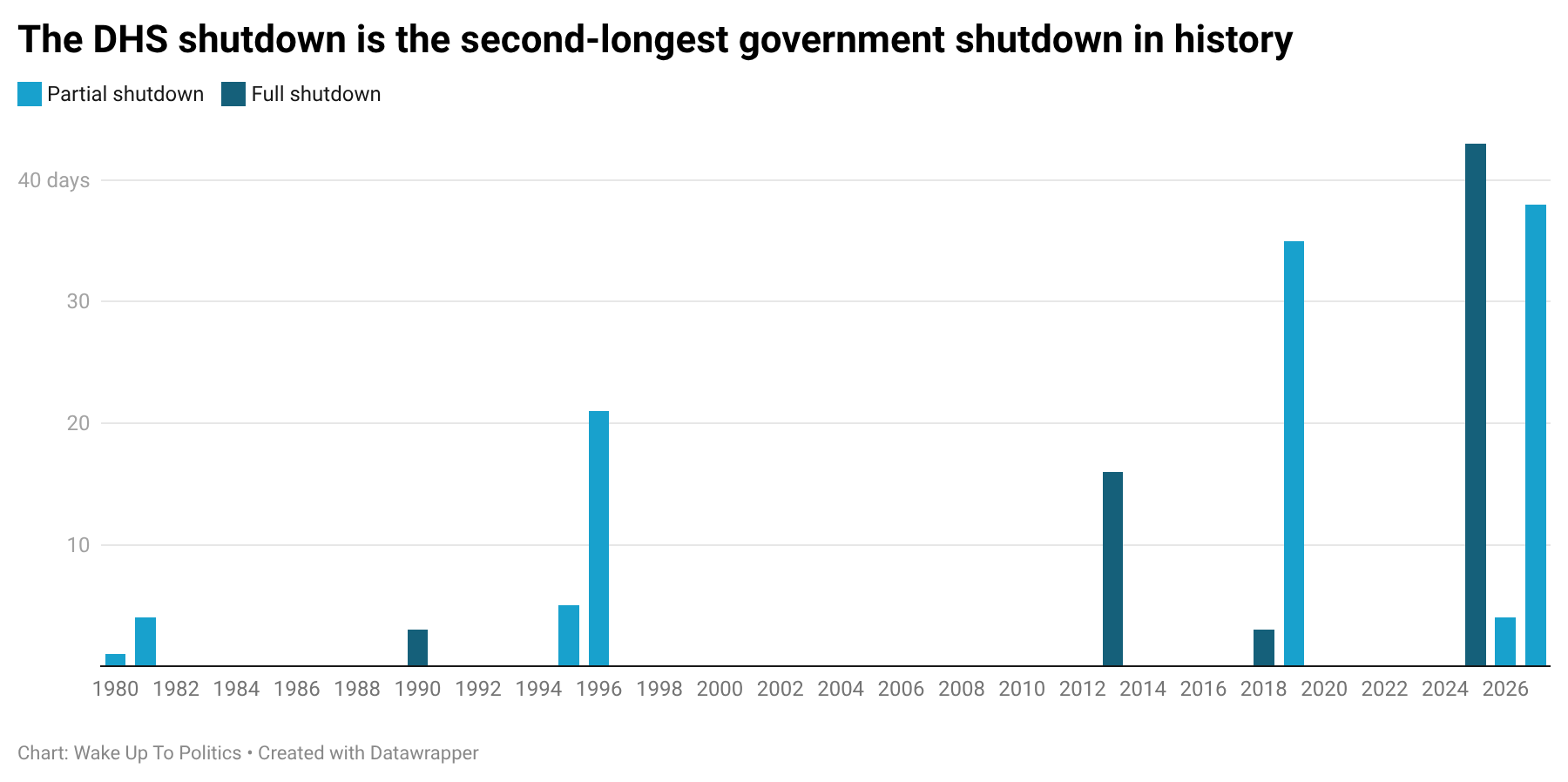
The Department of Homeland Security has now been shut down for 38 days, making it the second-longest government shutdown in U.S. history (although most previous shutdowns have impacted more than just one agency).
Democrats have said they will not agree to fund DHS without a deal to reform ICE; interestingly, compared to the record-setting 2025 shutdown, when Trump refused to negotiate on Obamacare subsidies while the government was closed, the White House has shown more willingness to negotiate this time — although the talks have so far failed to reach an agreement.
In their most recent counter-offer, the White House said it was willing to expand the use of body cameras by DHS law enforcement agents, limit immigration enforcement at hospitals and schools (with exceptions for national security), increase oversight of DHS detention facilities, require DHS officers to clearly display identification, and “codify current practice of not knowingly detaining a U.S. citizen, except when the person violates a state or federal law that makes the citizen subject to arrest.”
Democrats dismissed the proposal, insisting on additional concessions like a ban on ICE agents wearing masks and a requirement that agents obtain a judicial warrant before entering private property.
Negotiations are still ongoing, as White House border czar Tom Homan repeatedly met with a bipartisan group of senators last week. There also appears to be a side-channel between Sen. Markwayne Mullin (R-OK) — who is poised to be confirmed today as DHS Secretary — and Rep. Josh Gottheimer (D-NJ). According to the Times, the two have discussed a deal that would require agents to obtain judicial warrants “for forced home entry, unless in hot pursuit”; bar immigration enforcement actions at hospitals, churches, schools and polling places except with the approval of a judge; and revert to the “training, use-of-force and detention facility standards that were in place under the Biden administration.” It is unclear whether their proposal has broader buy-in among either of their parties.
After weeks of the shutdown mostly taking place out of public view, the lack of funding for the TSA (which is part of DHS) has led to 400+ TSA officers quitting since the start of the shutdown, while others are refusing to show up without a paycheck. The ensuing staffing shortages have created chaos at airports across the country, with lines stretching for hours over the weekend.
Starting today, ICE agents will be deployed to 13 airports to assist the TSA with security services, following a Saturday directive from the president that reportedly caught ICE officials off-guard and left them scrambling to come up with a plan. (Trump wrote this morning that he is a “BIG proponent of ICE wearing masks as they search for, and are forced to deal with, hardened criminals,” but said that he would “greatly appreciate” ICE agents not wear masks while working at airports.)
On Capitol Hill, the long airport lines appear to have raised pressure for lawmakers to come to an agreement — although Trump doesn’t seem to feel the same. According to Punchbowl News, Senate Majority Leader John Thune (R-SD) approached Trump with a proposal yesterday to fund all of DHS except for ICE, which would allow the department to be funded without giving in to any of Democrats’ reform demands. (ICE already has enough funding from the One Big Beautiful Bill to continue operating.) Democrats have signaled they would agree to such a compromise.
But Trump kiboshed the idea, saying that there should be no DHS deal until the SAVE America Act — Trump’s bill to require proof of citizenship for registering to vote — is passed. He then went public with this stance, writing on social media: “I don’t think we should make any deal with the Crazy, Country Destroying, Radical Left Democrats unless, and until, they Vote with Republicans to pass ‘THE SAVE AMERICA ACT.’”
It is unclear whether congressional Republicans, who are growing antsy to strike a DHS deal, will heed Trump’s directive to halt talks in deference to the SAVE America Act.
Last year, I wrote that the party with the more unpopular stance during a shutdown is normally the one that ends up being blamed: when Republicans forced a shutdown to repeal Obamacare, Republicans were blamed because that was an unpopular policy demand, for example; when Democrats forced a shutdown to extend Obamacare subsidies, Democrats weren’t blamed because that was a popular policy demand.
According to YouGov polling, all of the key Democratic demands here have majority support in the polls, including requiring immigration agents to wear body cameras (84% support) and to have judicial warrants to enter homes (69% support), and banning them from entering schools or churches (66% support) or from wearing masks (55% support).
As a result, most Democrats have said they are in no rush to agree to a DHS deal, confident that Trump will be blamed for the airport chaos — especially once Americans start seeing ICE agents, who are associated with the president, at security lines.
That makes two adversaries who — at least publicly — claim to be content waiting Trump out, in no rush to negotiate with him. Trump seems frustrated with them both: “Now with the death of Iran, the greatest enemy America has is the Radical Left, Highly Incompetent, Democrat Party!” Trump wrote on Truth Social this weekend, actively comparing his domestic political rivals to a country he is at war with.
Great article. Your points are well done and on target.
"Trump laid out his five key war objectives in his post on Friday" strikes me as similar to Trump giving his endorsement to GOP primary candidates only after the polls show them highly likely to win the primary. It seems obvious that at least 1 thru 3 and maybe 4 can already be claimed to have been accomplished. I can absolutely guarantee I will accomplish everyone of my New Years resolutions this year as I plan to announce them this December 31.