


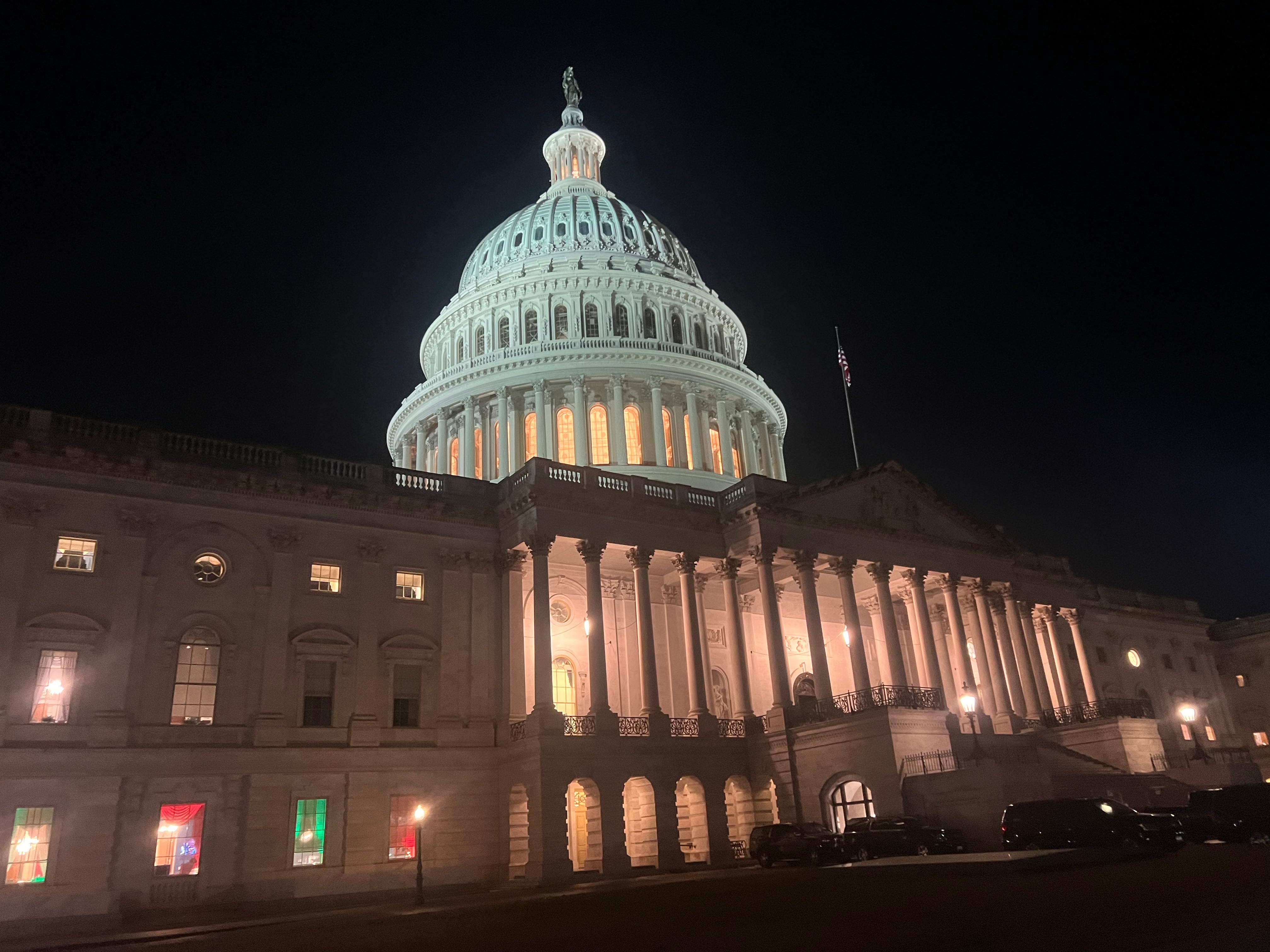
This is Congress’ last week in session of 2025. Let’s take a look at what is — and isn’t — on the agenda:
Health care
The temporarily enhanced Affordable Care Act premium tax credits are set to expire on December 31, and no deal to extend them is in sight. The financial strain is already showing: early data suggests that Obamacare enrollees are opting for cheaper plans or no coverage at all because the end of the tax credits will add hundreds of dollars more to their monthly premiums. (Yesterday was the deadline to sign up for Obamacare coverage that starts on January 1, which means enrollees are now locked into their prices for the new year. However, if Congress passes a health care fix in January, lawmakers can make it retroactive.)
Now that the Senate rejected a pair of health care bills, action has moved over to the House, which is set to vote tomorrow on the Lower Health Care Premiums for All Americans Act, a GOP health care plan. The package would not extend the enhanced Obamacare tax credits; instead, it would:
Expand the availability of association health plans, which allow small businesses to group together to offer health insurance with lower premiums for their employees.
Codify CHOICE Arrangements, which allow employers to offer their workers tax-advantaged funds to pay for individual health insurance instead of offering a traditional group insurance plan.
Fund cost-sharing reductions, discounts on deductibles for low-income Obamacare enrollees.
Impose new regulations on pharmacy benefit managers, who act as middlemen between health insurers, drug manufacturers, and pharmacies and are often blamed for high drug prices.
A group of moderate House Republicans are pushing GOP leadership to allow for a vote on an amendment that would extend the Obamacare subsidies. House Speaker Mike Johnson (R-LA) initially signaled that he would allow such a vote, but those plans have reportedly fallen apart after Johnson insisted that the extension would have to be paired with spending cuts offsetting the cost of the subsidies (around $35 billion a year).
The House Rules Committee is set to meet at 2 p.m. ET today to set up a vote tomorrow on the Republican health care package. It will be up to the panel, controlled by Johnson appointees, whether the subsidies amendment gets a vote on the House floor.
If the Rules Committee declines to set up an amendment vote, that will leave basically two potential avenues for the tax credits to be extended:
1. Discharge petition. I’ve written before about how this has been the Year of the Discharge Petition, the once-obscure procedural tool that allows a bill to reach the House floor — without the speaker’s sign-off — if 218 House members (a simple majority) sign on. There are currently three discharge petitions circulating on health care: one by House Minority Leader Hakeem Jeffries (D-NY) for a bill to extend the Obamacare subsidies for three years (214 Democratic signatories); one by Rep. Brian Fitzpatrick (R-PA) to extend the subsidies for two years (12 Democratic signatories and 12 Republican signatories); and another by Rep. Josh Gottheimer (D-NY) that would extend the subsidies for one year (29 Democratic signatories and 11 Republican signatories).
For this route to work, either Jeffries and almost the entire Democratic caucus will have to accept one of the shorter-term extensions, or four Republicans will have to accept the longer-term extension. So far, neither side appears willing to budge, although that could change if the Rules Committee rejects the amendment vote today.
2. A Senate deal. While House members lobby for various discharge petitions, a group of centrist senators are trying to fashion a compromise of their own. About two-dozen senators met last night in a bipartisan gathering convened by Sens. Susan Collins (R-ME) and Bernie Moreno (R-OH), who have proposed a plan that would extend the subsidies for two years while making other reforms to Obamacare.
For this route to work, a deal would have to come together very last-minute — or lawmakers will have to wait until January, after the tax credits expire, for negotiations to pick back up.
Appropriations
There’s another deadline to keep in mind when considering the health care fight: January 30, when (most) government funding is set to expire. Democrats, of course, have already forced one shutdown over health care this fiscal year; there’s nothing stopping them from pushing through another if they so choose.
Since the last shutdown ended on November 12, with a compromise that also funded three out of the 12 annual appropriations bills, neither chamber of Congress has held a vote on any of the nine remaining spending bills. It is unclear if any such votes will be held between now and the end of the year: Senate Majority Leader John Thune (R-SD) is trying to push forward five bipartisan spending bills in the upper chamber, but a group of fiscal conservatives are holding up the package in a bid to reduce spending.
If no more appropriations bills are signed into law by January 30 (which seems a near-certainty), a continuing resolution will need to be approved by then to avoid a partial shutdown.
Defense policy
Here’s a bipartisan package that is expected to become law by the end of the year: the National Defense Authorization Act (NDAA), the annual defense policy bill that lawmakers have passed every year since 1961. While appropriations bills set funding levels, authorization bills set the policy for the programs that they fund — the conditions under which the money in appropriations bills will be spent.
Authorization bills also set recommended funding levels, although those dollar amounts are only made official if they’re included in an appropriation bill.
Here’s the text of this year’s NDAA, which runs 3,022 pages and authorizes up to $900 billion in military spending. The package passed the House in a 312-112 vote, backed by 197 Republicans and 115 Democrats and opposed by 18 Republicans and 94 Democrats. The Senate advanced the bill in a 76-20 vote yesterday, with opposition from 17 Democrats and three Republicans, and is expected to give it final approval this week.
The package includes a 3.8% pay raise for servicemembers, $400 million in Ukraine aid, a ban on DEI programs at the Pentagon, a repeal of Iraq and Persian Gulf War-era authorizations for the use of military force, a rollback of sanctions on Syria, and more. The bill also blocks Defense Secretary Pete Hegseth from using 25% of his travel budget until he gives congressional committees unedited video of the U.S. strikes on alleged drug boats in the Caribbean.
And more
Another discharge petition in the mix: Rep. Anna Paulina Luna’s (R-FL) push to ban congressional stock trading has attracted 67 signatories, including 52 Democrats and 15 Republicans.
Secretary of State Marco Rubio and Defense Secretary Pete Hegseth will brief lawmakers today as congressional probes continue into U.S. boat strikes off the coast of Venezuela. The Senate will likely hold a vote this week on a measure by Sen. Tim Kaine (D-VA) to “direct the removal of United States Armed Forces from hostilities within or against Venezuela that have not been authorized by Congress.” (Under the War Powers Resolution of 1973, senators can force votes on bills directing the president to remove U.S. forces abroad.)
Conservatives are pushing the Senate to vote on the long-delayed nomination of former Rep. Mark Walker (R-NC) to be U.S. Ambassador-at-Large for International Religious Freedom. Per NBC News, the vote has been held up by Sen. Ted Budd (R-NC), who beat Walker in the 2022 North Carolina Senate primary.
What’s missing
Many rank-and-file Republican lawmakers are raising alarms about what’s missing from their year-end congressional agenda: any bills likely to become law that will lower the cost of living, even as Americans increasingly express concerns about inflation and the broader state of the economy.
Republicans are considering putting together a second reconciliation bill — a measure, like the One Big Beautiful Bill Act, that can advance with party-line majorities in both chambers of Congress without being subject to the Senate filibuster. Such a package could potentially include measures to lower housing costs, drug prices, and health care premiums, although there is hardly a consensus Republican position on any of those issues and wrangling the party’s disparate factions could prove difficult.
With only four days left in session this year, Republicans are likely to punt any bills on affordability to be a 2026 legislative problem — though the longer they wait, the longer it will become a 2026 political problem as well.
Sounds like mere fiddling in relation to the planets concern.
I just want to say, I am so. very. tired. of things getting more expensive all the time. Feels like every time I turn around another essential has gone way up in price from where it was 5 years ago. Rent, car repair, food… I don’t actually care all that much about the price of dolls or Pelotons 😪