


Now that campaigning is over, the real work can begin.
No, I don’t mean the next Congress, which will convene in January. I mean that age-old tradition, the lame-duck session, where members of Congress (including those who are retiring or were rejected at the ballot box) float around Washington like ghosts for the two months between Election Day and the end of their terms.
Ghosts who often get a lot done, that is.
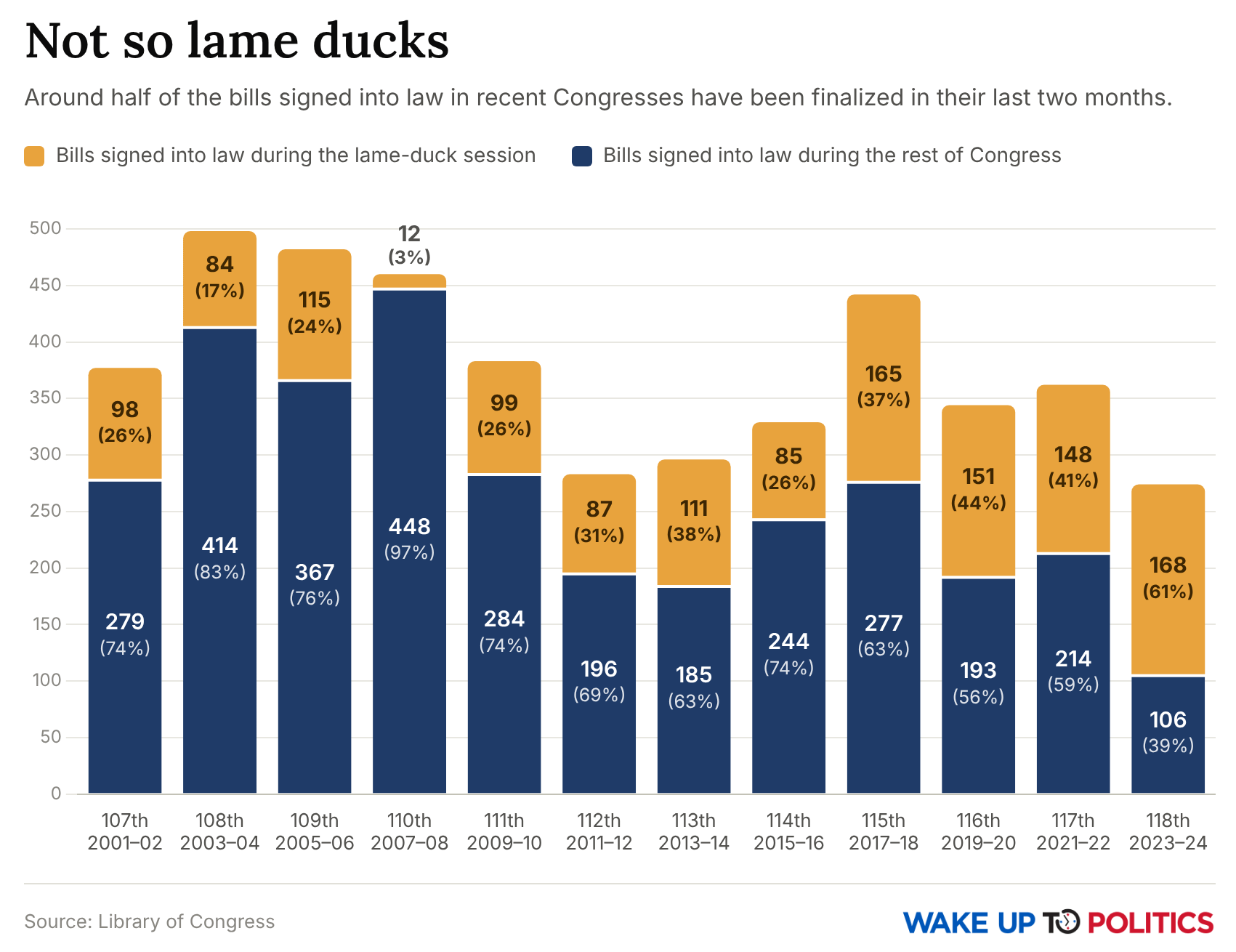
Here’s a fun fact for you: more bills became law in the final two months of the last Congress (168) than in its first 22 months combined (106). The brief period after Election Day — after some of them had already been voted out of office! — turned out to be the most productive of that entire Congress. Not so lame after all, huh?
This year, one major piece of legislation has already started inching towards the president’s desk during the lame-duck. Lawmakers are hoping more will follow.
In a 62-33 vote on Thursday night, the Senate passed the Bipartisan American Affordability and Jobs Act, also known as BAAJA. The measure would overhaul the lengthy process for approving new energy projects in the U.S., which can currently stretch on for years.
This push (known as permitting reform) has been a white whale for policymakers for years now. Sens. Shelley Moore Capito (R-WV), Mike Lee (R-UT), Sheldon Whitehouse (D-RI), and Martin Heinrich (D-NM) — the chairs and ranking members of the Senate Environment and Public Works (EPW) and Energy and Natural Resources (ENR) committees — ultimately inked an agreement by giving something to everyone. BAAJA would speed the permitting process for fossil fuel and clean energy projects alike, while also making it harder for presidents to stop both, whether it’s Joe Biden blocking the Keystone XL pipeline or Donald Trump blocking wind farms.
The bill was backed by all but two Senate Republicans and about one-third of Senate Democrats. Advocates argued that the measure will boost energy supply, thereby lowering energy prices; supportive Democrats also pointed to analyses finding that the net impact of the bill would favor clean energy projects. Progressive critics argued that the bill would make it difficult to block environmentally harmful projects and pointed to concerns raised by Native American tribes. The measure now heads to the House, where Republican leadership has signaled support.
Lower-profile bills have also been moving through the legislative pipeline. Since the election, about a dozen bills have been sent to the president’s desk, including measures requiring veterans’ benefits to keep pace with inflation and bolstering the fight against child sexual exploitation.
The Senate has also passed bills banning prediction markets from offering bets on war, terrorism, assassination, or individual deaths and ensuring that parents who work for the same employer receive the same amount of family leave as other parents. (Currently, parents who work for different employers are guaranteed 12 weeks of unpaid family and medical leave each, while parents who work for the same employer — including many military families — are only legally guaranteed 12 weeks combined.) The House also passed a long-stalled veterans bill that I covered back in September.
Lawmakers face several year-end deadlines that will force movement on other fronts. Most notably, government funding is set to expire on December 11; some Democrats are pushing the party to spark a shutdown unless they secure language cutting off funding for the war in Iran. Bipartisan negotiations that could choke off war funding have already begun, although it is unclear if President Trump would sign any eventual agreement into law.
Various farm, transportation, and health programs also expire in December; plus, the annual defense policy bill remains unfinished, as do talks over extending a key surveillance authority.
These major packages that have to get out the door before the end of the year are sometimes known as Christmas tree bills, a nod to the season — and the fact that everyone tries to hang their own priorities on them like ornaments. If only a few pieces of legislation are absolutely guaranteed to get a vote before the Congress comes to an end, then oftentimes your best bet is to push for your bill to be added to one of those must-pass bills as an amendment.
This year is no exception, which means a flurry of bipartisan legislating is possible in the next month. Some lawmakers are pushing for child online safety legislation to get tacked on to the defense policy bill. Others want a bipartisan bill capping the cost of insulin at $35 a month to be included with the spending bill. A deal to ban Chinese cars from the U.S. is in the works. So is a bipartisan tax package. It’s also possible that a continuing resolution to extend government funding and the defense bill themselves could be packaged together, creating a massive mega-bill.
President Trump had been hoping to use these final few weeks of Republican control of Congress to bypass Democrats and push through a $350 billion defense spending package, using the party-line reconciliation process one last time. However, Republican lawmakers appear unlikely to bow to his request; several of his more controversial nominees are also facing roadblocks getting confirmed in the last days before Democrats retake the Senate.
No matter the priority, time is running out: both chambers of Congress are on recess all week for Thanksgiving, and they are set to take off the last two weeks of December as well. In total, the House is only set to be in session for 12 more days this year; the Senate is scheduled for 14. (Then again, this can often provide a forcing mechanism of its own: no one wants to be stuck in Washington for Christmas!) Complicating matters further, both chambers were plagued with attendance issues last week: with a record number of members headed for the exits — about 20% of lawmakers will not be returning next Congress, either because of retirement or defeat — many seem to have already checked out.
It’s sort of like a case of senioritis, except with senior citizens instead of high school seniors — and with the entire budget of the U.S. federal government on the line. No biggie.
What does it say about our government that so much crucial policymaking happens in such a mad dash in the last few weeks, when some lawmakers have already been voted out and many are barely even paying attention?
The annual lame-duck session was supposed to be abolished by the 20th Amendment, ratified in 1933, which pushed the first day of Congress up from March to January. Although that still left the potential for a year-end meeting, at the time, it was widely assumed that Congress would simply not convene between November and January, ending lame-duck sessions once and for all.
Instead, senators and congressmen quickly realized that — without those pesky elections to be afraid of — lame-duck sessions could actually be a nifty time to get stuff done.
Lawmakers have given themselves a pay raise during lame-duck sessions. They’ve impeached a president. And installed a new vice president. Many bipartisan efforts have snuck through during lame-duck sessions, often as part of large “omnibus” packages. After the 2010 elections, the outgoing Congress repealed “Don’t Ask Don’t Tell,” approved a bipartisan tax deal, expanded health care benefits for 9/11 first responders, and ratified an arms control treaty with Russia.
The bipartisan First Step Act criminal justice reform deal was passed after the 2018 elections. The aftermath of the 2022 elections saw approval of the Electoral Count Reform Act, Ukraine aid, and the Respect for Marriage Act.
These legislative bonanzas pit two of our most prized American values against each other. From a small-d democratic perspective, it seems pretty strange that members of Congress who have already been ousted by the voters continue to make major policy decisions for two more months. There are many other countries that don’t do this: in the United Kingdom, for example, there’s often a brief “wash-up period” lasting a few days after new elections are called, but then the outgoing parliament is completely dissolved until a new one is chosen. Then, less than a week generally passes between the elections taking place and the new parliament convening.
“I think it is an outrage upon public sentiment and a disgrace to our system that the representatives of a party which has been repudiated at the polls should afterwards defy the will of the people by legislating in accordance with the policy that had been adopted before their repudiation,” one congressman said as far back as 1891, railing against what was then an even lengthier lame-duck session.
However, from a small-r republican perspective — focused less on direct rule by the people, and more on reasoned decisions being made by representatives on their behalf — lame-duck sessions might look a bit more appealing. This is as far from electoral pressure as any members of Congress will ever get: some because they will literally never face the voters again, and others because they won’t have to do so for two more years. Elections are never as far away as they are now. This might allow lawmakers to exercise a bit more of that reasoned judgment, striking deals that might be politically unpopular during the campaign season.
“This is one time in the life of a member of Congress when he can vote his real convictions without the hope of reward or the fear of punishment,” another congressman argued in 1932, battling against the 20th Amendment. “I defy successful contradiction of the statement I am about to make: that some of the best legislation that has ever been passed by any Congress has been passed in the [lame-duck] session, and often when a considerable number of men have been defeated.”
Does this hew to the will of the people? Oftentimes, no. Does a lot get done that might be in their best interest? Oftentimes, yes. Our country was founded on both democratic and republican principles (here, these value systems have nothing to do with the competing political parties that took their names); reasonable minds can differ on how best to strike that balance, and whether the anti-democratic, often-quite-productive lame-duck session falls on the right or wrong side of that line.
According to a 2016 study, members are ever-so-slightly more likely to break with their parties during lame-duck sessions — though they are also much more likely to miss votes entirely.
Since the 20th Amendment shortened the lame-duck session, but failed to end it completely, there have been some attempts to finish the job. In 1970, a Democratic congressman from California proposed a constitutional amendment that would have set the start of a new Congress to be “the Tuesday following the third Monday in November,” two weeks after Election Day. It was never voted on. (For one thing, we would have to count ballots faster: we are now three weeks after Election Day, and a handful of House races remain uncalled.)
More recently, in 2010, then-Rep. Tom Price (R-GA) introduced a resolution that would have barred the House from meeting for a lame-duck session, except to respond to an “unforeseen sudden emergency.” It was voted down.
These proposals deserve consideration. Although new members of Congress need some time to staff up and get ready, they might not need two months — which means those members should arguably be seated sooner, since they (not their predecessors) are the representatives with a democratic mandate from the American people. That said, that would probably prevent some substantive pieces of bipartisan legislation from becoming law. These are the trade-offs of democratic and republican systems of government.
Unless and until the Constitution is amended, the lame-duck session is likely to continue — though perhaps it should be renamed. If around half (or more!) of Congress’ legislative output is being produced in these last two months, maybe it’s really the rest of a two-year term where lawmakers are “lame,” cowering in fear of elections and getting little done.
"the fight against child sexual exploitation”…why is this even a “fight”? I mean come on, why is this not a priority, and why doesn't it get unanimous support across the entire spectrum?