


Happy Friday morning! You all sent in some excellent questions, as always, which means I have a chock-full mailbag edition for you. We’ll answer these questions:
Can Trump unilaterally withdraw from NATO?
Does Trump care about his sinking poll numbers?
Can members of Congress keep their pensions even if they resign in disgrace or get expelled?
Plus: Oftentimes when I solicit questions, at least a few of you write back with questions about Wake Up To Politics itself. I usually don’t pick those to be answered — but this month marked WUTP’s 15th anniversary, an exciting milestone. So I thought it would be appropriate to answer a few of those questions, and give a bit of a State of the Newsletter update.
We’re all in this together — and I know many of you have been reading for many of those 15 years — so I think it’s only fair that you be updated on how the newsletter is growing and what I have in mind for the future. So the last few questions will be about WUTP and where I see it going.
Whether you’ve been reading for one year or 15, thank you so much for being here. Let’s dive in!
Can Trump withdraw from NATO?
Q: How can Trump pull out of NATO notwithstanding the law that requires Congressional consent?
To start with the basics, NATO is the North Atlantic Treaty Organization (not “North American,” as the New York Times recently wrote), an alliance between the U.S. and 31 mostly European countries that dates back to the Cold War. It’s a mutual defense agreement, as crystallized in Article V of its founding treaty, which states that an armed attack on any NATO member state will be treated as an attack against them all. (This has been invoked once, on behalf of the U.S. after 9/11.)
Trump has never been a fan of NATO, and has long talked about withdrawing from it. As the questioner notes, lawmakers tried to head that possibility off by passing an amendment as part of the 2024 National Defense Authorization Act (signed into law by Joe Biden in December 2023) that prevents a president from leaving NATO unless authorized by a) two-thirds of the Senate, or b) simple majorities in both chambers of Congress.
That amendment, by the way, was co-authored by then-Sen. Marco Rubio.
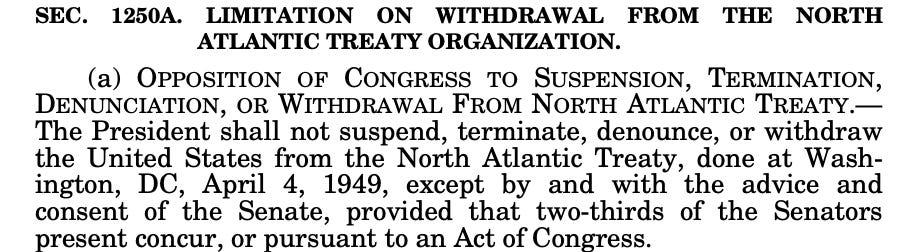
Seems pretty simple, right? Trump’s hands are tied? Not so fast. As is often the case with constitutional law, there is actually quite a bit more gray area than you might think. The Constitution lays out how the U.S. can enter into treaties (the president negotiates them, and then the Senate has to ratify them by a two-thirds vote, which the Senate did for the NATO Treaty in 1949). But it is silent on how the country might get out of them.
As a result, the practice has varied over time. In the country’s first century, we saw all sorts of combinations: the House and Senate passing a law to exit treaties; just the Senate doing it; the president telling foreign countries he was withdrawing from a treaty, and then Congress approving it; Congress ordering the president to say he was withdrawing from a treaty, and then him doing it.
In 1898, William McKinley became the first president to unilaterally withdraw from a treaty without any congressional participation whatsoever. Over time, this became the norm. In 1979, Jimmy Carter withdrew from a mutual defense treaty with Taiwan, as part of America’s normalization of relations with China. A group of lawmakers, led by Sen. Barry Goldwater (R-AZ), sued. You needed our permission to join this treaty, these senators reasoned. That means you need our permission to get out of it.
Carter argued that he had the power to terminate a treaty without congressional approval. The case went all the way to the Supreme Court.