


Before we get started today, a quick announcement.
At the beginning of this week, I sent out a survey asking you how you felt about our recent three-newsletters-a-week experiment. And the results are in: 70% of you said you preferred three days a week. 15% preferred five days a week. And another 15% had no preference. Thank you to everyone who took the time to share your thoughts: your feedback was incredibly helpful.
I’ll continue to experiment — including extra newsletters outside of the normal cycle when breaking news might warrant it — but, for now, this means we’re going to keep up with the Monday/Wednesday/Friday schedule from the last month. I hope you’ve found the newsletters over that period to be informative and of increased quality and depth. I also hear the feedback from many of you that, even at a three-day-a-week cadence, brevity is always important, and I will do my best to honor that and continue to try to be as respectful of your time as possible.
As always, if you have feedback for me, you can drop me a line at gabe@wakeuptopolitics.com and let me know how I can best serve your political journalism needs.
And, with that: time for today’s newsletter.
I’ll be starting with a question I received from a reader about the present state and future potential of the Democratic Party. I’ve received similar questions in the past about the GOP, so I’m going to be expanding the scope of the question a bit, and looking at where both parties sit and where they’re going.
To honor my brevity commitment, this is going to be split into a two-part series, trying to answer the question of whether either party has a long-term edge in controlling the various arms of the federal government (the White House, Senate, House, and Supreme Court).
Along the way, we’ll look at things like:
How the next census could jolt the Electoral College map away from Democrats
How many Senate seats Republicans have gambled away with extreme nominees
Where gerrymandering might be going next
And whether liberals will ever regain a majority on the Supreme Court
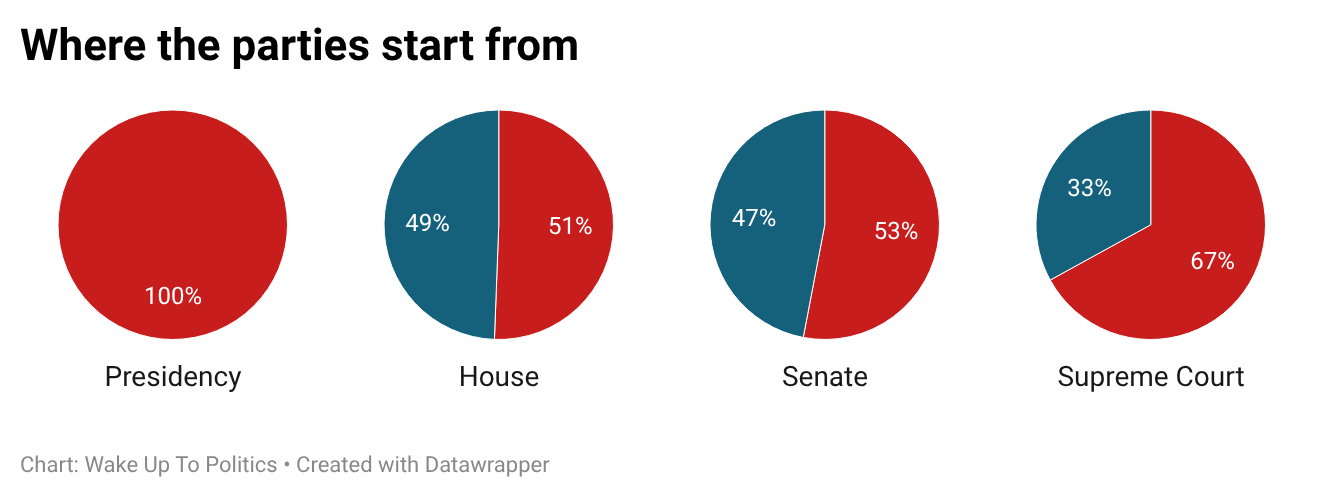
But we’ll start with the reader question, and by trying to level-set and see the position each party is starting out from…
Q: Why is the Democratic Party’s reputation so low? How could it be fixed?
There was an NBC poll that got some attention this week, testing the popularity of various newsworthy groups and individuals. Their finding: The only thing less popular than the Democratic Party, with its -22 net approval rating, is … Iran (net approval: -53). Not exactly a promising result for a party hoping to win back a foothold of power in this fall’s midterms.


If you look under the hood of results like this, though, the picture generally gets a bit more complicated. NBC doesn’t release the crosstabs (i.e., detailed demographic information) for its polls, but other surveys that ask the same question do, which allows us to see which groups are so down on the Democratic Party that it has such a dismal approval rating.
In general, the group that’s most down on Democrats seems to be Democrats themselves.
Here, for example, is a table based on YouGov data from January on the net favorability ratings of the Democratic and Republican parties in Congress, organized by the party affiliation of respondents:
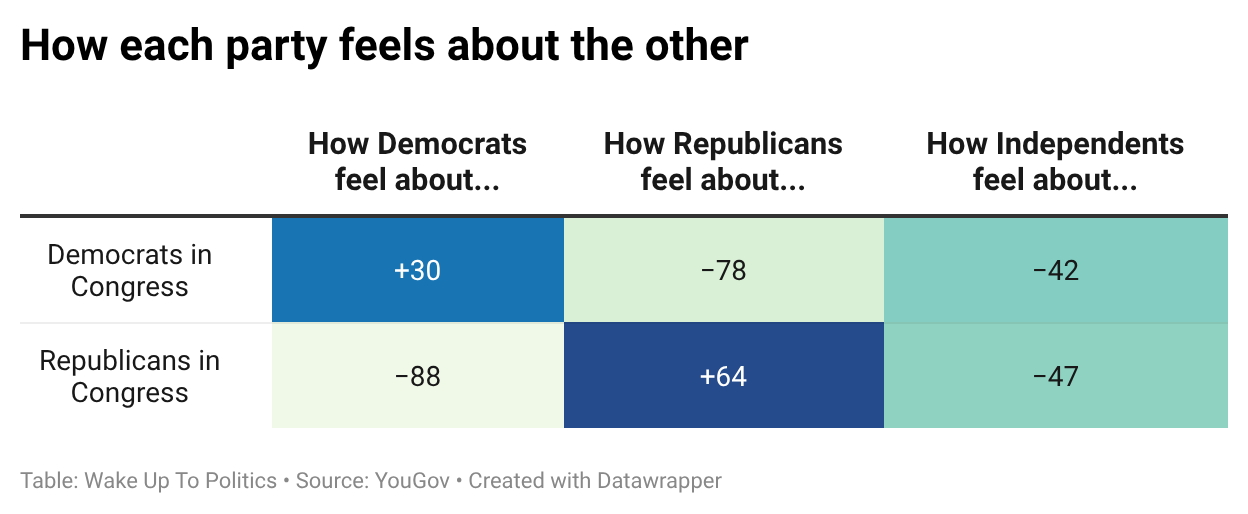
We can see that Democrats and Republicans both feel very negatively about the other party (if anything, Democrats feel slightly more negatively towards Republicans than vice versa). And Independents hate both parties too (again, if anything, the Republican score is slightly worse).
The real difference is that the Democratic rating of Democrats is “only” +30, while the Republican rating of Republicans is a much more favorable +64. That gap (Democrats feeling much more negatively towards their own party than Republicans do about theirs) pretty much singlehandedly explains why the Democratic Party’s favorability rating tends to be so much worse than the GOP’s.
This would still be electorally distressing for Democrats if it meant that Democratic voters were so disillusioned by their party that they planned to stay home in November. But the evidence we have so far, from special elections, state legislative elections, and off-year elections, suggests that Democratic voters are actually more energized to vote right now, their negative feelings towards party leadership notwithstanding.
Polls back this up, too: a recent Washington Post/ABC News/Ipsos poll found that 79% of registered Democrats said they are certain to vote in the fall, compared to 65% of registered Republicans. Many Democrats hate their party, but they hate Donald Trump more.
We have seen this play out before. As Lakshya Jain has pointed out, Democratic approval of Democrats is roughly where Republican approval of Republicans was in Barack Obama’s second term. There was no sign this disapproval hurt the GOP in the 2014 midterms, when the party won a 247-seat majority in the House and flipped a very impressive nine Senate seats. Partisans hate losing elections, and often sour on their own party after they do, but it never really has much of an electoral impact.
This isn’t really a “good news!” report for Democrats, though. The takeaway here isn’t that they’re popular, just that they’re really no more unpopular than Republicans (and it only seems otherwise because their own voters are upset with them, but this isn’t an electorally relevant fact since Democrats keep voting for Democrats regardless). Indeed, polling from Pew shows that our system is basically composed of two political parties that are widely hated at roughly equal levels:
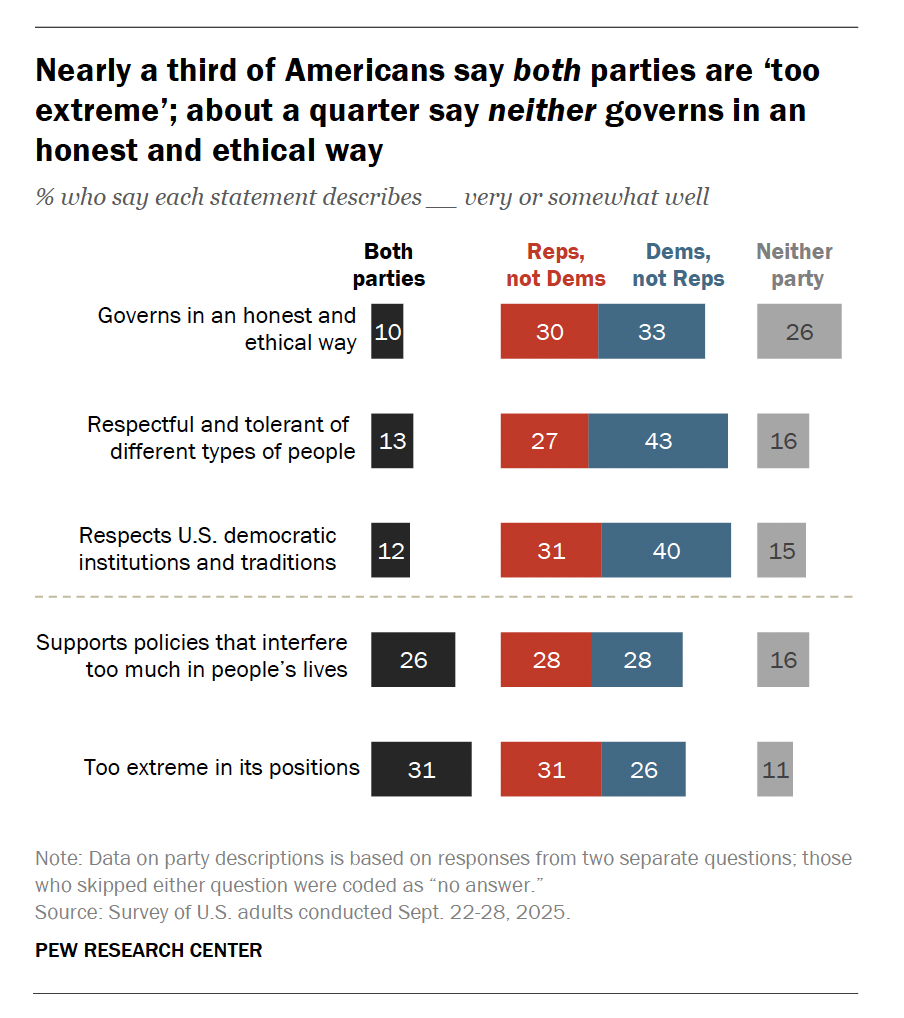
This got me thinking of another question, related to our original reader query above but a little bit more expansive. We can all agree that both American political parties are, um, not doing great right now: widely unpopular and apparently unable to win anything more than 51/49 victories or to hold on to power for longer than two years. (In the nine presidential elections since 1992, the only time a candidate has won more than 51.3% of the vote was Barack Obama’s 52.9% in 2008. In the last 20 years, no party has held control of both the presidency and Congress for longer than a two-year period.)
So if both parties are in bad shape right now … which one is in less bad shape?
In this two-part series, we’re going to walk through the major arms of the federal government — the presidency, the House, the Senate, and the Supreme Court — and ask ourselves which party is in a better position for the coming years. We’ll also look at each party’s most glaring vulnerabilities and how they might try to fix them.
The presidency
Presidential elections have become marked, in different ways, by high degrees of alternation and rigidity in recent years. What do I mean by that?
First, alternation: From 1993 to 2017, America went through a back-to-back-to-back run of two-term presidents, where the power of incumbency was enough to give three consecutive president eight-year tenures in the White House.
We have then replaced that, from 2017 to present, by embarking on a back-to-back-to-back run of one-term presidents, where there seems to be enough of an incumbency disadvantage that our three consecutive two-term presidents were succeeded by three consecutive one-term presidents. (This point is not undercut by the fact that two out of the three one-term presidents have been the same person. If anything, it underlines the point: The power of dissatisfaction towards the incumbent, and the rapidity with which Americans now swing from one party to the next, were both so strong that they fueled enough voters to vote differently in consecutive elections even when presented with the exact same candidate.)

And yet, also rigidity: In the last four presidential elections (2012, 2016, 2020, and 2024), all but nine states have voted exactly the same way each time. By comparison, in the four elections before that (1996, 2000, 2004, 2008), there were 17 states that flipped between red and blue.
At the highest level, this all tells us that the presidency is something of a jump-ball: highly liable to flip from one party to the next over the course of four years, largely dependent on the mood of a shrinking set of competitive states.
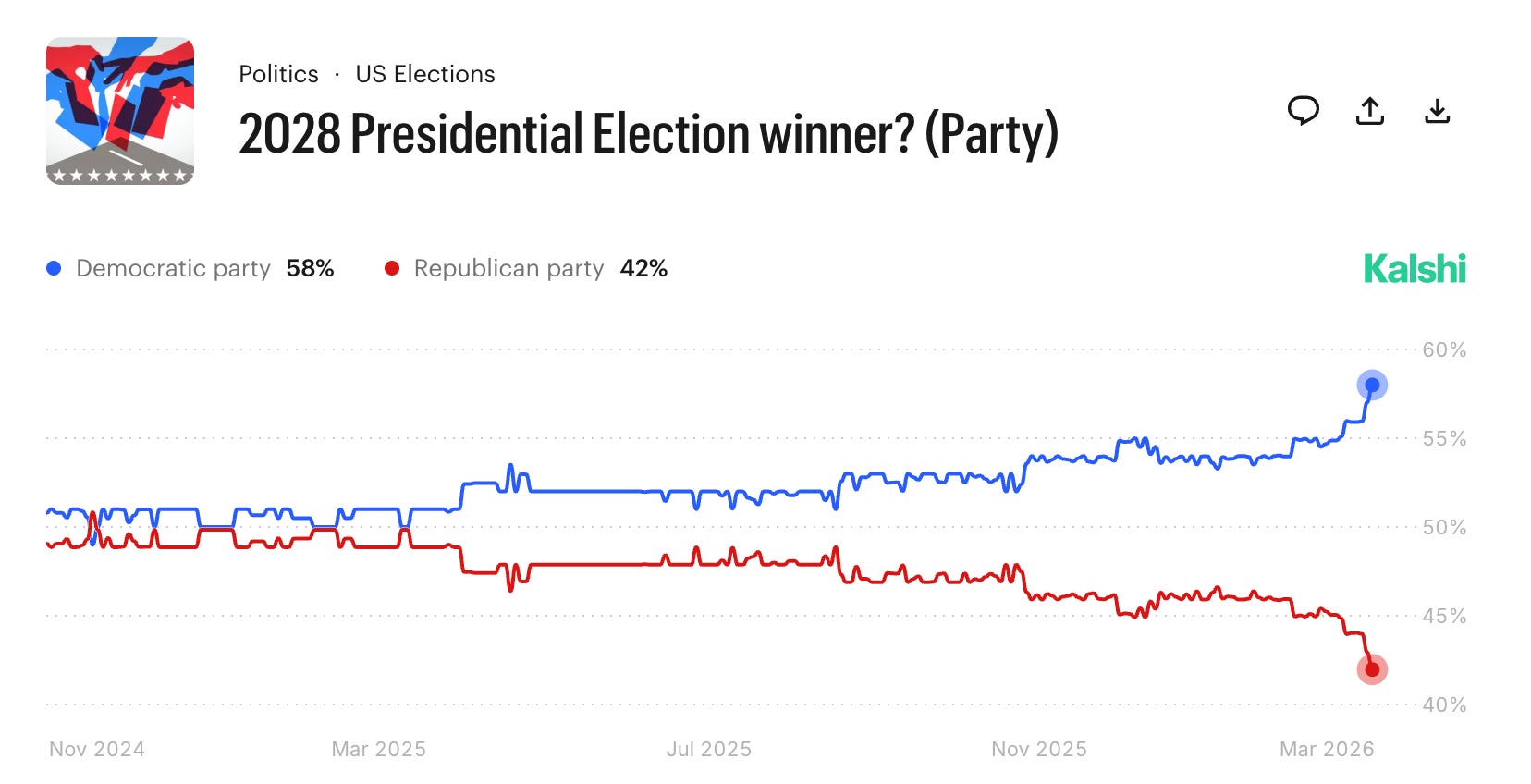
But let’s dig a little deeper. With these analyses, we’re hoping to look not just at the next election cycle, but to look around corners to see what’s coming for cycles down the line as well. Based on our recent string of ~50/50 presidential elections, we can assume neither party is much better positioned than the other in the 2028 election (unless you give a slight advantage to Democrats, as betting markets do, based on the boost that seems to be given now to non-incumbent parties).
But the 2032 election might look different, because in 2030, the decennial U.S. census will be conducted and each state’s allotment of Electoral College votes will be adjusted based on population ahead of the subsequent cycle. And early estimates of the population changes afoot show that Democrats may no longer be able to count on what is currently their most direct path to the White House.