


Here’s a puzzle for you.
Democrats are posting a series of dazzling poll numbers in red states, far exceeding how Kamala Harris (or other recent Democratic presidential candidates) performed in these same places.
But they’re also putting up poll numbers that are decidedly un-dazzling in blue states: not necessarily trailing behind their rivals, but certainly not running ahead of their own past benchmarks.
Gov. Tina Kotek at only 46% in Oregon (nine points lower than Harris 2024), while Senate candidate Mary Peltola is at 49% in Alaska (eight points ahead of Harris)? Gov. Kathy Hochul at 53% in New York (two points worse than Harris), while Senate candidate James Talarico is at 50% in Texas (seven points better)? Senate candidate Peggy Flanagan at 45% in Minnesota (six points under Harris), while Senate candidate Adam Hamilton is at 46% in Kansas (five points above)?
This isn’t necessarily what you might expect if you thought (as so many indicators are telling us) that a “blue wave” was brewing this November. Wouldn’t that mean Democrats would be showing big gains everywhere, outperforming Kamala Harris across the board?
Well, two answers are possible.
One could be that the polls are simply wrong. They could potentially be overestimating Democrats in red states, and underestimating them in blue states (or one or the other). Or they might not even be wrong, just early: maybe all the undecided voters in blue-state polls will “come home” to Democrats before Election Day, inflating the party’s numbers in those states compared to what we see now, while the opposite will happen for Republicans in red states.
The other possibility, instead of bifurcated polling error, is bifurcated results. Maybe we won’t see some big unified swing in 2026, with the same party overperforming in every state. That wouldn’t be unheard of. Consider, for example, the 2022 midterms, where Republicans overperformed (compared to their 2020 presidential numbers) in about half of the Senate races, while the other half had results that swung towards Democrats:
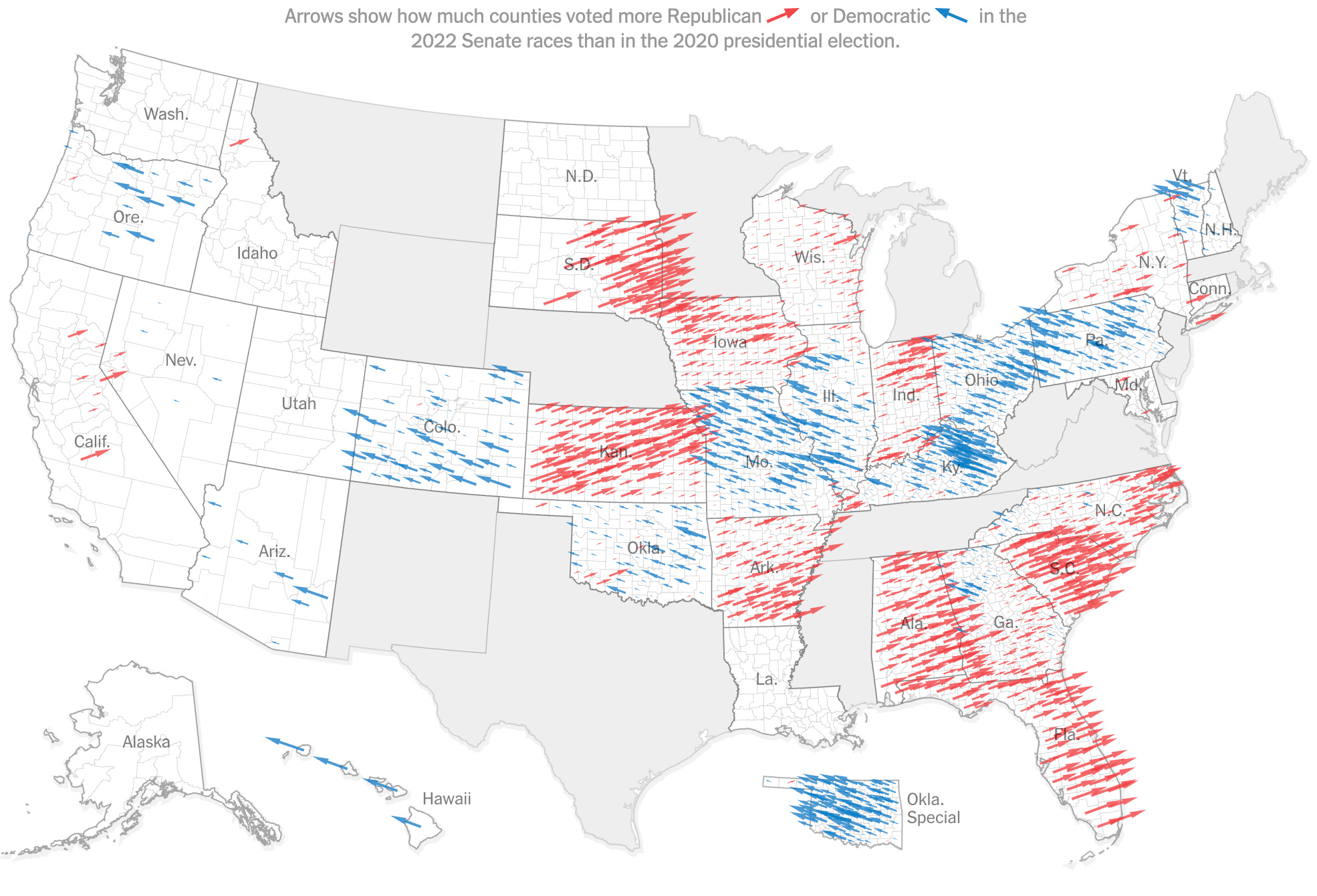
If we are headed towards another map like this, with some little red arrows and some blue ones, the question would be: what, if anything, is dictating which states are swinging in which direction? I believe the data paints a clear answer.
If the polls are correct, voters are rebelling against trifectas — united partisan control of state governments — across the board, no matter which party that means they’re punishing.
In Iowa, for example, Republicans will have controlled the governorship, the state House, and the state Senate (that’s what makes a trifecta) for a decade as of January; the governorship has been in GOP hands for even longer. But voters don’t seem terribly pleased with the results of this entrenched control by a single party. According to Morning Consult, outgoing Republican Gov. Kim Reynolds is tied for the title of most unpopular governor in the country, while outgoing Republican Sen. Joni Ernst is among the least popular members of the Senate.
Democrat Rob Sand has placed this at the center of his gubernatorial campaign. “We are 48th for personal income growth average over the last three years. We are No. 1 for cancer growth. And what has brought us here has been ten years of one-party control,” Sand said in an interview. He isn’t just running against his opponent, Republican Zach Lahn; he’s running against a trifecta (and against the very idea of trifectas: “I’m not telling you that the answer is to give the other private club ten years of total control,” he’s also said, explaining that “if you give one party all the control, it’s awfully tempting to just ignore the other,” no matter which party it is).
“This is a simple concept,” Sand has said. “Everybody in Iowa learns it when you’re young. You can have a good thing in there, but if that good thing is there too long, it starts to go bad and you have to take it out and replace it with something else. It’s time to rotate the crops in the Capitol building, ladies and gentlemen.”
This call for political “crop rotation” seems to be catching on with Iowans: Sand routinely leads in the polls by double digits.
A similar argument appears to be working in a very different state (and against a different party).
Democrats have had a trifecta in Oregon even longer than Republicans in Iowa: a few months short of 20 years (if you don’t count two years where control of the state House was tied). Oregon Democrats have held the governorship for longer still, contiunously since 1987.
Once again, voters seem to be tiring of it. Oregon has the second-highest homelessness rate of any U.S. state (behind only New York), and the seventh-worst scores on education. According to a recent poll, 57% of Oregon voters believe the state is moving in the wrong direction; only 35% said they had a positive impression of the state’s governor, Tina Kotek, just a point higher than those who said the same about Donald Trump, a striking result in a Democratic stronghold.
The same poll, conducted by Oregon Public Broadcasting, found Kotek struggling in her bid for re-election, two percentage points behind rival Christine Drazan, who would be Oregon’s first Republican governor in 40 years.
“Oregon needs change. Oregon needs to be done with one approach to the world. Single-party control has not been good for us in my home state. And we need that balance,” Drazan said in a recent interview.
“We need people to be at the table that have been ignored in the past to be able to turn our economy around, frankly, and turn our schools around and serve the people that are facing addiction and slowly dying on our streets,” she added. Another anti-trifecta message that is resonating.
Below, to get an idea of where party control is most entrenched, I’ve charted the number of years that the governorship of each state has been held by the party that currently controls it.
The first thing that jumps out is that most states are relatively un-entrenched: only 15 states have streaks going longer than 20 years. In the other 35, both parties have held the governorship in the last two decades: we’ve had Republican governors of Massachusetts, Maryland, Illinois, and New Hampshire, and Democratic governors of Montana, Kentucky, Kansas, and Louisiana. Voters generally like to “throw the bums out” eventually.
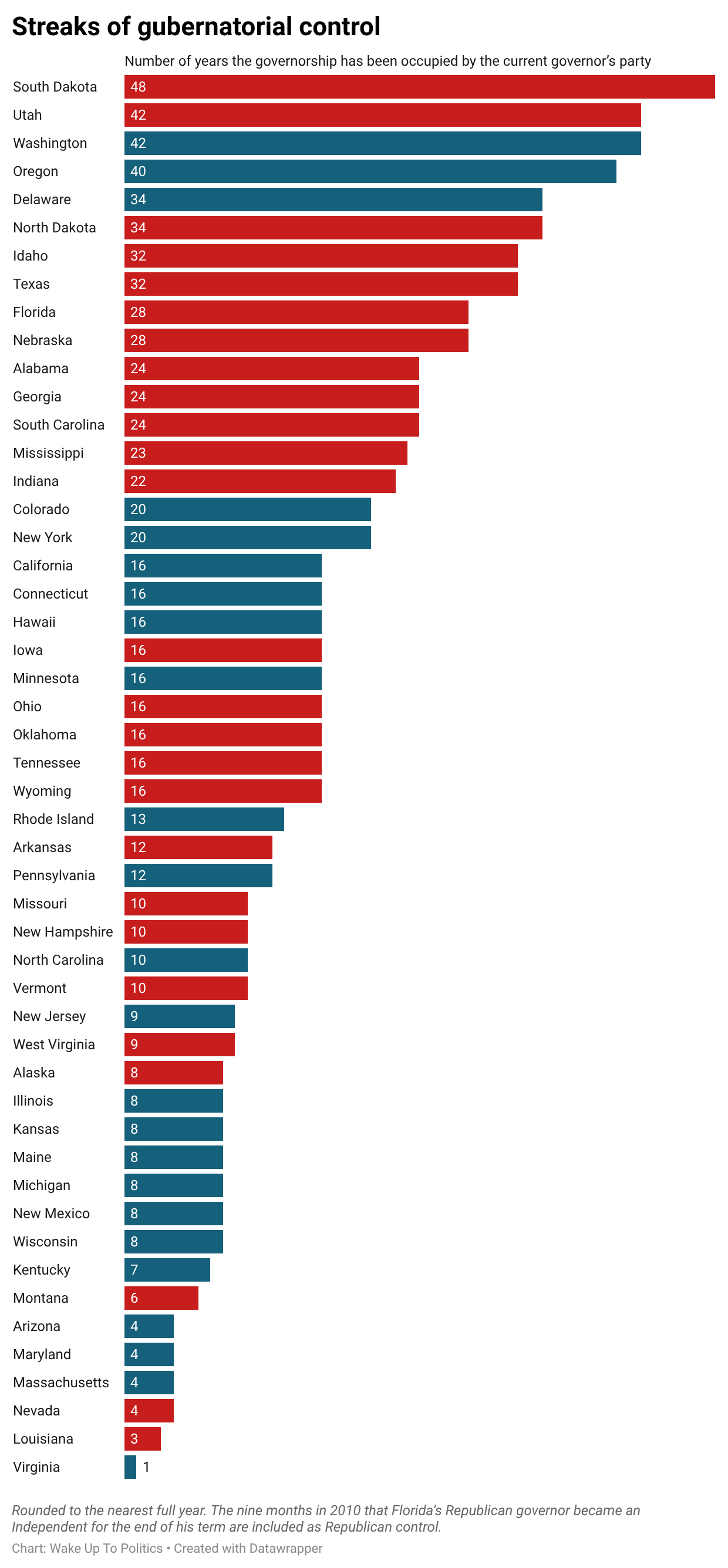
Several of the more entrenched states see risk of ending their streaks this November, including Iowa and Oregon — but also Texas and Minnesota, where Republican Gov. Greg Abbott and Democratic gubernatorial nominee Amy Klobuchar aren’t running very far ahead of their competitors. (Ditto the Republican Senate candidate in Texas, and the Democratic Senate candidate in Minnesota.) Democratic Gov. Kathy Hochul in New York is unlikely to lose re-election, but her middling numbers certainly don’t suggest an electorate that is thrilled with a continuation of the status quo, either.
In California, Democrat Xavier Becerra is similarly unlikely to lose the governorship — though, again, if you compare his polling to past Democratic performances in the state, you’d be hard-pressed to find many signs of a “blue wave” in the Golden State. Like the other candidates we’ve seen, Republican nominee Steve Hilton is trying to use his party’s longtime minority status to his advantage.
“California has voted the same way for years, and it’s not working. Wanna be a real rebel? Vote different this time around. Just try it. You’ll like it ;),” Hilton’s campaign wrote in the YouTube description of this ad, which compares Californians voting for a Republican for the first time with a woman experimenting with lesbianism.
It makes sense that candidates would be trying these pitches this year, at a time when voters are so dissatisfied with the way things are going in the country, in the economy, and in their lives. At the national level, that hurts Republicans, the party in control. But at the state level, that dissatisfaction can be turned against the party in power in their state capital, no matter which party that is.
If you’re a New Yorker who’s upset about the state of the economy, you might blame Republicans in Washington — but you could just as easily turn your ire towards Democrats in Albany.
Many of these anti-trifecta candidates have been adept at elevating specific local issues where voters are displeased, whether it’s homelessness in Oregon, or data centers in Texas, or the fraud scandals in Minnesota. (And at using state-specific metaphors to call for change, whether it’s crop rotation in Iowa or sexual liberation in California.)
Whether or not these are the candidates who end up toppling these trifectas, it shouldn’t be surprising to see united party government lose luster over time. According to one study, states with less entrenched partisan control have longer life expectancy, lower infant mortality, better educational outcomes, and higher incomes. “Party competition is not just healthy for a political system but for the life prospects of a state’s residents,” the study’s authors wrote.
Just like in a market economy, competition makes products stronger.
And that applies to politicians, too: state parties with longtime grasps on power can often become lumbering machines, churning out subpar candidates who eventually get caught unaware by the opposition. There’s a reason why top-tier political talent often comes out of political swing states like Georgia or Pennsylvania, where candidates need to be on their A-games to win general elections.
And a reason why so many Democrats were dissatisfied with their gubernatorial field in California. Iron sharpens iron. Conversely, lack of competition can breed middling politicians.
And, eventually, defeat.
A study last year put forward a “cruise-and-crash” model of state elections, finding that a ruling party will often “cruise along” for several years, “averaging more or less the same share of the vote election after election, until they fail to win another term, at which point all or nearly all of the cost of ruling, like a balloon payment on a loan, comes due.”
Several state trifectas might just be arriving at their crashes this November.
Great analysis! Thank you.
While I agree that change is needed, I don't agree that party change will help us. Our party system does not offer the change that will improve our lives. Over the past 60 years, income and asset inequality has grown to the point that our government is run not just by the wealthy but the small minority of the super wealthy. the kind of renewal we need. I believe that the Republican party is too far gone to be a valid alternative for our nation.The Republican party has no interest in the welfare of the majority of our citizens.
I see a serious reform of the democratic party as the best chance we have for a representative government.