


During Donald Trump’s first term, his then-chief of staff Reince Priebus referred to the times late at night that the president would be holed up at the White House all alone as “the witching hour,” according to a book by the journalist Bob Woodward.
Trump would spend much of the time on Twitter, sending out bombshells that would inevitably derail his aides’ days when they came into work the next morning.
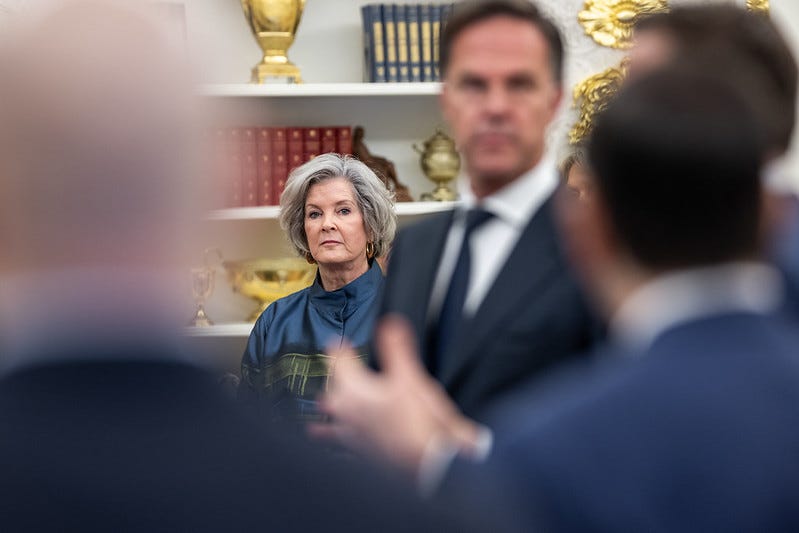
Susie Wiles, who now holds Priebus’ old job, can probably relate to that description. Trump seems to increasingly be making key decisions when Wiles isn’t in the room, going around his top aide and springing administration-shaping developments on her when she returns.
The latest example seems to be Trump’s selection of conservative commentator Katie Zacharia as the new White House press secretary.
According to the Washington Post, Trump completely bypassed Wiles when making the decision last week to hire Zacharia as the new TV face of his administration. The Daily Mail — which has beefed up its coverage of Washington lately, and was one of the three outlets Zacharia called on at her first briefing Tuesday — reported that Wiles had been pushing CNN contributor Scott Jennings for the role.
The report added that Wiles was only warned about the eventual pick when former press secretary Karoline Leavitt called her after speaking with Trump and flagged that he was leaning towards Zacharia. The choice was “the president’s pick and his alone,” as the Daily Mail put it. (Per Politico, while auditioning for the post, Zacharia would time her TV appearances based on Trump’s public schedule to be sure to go on when he would be most likely to be watching.)
CNN had previously reported that Wiles met with Jennings shortly after Leavitt announced her departure in August. “Wiles is looking for a ‘grown up’ who understands how the job works and can maintain a level of professionalism,” CNN reported at the time. Zacharia’s brief debut on Tuesday was widely panned; she delivered halting remarks before answering questions for just five minutes. Some White House officials are reportedly already wondering how long Zacharia will keep the job.
The Zacharia selection follows other recent reports of presidential freelancing.
Last month, Trump surprised his senior staff with his Truth Social announcement that CNN, MS NOW, and Politico were being banned from the White House. According to Politico, whenever Trump had previously raised the idea, his advisers had talked him out of it. This time, he moved forward while Wiles was out of town. (A federal judge extended his block of the press ban last night.)
Wiles was similarly absent in June when Trump announced Lance Schroyer as his nominee for the key post of ICE director. According to Semafor, Homeland Security Secretary Markwayne Mullin strategically chose to urge Trump to pick Schroyer — the former head of Mullin’s security detail — while Wiles was away from D.C. for her daughter’s wedding.
And in May, according to the Wall Street Journal, Wiles was caught off guard when Trump decided to scrap a planned executive order that would have set up a voluntary process for government testing of AI models. Venture capitalist David Sacks, a Trump tech adviser, reportedly talked Trump out of signing the high-profile EO in a last-minute phone call, without Wiles on the line.
Zacharia should be warned, however: Wiles tends to get her way in the long run. Schroyer’s nomination was withdrawn last month. A slimmed-down version of the AI order was eventually signed. During the transition, Trump’s controversial legal adviser Boris Epshteyn reportedly convinced Trump to pick Bill McGinley as White House counsel while Wiles was away in Las Vegas and to pick Matt Gaetz as attorney general while Wiles was in a different room on Trump’s plane, apparently unaware. Gaetz’s nomination was quickly withdrawn, while McGinley was swapped out for David Warrington, Wiles’ initial pick for the counsel role, before the administration even started.
At least, that’s been the pattern — Wiles winning out — for most of Trump’s second term, which has been widely seen as Trump’s most organized operation yet, with the “Ice Maiden” (as the president calls Wiles) at the helm. However, as the administration rolls on, some cracks in that order seem to be appearing, with Trump seeming to revert with more frequency to his first-term ways.
An administration source described Zacharia’s selection to the Daily Mail as “one of many recent microaggressions” directed by Trump towards Wiles. “He is taking back control, and it is starting to feel more like the first term,” the source said.
The president also recently rebuked two of Wiles’ closest allies, after the New York Times reported that outside Trump advisers Chris LaCivita and James Blair spent several days in a Bosnian-controlled territory consulting for a pro-Russian government while they are supposed to be leading Trump’s political operation for the midterms.
LaCivita is a longtime friend of Wiles’ who she recruited to come onto Trump’s 2024 team as her co-campaign manager. Blair is a Wiles protégé who worked with her for Ron DeSantis before they were both pushed out together and went to work in Trumpworld. “James is a top lieutenant of the president’s and has been invaluable to me for the better part of a decade,” Wiles said of Blair in April.
Those ties to Wiles didn’t stop Trump from threatening to fire the duo in a Truth Social post last week. “I do not have any idea who else they work for but will, on reflection, ask them and, if there’s a conflict, I will terminate them, immediately!” Trump wrote about LaCivita and Blair. (Complicating matters further, Wiles’ daughter Katie is a partner at the lobbying firm that arranged the Bosnian trip and herself traveled to the territory in August.)
The president is known to dislike advisers profiting off their ties to him, a dynamic which also led to Kimberly Guilfoyle’s ouster yesterday as U.S. ambassador to Greece. He also doesn’t like the perception that he is being managed, or that any of his aides have more power than he does, which reportedly led to some tensions with Wiles during the campaign.
Trump seems to enjoy occasionally breaking free of his aides’ control and making decisions without them, if only to remind them who’s boss every once in a while. In his first term, Trump grew more comfortable with the role after about two years, becoming bolder as time went on and as he weeded out aides who he perceived as getting in his way.
The same thing could be happening now, with Trump tiring of being handled by Wiles and increasingly lashing out and doing things his way as his polling numbers decline and his lame-duck era looms. If Trump is already abandoning what semblance of a decision-making process had been in place, it raises questions about what could be coming in his last two years. It is easy to imagine him throwing caution to the wind — yes, even more than his normal level of low caution — knowing that the political consequences will not be his to face.
It is unknown how long Wiles will remain on the job; out of the five White House chiefs of staff who have served under Trump, she is already the longest-serving. If Wiles were to leave, there are not many other figures in Trumpworld who have her heft or her ability (or inclination) to sometimes rein in the president’s impulses. With some of the Wiles-less decisions in the last few weeks, we seem to be getting a hint at what a Trump second term without her at the helm might look like.
These last two years are going to be a wild ride, whether or not congress flips. Just knowing he won't be the center of attention anymore is going to set off a 24 month tantrum....
what can be done